Get Full Government Meeting Transcripts, Videos, & Alerts Forever!
Get email alerts on the Cybersecurity Services topic
No spam. Unsubscribe anytime.
UTRGV offers free cybersecurity monitoring and training to Weslaco under DIR regional SOC program
Summary
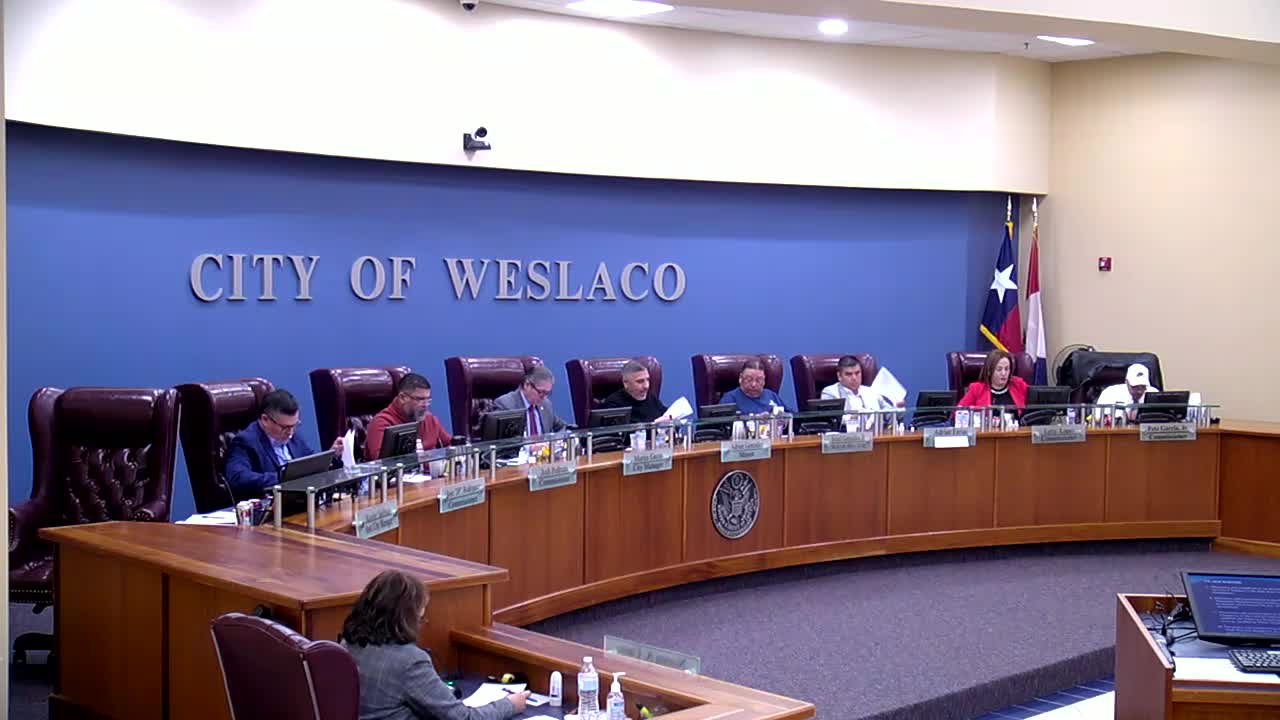
UTRGV officials told the Weslaco City Commission on Jan. 21 about a DIR‑funded Regional Security Operations Center that can provide free cybersecurity monitoring, incident response and training to local governments through a voluntary interlocal agreement.
Representatives from the University of Texas Rio Grande Valley and city staff presented a voluntary interlocal option on Jan. 21 for Weslaco to join a Texas Department of Information Resources‑funded Regional Security Operations Center (RSOC). The center provides network monitoring, vulnerability scanning, incident response guidance, policy support and workforce development at no direct cost to participating local governments while the program is funded by DIR.
Kevin Krause, who said he represents UTRGV, explained that Senate Bill 475 (2021) authorized state action to improve cybersecurity statewide and that DIR added RSOC funding to its base budget. He described services that include network detection and response, endpoint detection and response, dark‑web credential validation, vulnerability assessment and incident response support. Krause said the centers also provide training and a student analyst pipeline; student analysts undergo background vetting similar to full‑time staff, he said.
City staff and the city manager asked questions about the program’s stability and vetting. Krause said the program’s funding is now part of DIR’s base budget, which he said provides more stability than one‑time appropriations; he added that the legislature could still change funding in future sessions. He also said roughly seven interlocal agreements were signed and 23 were in workflow across the region at the time of the presentation.
City staff characterized the next step as establishing an interlocal cooperation agreement so UTRGV can legally scan public assets and provide services; staff asked the commission to consider the agreement at a future meeting. No formal vote was taken during the presentation.
Krause said the RSOC will tailor service tiers to participants’ needs and stressed that scanning and defensive activity require a signed agreement to avoid legal exposure for UTRGV and the city.
The commission did not vote; staff said it expects to place an interlocal agreement on a future agenda for formal action.