Get Full Government Meeting Transcripts, Videos, & Alerts Forever!
Get email alerts on the Public Safety Fire Funding topic
No spam. Unsubscribe anytime.
Rancho Cordova council hears Metro Fire request for yearlong funding for Squad 61; staff told to negotiate details
Summary
Metro Fire asked Rancho Cordova City Council for city support to staff Squad 61 for one year. Councilmembers were split but directed staff to negotiate with Metro Fire on specifics and potential cost-sharing, with staff eyeing legacy project reserves as a possible source.
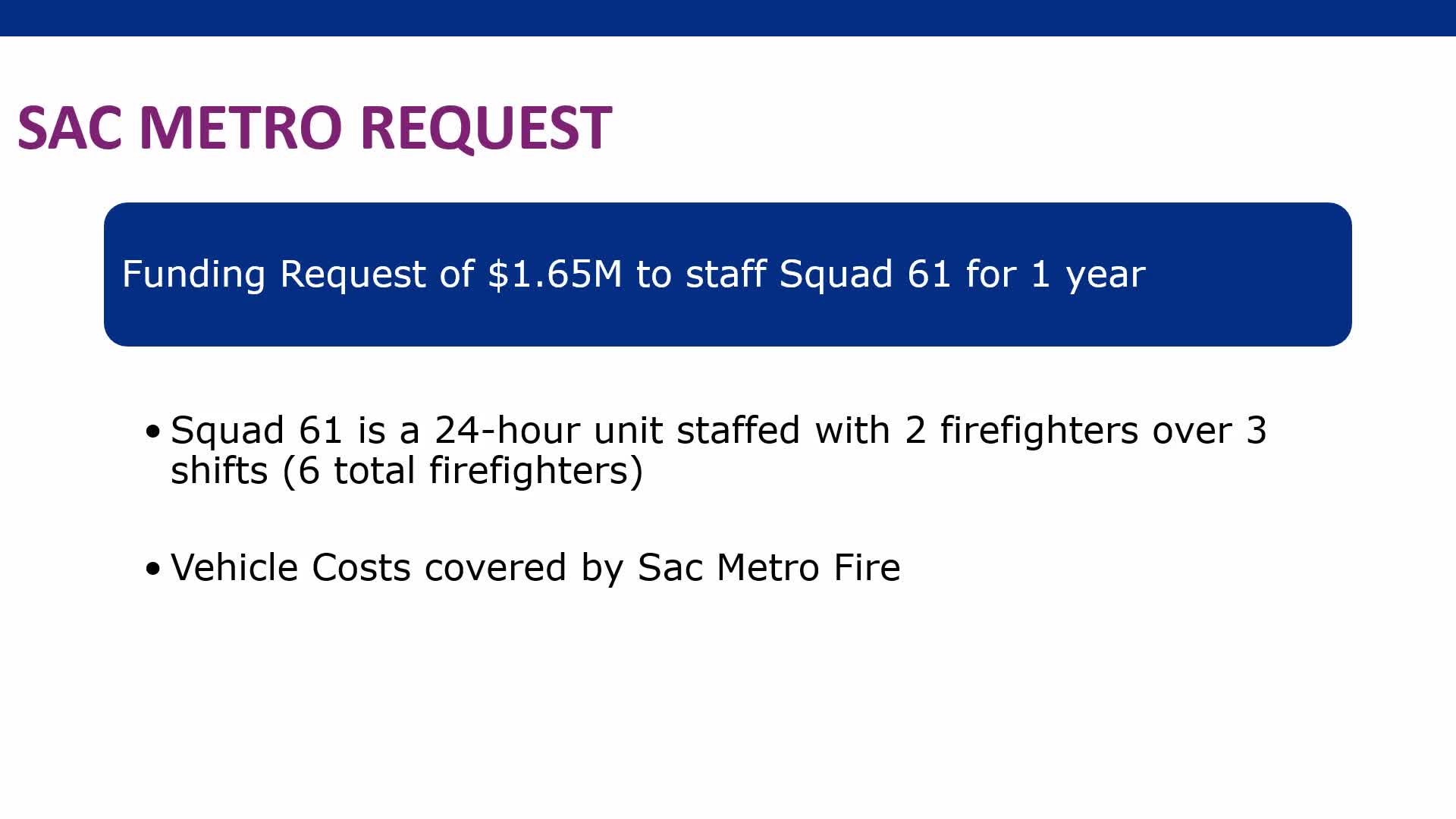
Metro Fire asked the Rancho Cordova City Council on Wednesday to fund personnel for a locally based “squad” vehicle at Station 61 for one year to keep a grass-rig response unit operating full time.
The request, presented by Sean Schollard, vice president of Sacramento Area Firefighters Local 522 and a Metro Fire captain, would pay for six firefighters to staff the squad and make a grass-rig—an off‑road, suppression-capable vehicle—consistently available for responses on the American River Parkway and nearby areas. Schollard said the unit “provides a relief on medical aids, vehicle accidents, [and] water rescue calls” and argued it would make Rancho Cordova safer by preventing the district’s full-size engine from being taken out of service when crews cross‑staff grass rigs.
Council members raised several concerns about cost, precedent and the city’s role in funding fire district operations. “It is not the responsibility of the city to do fire because we have a special district charged with that,” said one councilmember, adding that the Sacramento-area district has its own budget and governance. Other councilmembers emphasized the safety case and said they were open to a temporary, limited contribution if Metro Fire and the district can provide a clearer, written plan.
Staff framed the request as an operating expense the city did not include in its baseline two‑year operating budget. Micah (staff member) said the ask could be funded from existing set‑asides but warned that any one‑time city support for ongoing operations raises sustainability questions for subsequent years. Kim Duran (staff member) noted staff would need council direction on whether to reallocate legacy project set‑asides or other funds to cover a partial city contribution.
After extended discussion, council directed staff to return with a negotiated, written proposal in consultation with Metro Fire. Councilmembers discussed a possible city contribution capped at roughly half of the one‑year cost, contingent on Metro Fire identifying the other funding sources and committing detailed performance reporting. No formal motion or appropriation was made at the meeting.
What happens next: staff will work with Metro Fire to produce a written funding proposal and financing options and return to council with the recommended funding source(s), estimated ongoing cost implications and proposed performance metrics for any short‑term support.
Speakers quoted in this article are drawn from the meeting transcript and include Metro Fire and city staff.