Get Full Government Meeting Transcripts, Videos, & Alerts Forever!
Get email alerts on the Land Use Development topic
No spam. Unsubscribe anytime.
Council certifies EIR and introduces ordinance for 1450 Artesia specific plan after discussion on contamination, traffic and community benefits
Summary
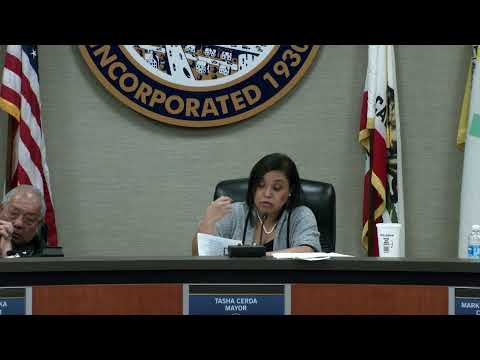
The Gardena City Council on Tuesday certified the final environmental impact report for the 1450 Artesia Specific Plan and introduced Ordinance No. 18-79 to implement a development agreement after a public hearing that drew developers, environmental consultants, union supporters and neighborhood critics.
The Gardena City Council on Tuesday certified the final environmental impact report for the 1450 Artesia Specific Plan and introduced Ordinance No. 18-79 to implement a development agreement after a public hearing that drew developers, environmental consultants, union supporters and neighborhood critics.
City staff told the council the project site covers roughly 6.3 acres near the southwest corner of Artesia Boulevard and Normandy Avenue and would be redeveloped with a single 268,000-square-foot mixed-use building about 75 feet tall. Amanda (staff presentation) said the developer’s package includes self-storage, about 72,000 square feet of industrial/warehouse space on the ground floor, ancillary office and retail, and a portion of the site reserved for city-sponsored events.
The council heard technical testimony from Dudek environmental consultant Nicole Cobley, who summarized CEQA review and mitigation. Cobley said the draft EIR was circulated in August 2024, received six comment letters during the public review period, and that most resource areas could be mitigated to less-than-significant levels except for an unavoidable construction noise impact on the western edge of the site. She described mitigation proposals including requiring Tier 4 construction engines, all-electric cargo-handling equipment for operations, cultural-resource monitoring and an 8-foot noise barrier along the western property line to reduce construction noise.
Developer representatives said the site has long been blighted and constrained by a legacy contamination area known locally as the Gardena Sumps. Brian Sorensen of Insight Property Group said, “This is a project long time coming. We've been working on it for over 5 years now, almost 6. And we're very we're local. We're here.” He told the council Atlantic Richfield (ARCO/BP) is the responsible party for the environmental cleanup and that the developer has worked with the state Department of Toxic Substances Control (DTSC) on a cap and monitoring approach.
Geologist Mauricio Escobar, retained by the developer, described the remediation approach in more detail and said the remedy includes consolidating contaminated material, an engineered cap with multiple layers and a vapor-collection system, perimeter monitoring probes and ongoing operation-and-maintenance requirements overseen by DTSC. Escobar said the remedy is intended to remain in place with regular monitoring and periodic reviews; when asked whether monitoring is indefinite he replied the program is long-term — “it’s forever” — and will include recurring sampling and five-year reviews.
Residents raised concerns about traffic, proximity to Gardena High School and long-term air and soil-vapor risks. Claire Clarence Davis, who identified herself as a 20-year Gardena resident, said she opposed placing the project near a high school and voiced general concerns about air quality and traffic on Artesia. Union representatives and building-trade speakers testified in support. Andrew Mayorga from LiUNA and Kyle Patterson from the Carpenters Union said the development would create local construction jobs, training opportunities and long-term economic activity.
Developers offered community benefits that staff summarized for the council: a one-time $1,000,000 payment to the city’s general fund; a local-hiring and materials-sourcing commitment, including memoranda of understanding with unions; exclusive weekend access for city events on a portion of the site; and the developer’s agreement to provide a vapor-protection system beneath buildings. The development agreement discussed at the hearing would run five years with one optional five-year extension and requires a lot merger of six parcels.
Council members asked technical questions about the cap, vapor mitigation and monitoring. Staff and the developer’s geologist said DTSC will oversee remediation, require vapor controls beneath occupied buildings, and impose monitoring and reporting obligations. Councilmember Francis asked whether the city could receive DTSC reports; the council added an amendment to the development agreement requiring the developer to provide copies of DTSC reports to the city manager upon receipt.
After deliberation the council voted to certify the final EIR (Resolution No. 66-93) and to introduce Ordinance No. 18-79 with the amended development agreement language that adds a reporting requirement for DTSC documents. The council made clear the project will remain subject to the mitigation measures in the final EIR, and the developer must coordinate the remediation plan with DTSC before major construction.
What happens next: introduction of the ordinance sends the development agreement and specific-plan text to a subsequent meeting for final adoption. If the EIR certification stands, the city will file a Notice of Determination and the 30-day statute-of-limitations period for CEQA challenges will begin.
Votes and motions recorded: the council voted to certify the EIR (Resolution No. 66-93) and later introduced Ordinance No. 18-79 with the amended development-agreement language. The development team and DTSC oversight remain central conditions of future approvals.