Get Full Government Meeting Transcripts, Videos, & Alerts Forever!
Get email alerts on the Residential Standards topic
No spam. Unsubscribe anytime.
Commission directs staff to draft rules on front-yard paving, residential lighting and semi-permanent commercial structures
Summary
The Planning Commission asked staff to prepare draft code language limiting front-yard impervious paving, extending outdoor-lighting standards to residential projects and creating a pathway for limited semi-permanent commercial structures after public comment from a local RV dealership.
Millcreek — The Planning Commission directed staff to develop new rules and options addressing three recurring neighborhood issues: excessive front-yard paving (impervious surface), residential outdoor lighting standards, and whether to allow semi-permanent commercial structures for seasonal use.
Public comment: Andrew Brown, representative of Motorsports Land (4001 South State Street), told the commission his RV dealership invested in a 24,000-square-foot temporary/semi-permanent structure used for winter display and storage. He said the business27s decision relied on the prior allowance of a six-month temporary structure; the proposed code would reduce that allowance to ten weeks and he asked for reconsideration or an alternative mechanism for seasonal commercial uses. Staff said the 10-week draft limit aims to avoid year-round temporary-structure use and noted cities often allow 302690 days for temporary structures; staff offered to explore a "semi-permanent" permit pathway with guardrails.
Impervious surfaces and vegetation: Staff flagged recurring cases in which property owners pave large parts of a front yard for parking, raising concerns about heat-island effects, drainage and neighborhood character. Commissioners asked for a balanced approach. Staff presented neighboring-city examples showing approaches that range from percentage-based limits on front-yard impervious area to minimum vegetation requirements; commissioners suggested a front-yard-focused standard (for example, a maximum impervious percentage combined with a minimum vegetation requirement) and asked staff to identify reasonable exceptions for small, narrow or flag lots and for arterials where safety considerations can justify different approaches.
Outdoor lighting: Staff proposed extending proposed lighting standards to residential additions and new residential construction (in addition to commercial projects already covered). The proposed residential language would require fixture shielding to reduce trespass and set limits on light color/temperature; Salt Lake City-style language prohibiting strobes, flashes and flickering was raised by commissioners and received support from several members who said such limits are reasonable and enforceable. Commissioners discussed enforcement practicality and generally supported applying standards to new construction and to projects that trigger permits; several commissioners also supported applying standards to existing residences, enforced reactively via complaint or when a building permit is sought.
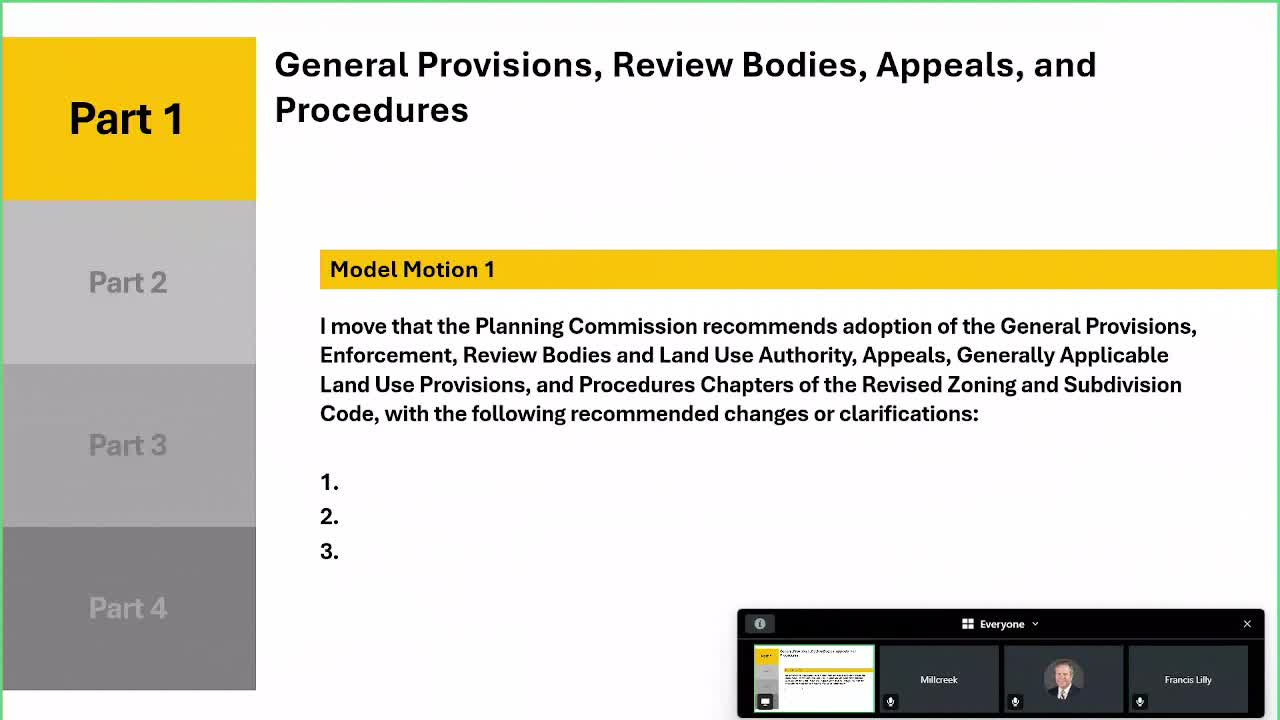
Commission direction and vote: The commission moved and approved a motion that recommended staff consider options for semi-permanent commercial structures, prohibit non-stealth monopoles in sensitive or residential areas, develop minimum vegetation and maximum impervious-cover standards for front yards, and extend the proposed lighting standards to residential properties, including limits on strobe and flashing lights.
Ending: Staff will draft specific code language and examples, including proposed thresholds, exemption language for small lots and arterials, and an administrative path for semi-permanent seasonal commercial structures; the commission asked that staff return with redlines within the next several weeks.