Get Full Government Meeting Transcripts, Videos, & Alerts Forever!
Get email alerts on the Procurement Policy topic
No spam. Unsubscribe anytime.
Millcreek reviews restated procurement policy in first reading
Summary
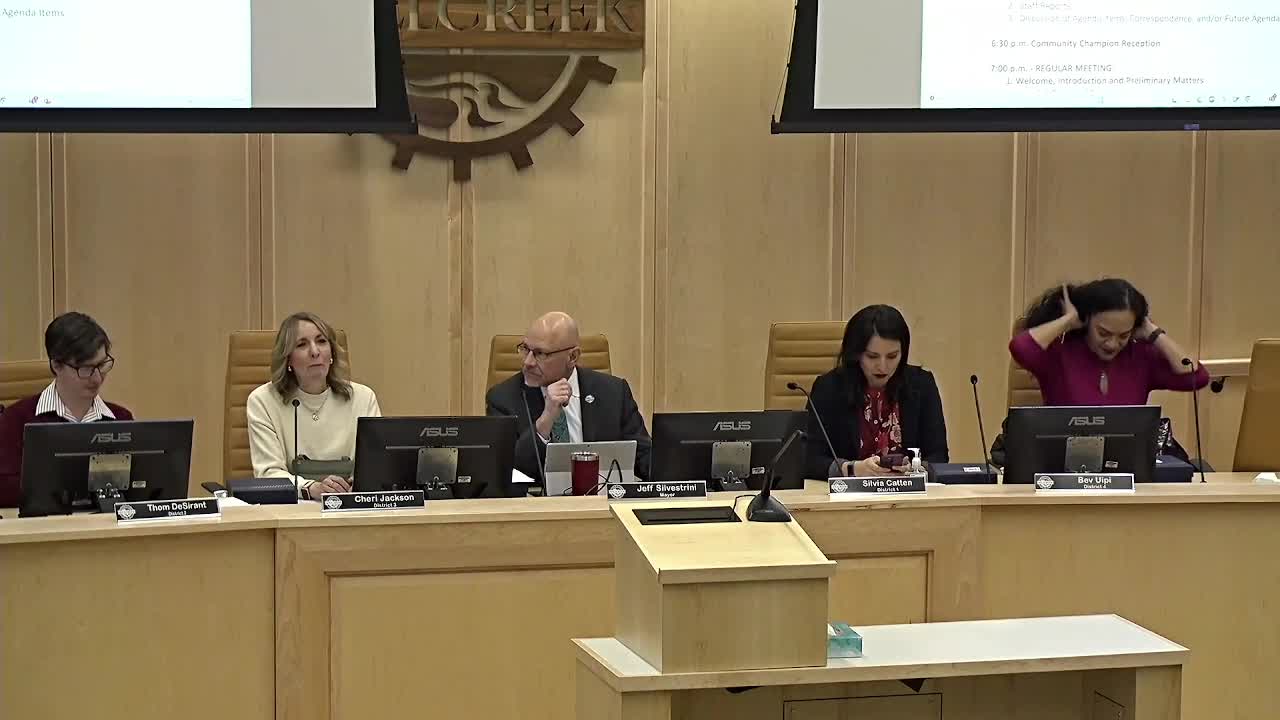
Lisa Dudley, Mill Creek finance director, presented a first reading of a restatement of the city’s procurement policy at the Millcreek City Council work meeting on Feb. 24, 2025.
Lisa Dudley, Mill Creek finance director, presented a first reading of a restatement of the city’s procurement policy at the Millcreek City Council work meeting on Feb. 24, 2025. The draft would replace the current language in Mill Creek Municipal Code chapter 2.22 to clarify purchasing authority, definitions and award methods.
Dudley said the draft adds a formal purpose section numbered 2.22.012 and “establish[es] authority and responsibility for purchasing activities conducted on behalf of the city and ensure[s] compliance with all applicable laws, regulations, and standards.” She told the council the draft also expands definitions tied to the purchasing card (P‑card) program and to larger projects such as “public improvement project,” and it lists evaluation criteria and methods of award for larger procurements.
Under the draft, purchase-award methods are described as follows: quote-level purchases would go to the “lowest responsible and responsive bidder”; requests for proposals (RFPs) would be awarded using a best-value ranking; and requests for qualifications (RFQs) would select the highest qualified candidate. The policy also presents dollar thresholds and delegated authority: department heads for purchases below $10,000; the mayor or designee (city manager/assistant city manager) for purchases between $10,000 and $20,000; and three quotes or formal procurement processes beginning above those levels, with formal invitations for bid, proposals or qualifications for contracts above $40,000.
The draft explicitly identifies the assistant city manager as a possible designee to the mayor for certain authorizations. It also clarifies procedures for emergency purchases and for protests of awards; the protest procedure would permit a protest to be filed with the mayor or the city attorney. Dudley emphasized the policy is a “living document” and will be revised as laws and circumstances change.
Mayor (unnamed) pressed staff to confirm that the emergency-procurement language is broad enough to cover urgent infrastructure repairs that do not follow a formal citywide state-of-emergency declaration — for example, rapid stormwater collapse repairs that must be made before the next significant rainfall. He noted past instances when staff asked him to sign emergency contracts to avoid imminent flooding and requested that the emergency section explicitly accommodate that type of exigency. The city attorney was asked to double-check compliance with state code as written in the draft.
No formal action was taken; the presentation was treated as a first read and will return to the council for further editing and a subsequent reading.