Get Full Government Meeting Transcripts, Videos, & Alerts Forever!
Get email alerts on the Land Use Zoning Code Update topic
No spam. Unsubscribe anytime.
City holds first reading on ZT‑2418 zoning and subdivision code update; staff propose performance‑based stepback relief and code modernizations
Summary
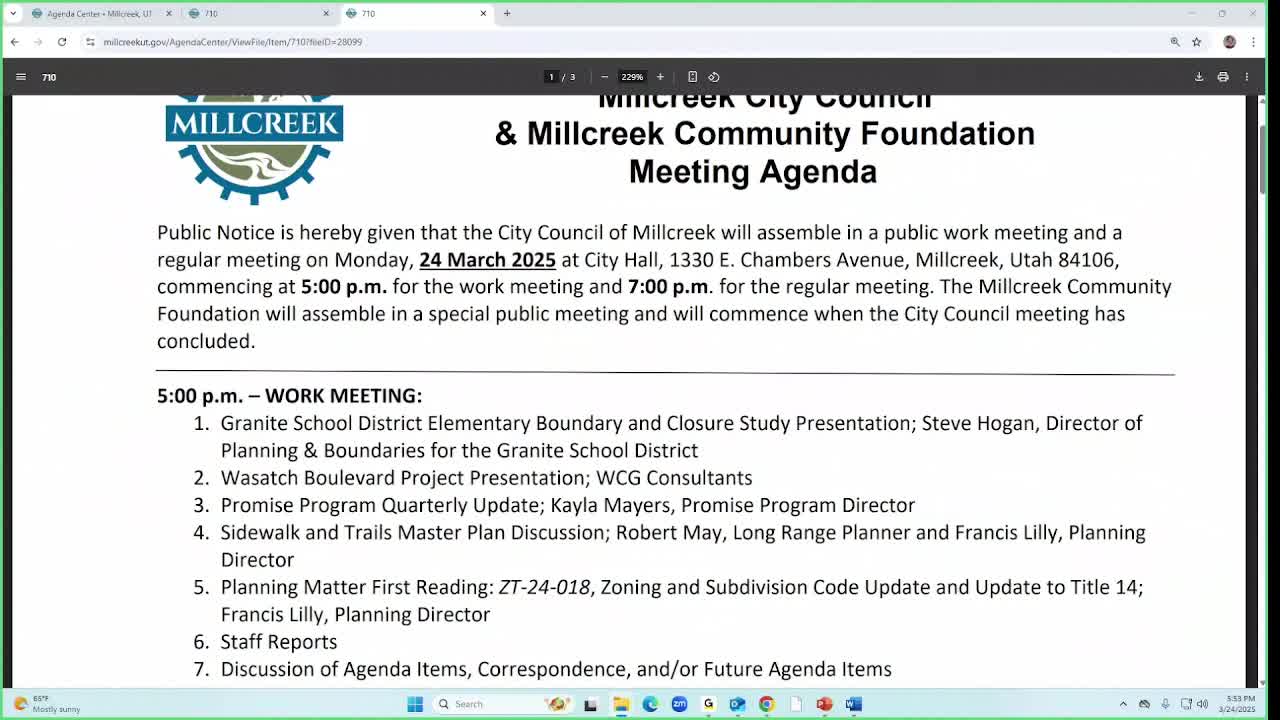
Mill Creek held a first reading on ZT‑2418 — a comprehensive rewrite of the zoning and subdivision code — on March 24, during which staff laid out proposed changes to zones, development standards and application procedures.
Francis presented the first reading of ZT‑2418, Mill Creek’s proposed comprehensive zoning and subdivision‑code update, at the March 24 work session. The proposal reorganizes Title 19 terminology, consolidates several zoning categories, updates development and use standards, and aligns Title 14 engineering standards with the new code.
Staff described the outreach and review process: more than 43,000 mailed notices and numerous community meetings, 18 code chapters reviewed by staff and stakeholders, and favorable recommendations from the four community councils and the planning commission on many elements. Staff said the update clarifies 24 distinct planning application types, defines uses, modernizes landscaping and parking standards, and adds urban design and submittal checklists for consistency.
Key policy questions discussed included stepback requirements in the City Center overlay (CCOS), legacy zone treatment (e.g., R4 and C1), impervious‑surface limits (proposed 50% maximum in many cases), dual‑driveway allowances (two driveways allowed on lots wider than 60 feet), and outdoor lighting standards for residences. Francis told the council the code is not intended to “radically alter potential entitlements or densities,” but to streamline language and implementation.
On stepbacks, staff proposed a public‑benefit or performance‑based pathway that would allow stepback reductions in exchange for specific public outcomes — for example, additional public open space, shared parking, affordable housing set‑asides, or cultural/arts amenities — and three or more design enhancements. Several community councils and the planning commission favored some flexibility but asked for guardrails; staff said a development‑agreement option could be retained for higher‑impact areas to preserve council oversight.
The planning commission also recommended tighter controls on monopole cell towers in sensitive and residential lands, a ban on certain temporary uses unless permitted, development of vegetation minimums and maximum impervious surface standards, and residential lighting limits for strobes or flashing lights; staff recommended further review before codifying residential lighting enforcement due to enforcement and constitutional concerns.
Francis said the city will return with additional materials before a second reading; staff proposed an April 14 check‑in and April 28 for second reading and adoption, with related updates to Title 14 and the consolidated fee schedule to follow. No ordinance adoption occurred at the March 24 meeting.