Get Full Government Meeting Transcripts, Videos, & Alerts Forever!
Get email alerts on the Code Update topic
No spam. Unsubscribe anytime.
Planning staff outlines code update timeline and new state rules that change how some business uses are classified
Summary
Planning staff told the Millcreek City Planning Commission that the city’s updated land-use code will become effective May 19 and outlined several changes, including a discretionary development-agreement pathway and a state-mandated classification-request process for ambiguous business uses.
Planning staff updated the Millcreek City Planning Commission on April 16 about the city’s code update, revised development-agreement practices and new state legislation that requires a "classification request" process for ambiguous business uses.
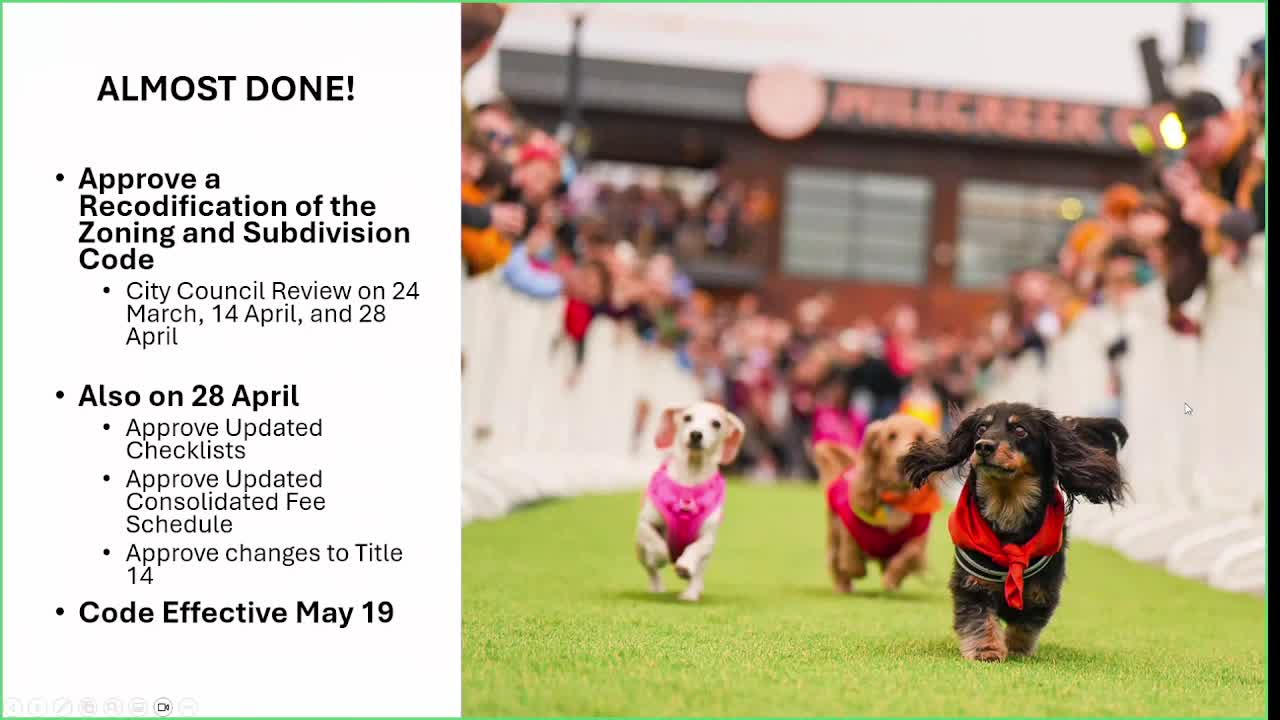
Planning staff said City Council will adopt the updated land-use code April 28 and the new rules will take effect May 19. Staff are aligning online application forms and fee schedules so the updated portal can accept applications under the new code. Staff warned commissioners to expect an increase in applications once the code becomes effective.
Staff described how the city intends to use development agreements to allow limited flexibility in the City Center Overlay Zone (CCOS) and other districts. The council supports eligibility criteria for exceptions—such as publicly accessible open space, parking and affordable housing—while excluding certain sensitive areas from eligibility (for example, properties north of Chambers Avenue on Highland Drive and properties that front narrow residential streets). The draft ordinance preserves a set of baseline criteria while allowing consideration of other context-specific items under a discretionary development-agreement review and enhanced public review steps.
Planning staff also briefed commissioners on recent state legislation that creates a formal classification-request process for business-license applicants whose proposed use may not clearly fit an existing code category. Under the state law, an applicant may ask the planning director to classify a proposed use; if the director finds the use does not align, the applicant may seek City Council review. Staff said the city will route such matters into the text-amendment process to ensure community-council, planning-commission and council review, and noted the statute, as written, also allows an applicant to appeal the council decision to the land-use hearing officer in certain circumstances. Planning staff described the new process as complex and said state officials may revisit the law in a future session.
Staff also summarized other state-driven changes the city will adopt, including streamlined boundary-line adjustments for lots vs. parcels, statutory timeframes for releasing bonds for required improvements, and an explicit clarification that parking-space measurements in Utah statute are 9 by 18 feet. Staff said they will make minor wording adjustments to remain compliant.
Staff asked commissioners to provide any final comments by April 23 so code language can be finalized. The commission received the update; no formal action was required during the meeting.