Get Full Government Meeting Transcripts, Videos, & Alerts Forever!
Get email alerts on the Telecommunications topic
No spam. Unsubscribe anytime.
Planning commission approves monopole replacement at Evergreen Junior High with condition to remove old pole
Summary
The commission approved CU25001 to replace and slightly relocate a 60-foot monopole at Evergreen Junior High, subject to removal of the existing wood pole after the new pole is operational. A resident submitted written objections about EMF exposure; staff said FCC rules preempt local regulation of radiofrequency safety.
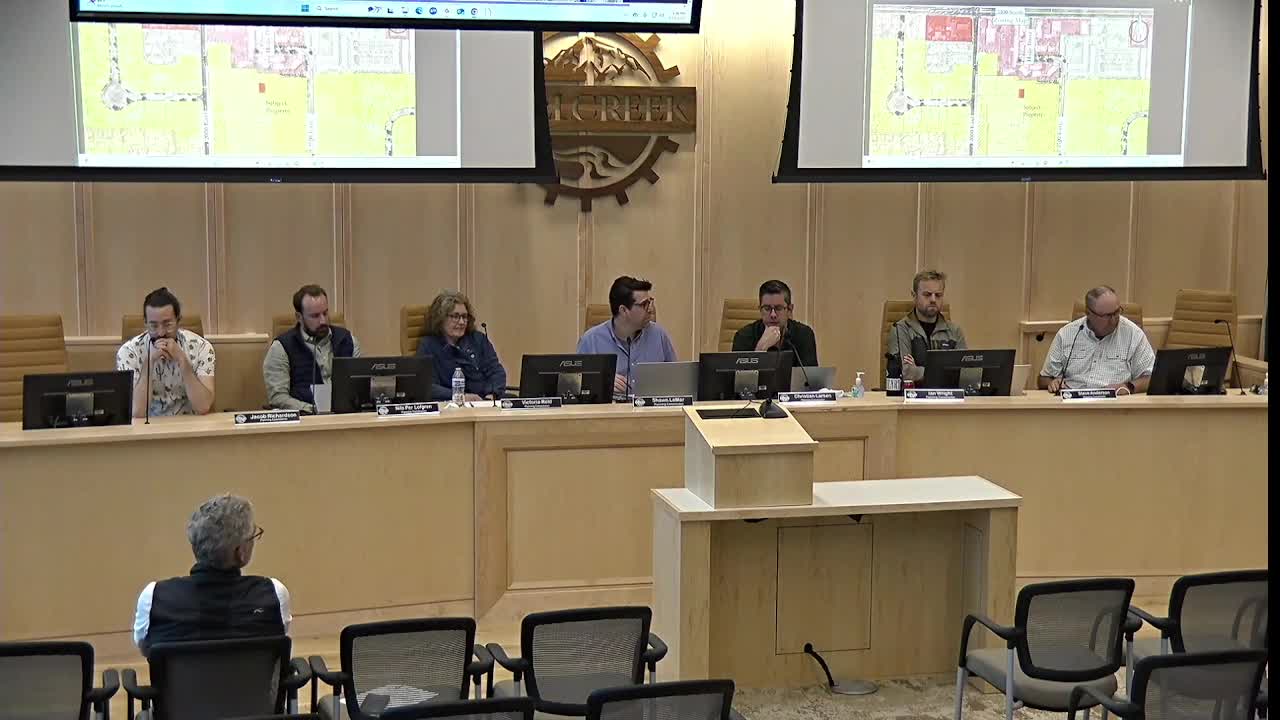
The Millcreek City Planning Commission on April 16 approved conditional-use application CU25001 to replace and relocate a 60-foot telecommunications monopole at Evergreen Junior High, subject to the condition that the existing pole be removed once the new structure is operational.
Brad, a planning staff presenter, told commissioners the proposal would move the existing wood pole about 10 feet north (and slightly east) and keep the height at 60 feet. The new structure would accommodate larger antenna brackets that extend roughly five feet from the pole to support current technology; the applicant and staff said the monopole meets existing code standards, including the 60-foot height cap.
Applicant Rock Schuchar told the commission the current wood pole is a Rocky Mountain Power pole and has been in place for about 25 years; T-Mobile holds a lease with Granite School District and Rocky Mountain Power for the site. "We are trying to put in a better structure, that will meet better structurally the demands of current technologies," Schuchar said.
One written public comment from Carrie Levitt objected to moving the monopole and expressed concern about RF/EMF exposure, asking that the pole be located away from where people and children live and play. Planning staff responded to the comment in the meeting record, noting that the Federal Communications Commission preempts local regulation of RF safety and that the Planning Commission’s authority is limited to land-use considerations.
Commissioners asked about co-location capacity, whether other carriers could be added, and community-council review. Brad said the new design could accommodate additional antennas but that co-location can present height and tree-line issues; he also reported the application had gone to neighborhood and community councils without recommended conditions.
Commissioner Loughgren moved to approve CU25001 "subject to the existing pole being removed upon completion of the new pole as presented," and Commissioner Richardson seconded. The commission approved the motion by voice vote.
Next steps: the applicant may proceed with construction permitting once conditions are met and any required permits are issued. The removal of the existing pole is a condition of the approval recorded in the staff recommendation.