Get Full Government Meeting Transcripts, Videos, & Alerts Forever!
Get email alerts on the Waste Recycling topic
No spam. Unsubscribe anytime.
Millcreek residents lead district recycling efforts; city diversion rate topped 24% in 2024, officials say
Summary
Wasatch Front Waste and Recycle reported strong Millcreek participation in glass and green‑waste recycling and said the city exceeded the district diversion goal in 2024; staff described program changes to lower costs, improved contamination controls and a 2025 fee increase that took effect in April.
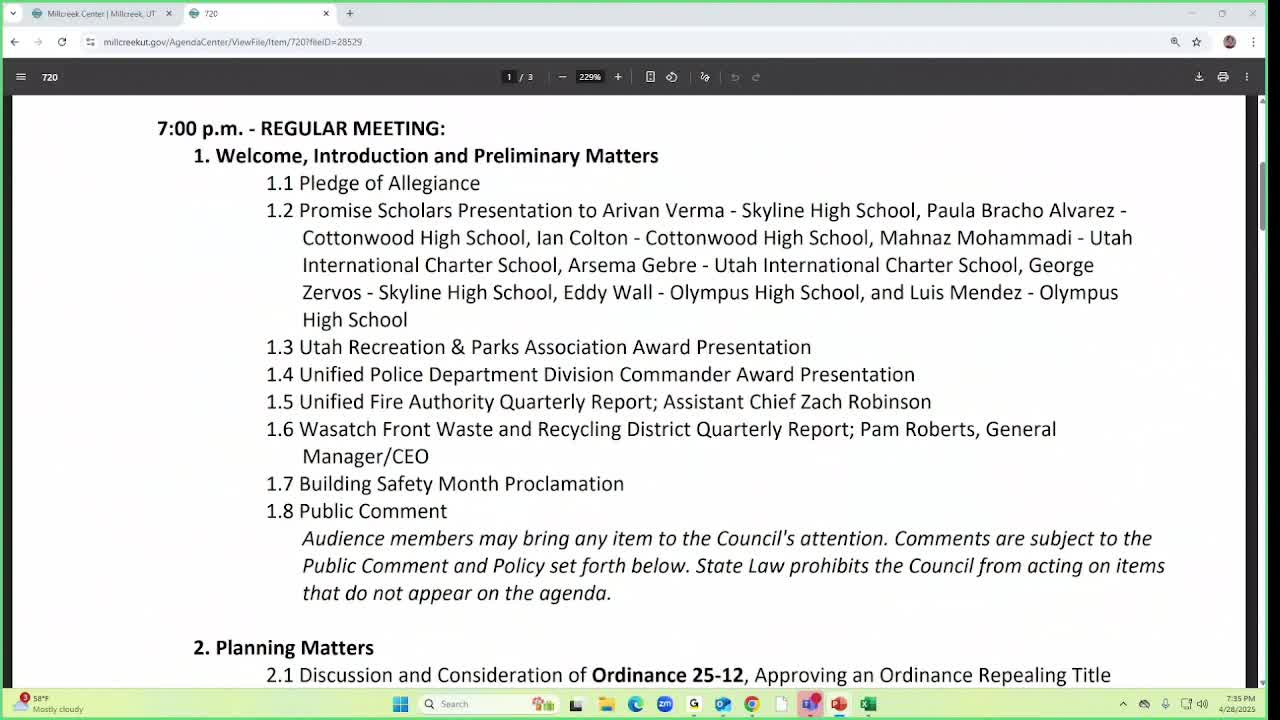
Wasatch Front Waste and Recycle representatives reported April 28 that Millcreek residents accounted for a disproportionate share of the district’s recycling and green‑waste tonnage in 2024 and that the city exceeded the district diversion target.
James Kelsey, sustainability coordinator, said Millcreek made up roughly 18.25% of the district’s customer base but generated 29% of green‑waste tonnage and 49% of glass recycling tonnage in 2024. Millcreek’s overall diversion rate finished 2024 at 24%, above the district goal of 18%, and first‑quarter 2025 diversion was 22% (Kelsey said the seasonal green‑waste stream should raise the full‑year figure).
Kelsey and Pam Roberts of Wasatch Front discussed contamination trends in single‑stream recycling, driver reporting and education efforts. Kelsey said Millcreek’s clean‑recycle rate improved from roughly 81.66% in 2024 to 87.91% in quarter 1 of 2025. Staff said district drivers filed 753 driver contamination reports in 2025 to date (up 60% from 2024) though Millcreek accounted for a small share of those driver reports.
Pam Roberts outlined operational changes intended to reduce costs: switching equipment and methods for leaf‑bag pickup, downsizing some trucks, use of dash‑cam footage to validate missed pickup claims (which she said saved roughly $24,000 in the first quarter), and new loading practices to pack more recycling aboard single trips. She noted truck replacement and operational costs have risen and cited a typical new garbage truck price of about $450,000.
Roberts also told council that a fee increase took effect in April: quarterly bills moved from $58.50 to $78 per quarter (an increase equivalent to $26 per month), a change the contractor said reflected rising operational expenses and processing fees.
Ending: City staff and the contractor praised Millcreek residents’ participation and said staff will keep education campaigns and curbside enforcement to improve recycling quality while monitoring markets and processing fees for any necessary future adjustments.