Get Full Government Meeting Transcripts, Videos, & Alerts Forever!
Get email alerts on the City Budget topic
No spam. Unsubscribe anytime.
Salisbury presents fiscally conservative recommended FY 2026 budget with no property tax increase
Summary
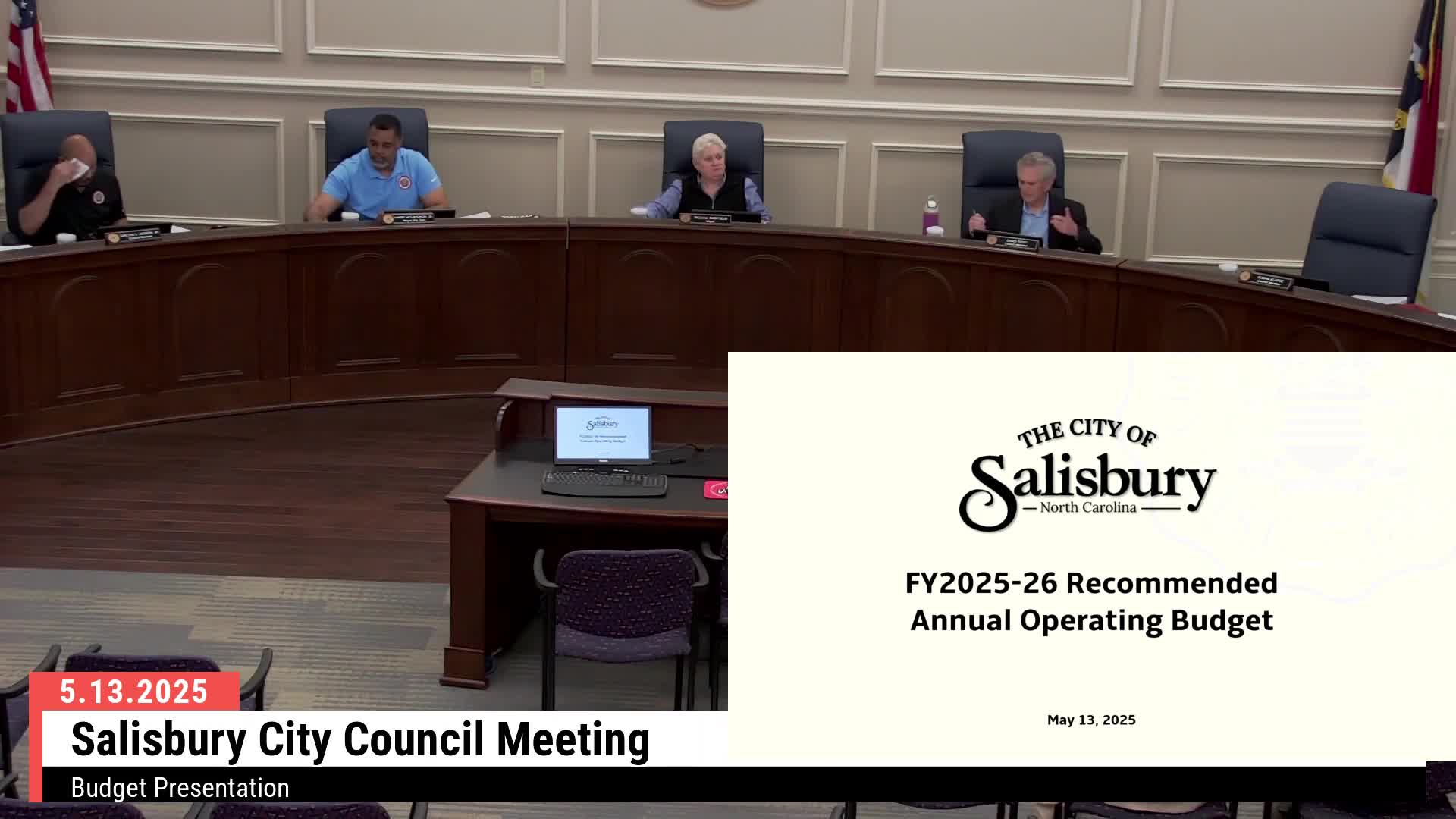
City Manager Jim Green presented the City of Salisbury’s recommended fiscal year 2026 budget to the City Council on a special meeting, saying “the recommended budget that is presented to you tonight is balanced.”
City Manager Jim Green presented the City of Salisbury’s recommended fiscal year 2026 budget to the City Council on a special meeting, saying “the recommended budget that is presented to you tonight is balanced.” The document outlines roughly $118 million in citywide spending, preserves the current property tax rate, and uses one-time fund balance to cover selected capital needs while recommending a conservative revenue approach.
The recommended budget matters because it sets spending and service levels for the coming year and identifies tradeoffs staff say are necessary amid flat or slowing revenues, federal and state grant uncertainty, and continued growth. Green told council members the plan focuses on “taking care of what we've got” through infrastructure maintenance, targeted new positions, and reorganizations intended to improve outreach and economic development.
City Manager Jim Green and Assistant City Manager Kelly Baker emphasized priorities and structural changes. Green said he is not recommending a property tax increase and described the year as “the most challenging budget” he has worked on because of uncertainty in state and federal funding and flat sales-tax growth. Baker said the budget “is the action step” that links the council’s strategic plan to projects and programs residents will see.
Finance Director Wade Purchase provided the revenue and expenditure detail. “Total budget citywide is just short of $118,000,000,” Purchase said. He said the general fund is recommended below $67 million and that property taxes account for about 46.1% of general fund revenue. Purchase told council staff used conservative assumptions for sales tax and interest income and expects sales tax receipts to be essentially flat compared with current-year projections, with an anticipated $13.2 million in local sales tax receipts for FY 2026.
Key spending and policy choices
- No recommended property tax increase: Green said the recommended budget preserves the current tax rate while asking departments to absorb demand and inflation pressures through other means.
- Fund balance use: Staff recommended appropriating $1.9 million in fund balance for one-time capital needs, including match money for grant-funded greenway and sidewalk projects and the Fisher Street bridge.
- Reorganizations and position changes: Green recommended creating a Community Engagement department to merge communications and diversity, equity and inclusion functions, to be led by Anne Little, and integrating downtown and citywide economic development under Sada Trautman. The budget proposes eliminating three vacant management positions (deputy city manager, communications director, transportation director) to fund other priorities and funds 22 of 43 new position requests that departments submitted.
- Public safety staffing and grants: The budget includes funding for seven firefighter positions and one new fire inspector; staff recommended pursuing a federal SAFER grant to cover six firefighter hires. When asked about a plan B if the grant is not awarded, staff said they currently would not hire those six if the SAFER funds are not secured and agreed to prepare a scenario showing the cost and associated tax or budget impacts if council wants to fund the positions without the grant.
- Utilities and enterprise funds: Salisbury Rowan Utilities (SRU) and staff recommended a 4% water and wastewater rate increase, which Purchase said would equal about $2.61 per month for an average residential customer using 4,000 gallons. Stormwater fees were proposed to increase by $0.53 per month per equivalent residential unit (ERU), moving the monthly rate to $5.82 per ERU to support the stormwater master plan and capital projects. Mark (enterprise funds presenter) described enterprise fund projects including a river pump station relocation; staff said a previously announced $22.5 million BRIC federal grant for that project was canceled and they are seeking alternate funding.
- Capital projects and major investments: The 10-year capital improvement plan presented by Budget Manager Tracy Keyes ties projects to the council’s strategic plan. Key highlights noted in the presentation include a proposed Wells Fargo event center renovation (estimated at $7.5 million), continued investment in street resurfacing ($1.1 million next year), funding carried forward and added for purchase and renovation design of a depot property (roughly $2.9 million carried forward plus $2.8 million proposed), and $750,000 for the Fisher Street bridge demolition and replacement activity.
- Fees and collections changes: Staff proposed a convenience fee policy charging a 3% fee on individual card transactions over $1,000 to recover merchant costs for large development- and commercial-related payments. Purchase said smaller residential water/sewer customers would generally not be affected unless a single transaction reached the threshold. Other fee updates include increases to recreation damage deposits and several land and development services fees; a redline fee schedule was provided to council for review.
- Recycling services: The budget proposes bringing recycling collection in-house, adding two positions in fourth quarter of FY 2026 to shadow the current provider and learn routes; staff said the change is intended to control costs and improve service reliability.
Council questions and next steps
Council members asked for more analysis on contingency options and the effect of federal and state grant uncertainty. One councilmember requested a clear “plan B” showing the tax or budget changes that would be required to fund the six firefighters without the SAFER grant; staff agreed to provide that cost estimate. Staff proposed a budget workshop on May 20 and said the required public hearing will be held June 3, with final budget approval scheduled for the June 17 council meeting.
What didn’t happen at this meeting
Council did not vote on or adopt the budget at this meeting; the presentation was informational and no formal adoption of the FY 2026 budget occurred. The meeting did include routine motions to adopt the meeting agenda at the start and to adjourn at the end.
Taper
Staff said they will return with additional materials, midyear revenue reviews and any recommended budget amendments as revenue and grant decisions become clear. Green closed by saying he was “very confident in this organization” and committed staff to more frequent budget conversations during the fiscal year if grant or revenue conditions change.