Get Full Government Meeting Transcripts, Videos, & Alerts Forever!
Get email alerts on the Municipal Budget topic
No spam. Unsubscribe anytime.
Cornelius manager presents FY2026 budget, proposes no property tax increase and opens public hearing
Summary
Town Manager Andrew Grant presented a manager's recommended FY2026 budget that keeps the property tax rate at $0.1731 per $1 of assessed value, funds transportation and public safety priorities, and projects use of fund balance for one-time costs; the board opened and then continued the public hearing to May 19.
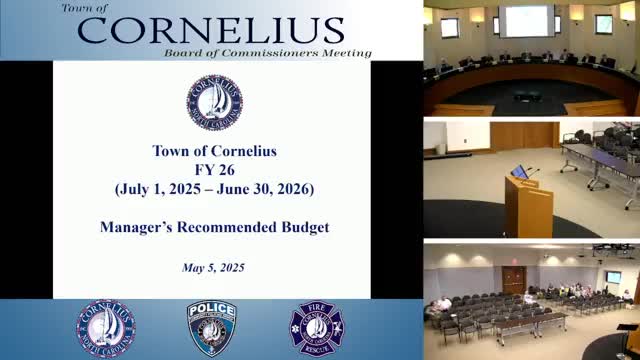
Town Manager Andrew Grant presented the manager's recommended fiscal year 2026 budget to the Cornelius Town Board on May 5, saying the recommended property tax rate remains 17.31 cents per $100 of assessed value (stated as 17.31). The presentation said the recommended budget maintains current service levels, funds citizens' priorities — primarily transportation, public safety, parks and public works — and includes $4.5 million in one-time expenditures funded by restricted or dedicated sources.
Why it matters: The budget frames town spending priorities for the coming year and projects the town's long-term financial outlook, including a forecasted decline in the town's general fund balance that staff said could violate the town's fund balance policy in fiscal year 2029 unless adjustments are made.
Grant told the board the recommended budget "generally maintains current service levels" and recommended keeping the property tax rate at 17.31. He said staff removed roughly $98,000 in recurring operating costs after an internal review and that the recommended budget does not include new recurring expenditures that could not be supported by current revenue. The presentation allocated funds for town match commitments to multiple NCDOT road projects, pedestrian safety improvements (including three RRFB crosswalk installations), new sidewalks, and updates to the town's bike-and-pedestrian plan. Grant also recommended a market and compression salary adjustment for public safety employees costing about $95,000, and outlined the next-year costs for the multi-year transition of the fire department from part‑time/volunteer staffing toward a career department (recurring costs of $411,000, including three full‑time firefighter positions and related staffing changes).
On debt and long-range finance, Grant noted the town has about $52 million committed to road projects and more than $34 million in active NCDOT partnership projects; the town expects total capital projects on the CIP to exceed $200 million. He presented a 10‑year forecast showing the general fund balance declining toward the town's minimum policy level; staff said that without corrective action the forecast could show a policy violation in FY2029. Grant summarized: when the $4.5 million of one‑time, restricted funding is reconciled out, the budget shows a small net contribution to fund balance, which is why he recommended no tax increase this year.
Board discussion emphasized retention and recruitment costs for town employees, the long-term fiscal implications of bond sales and the fire transition plan, and the idea of drafting a non-binding policy that would signal future boards to consider targeted revenue actions (for example, a tax increase) when debt or recurring commitments are added. Commissioner comments noted that a large share of the proposed personnel increases (staff stated 87%) would go to public safety.
The board voted to open a public hearing on the FY2026 budget and tax rate and then voted to continue that public hearing to the May 19 meeting to allow further citizen input. Both votes passed by voice vote with all members voting in favor.