Get Full Government Meeting Transcripts, Videos, & Alerts Forever!
Get email alerts on the Transportation topic
No spam. Unsubscribe anytime.
Residents urge traffic studies and infrastructure funding as new developments advance near Eagle Heights and Country Club Hills
Summary
Multiple residents told Salisbury council that planned and recently approved housing developments will increase traffic on narrow neighborhood streets and asked the city to pursue traffic impact analyses, speed adjustments and other safety measures.
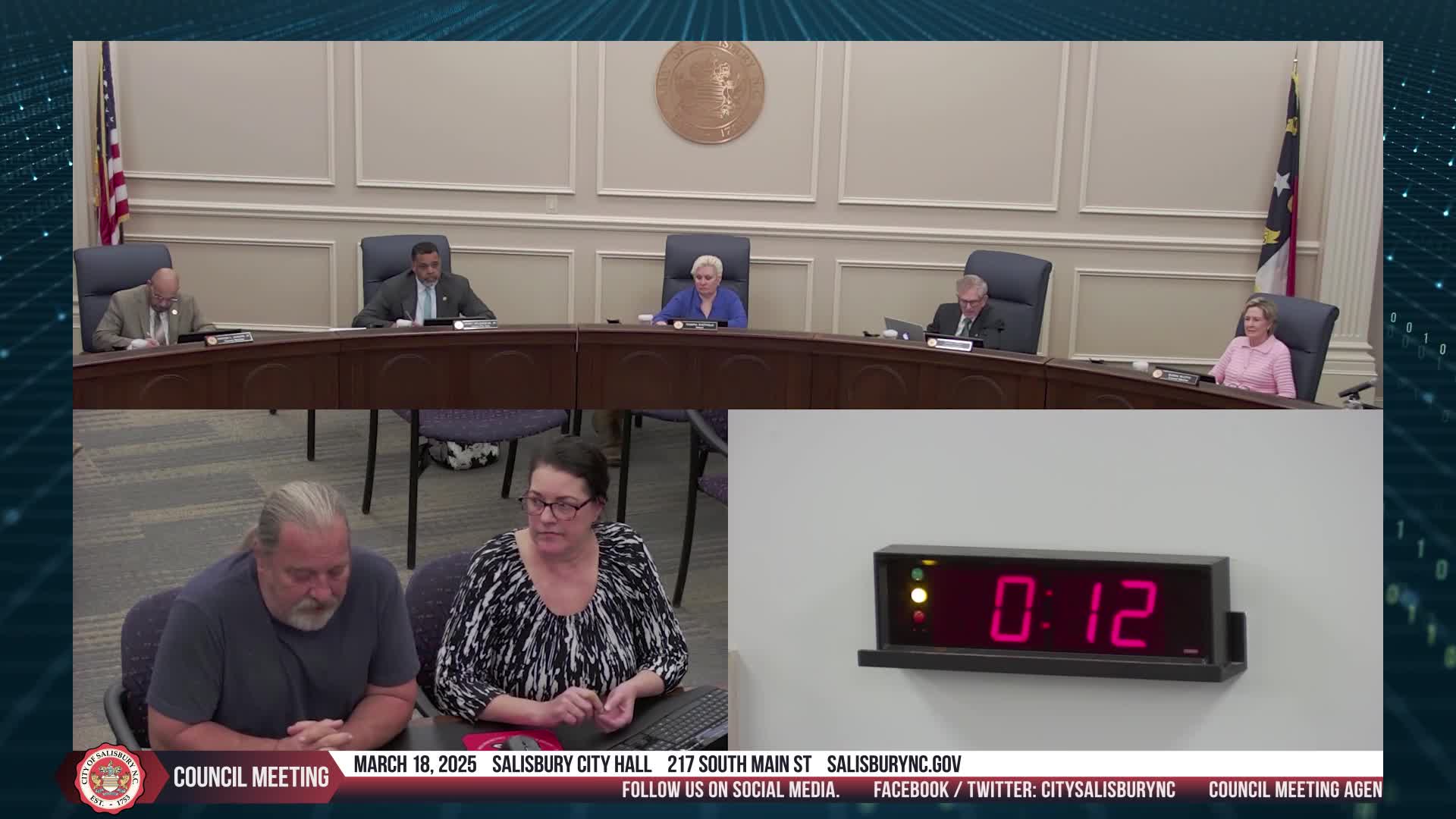
Several residents from Eagle Heights, Country Club Hills and nearby neighborhoods told the Salisbury City Council on March 18 they are concerned that multiple new housing developments will overload narrow local roads, create safety risks for school traffic and increase stormwater and erosion problems.
Why it matters: Speakers said the city and NCDOT should anticipate cumulative effects from several subdivisions and not treat each trip generation calculation in isolation. Residents requested traffic impact analyses, speed-limit adjustments, school traffic studies, erosion mitigation, and consideration of traffic-calming measures before additional annexations or approvals proceed.
What residents said Jane Smith Steinberg, a 55‑year Eagle Heights resident, said narrow roads and nearby school locations make new development hazardous: "When these houses become full and the traffic begins to get worse than it is now, we're gonna have a serious problem out there." She said decisions by NCDOT and future connections from new subdivisions could turn quiet streets into unsafe cut-throughs.
Leanne Norris, speaking after a neighborhood site visit to the Chatham Creek development on Sells Road, summarized action items discussed with city staff and volunteers: request a larger buffer from the developer, lower the trip threshold so a traffic impact analysis (TIA) is required for more projects, request an NCDOT study at the Highway 601 and Sells Road intersection, and pursue grants for a cumulative TIA of Sales Road, Old Mocksville Road and Hawkenstown Road.
Jonathan Barbee, a Country Club Hills resident, urged the council to use tax revenues from annexed properties to prioritize capital investment where growth is occurring and called for more routine police speed enforcement in neighborhoods rather than relying solely on physical devices: "Most want simple traffic control measures — primarily a human police officer to do routine speed checks and issue violations for speeding through the neighborhood, which requires no study at all."
Numbers cited and clarifications - Norris said a single development's published threshold of 953 daily trips "does not seem overwhelming," but she estimated cumulative trips in the area could reach an estimated 4,000 daily trips as multiple projects build out. - Staff and residents said they had consulted NCDOT contacts (Brian Thomas for intersection studies and Maria Louder at North Hills Christian School for school traffic studies).
City response and council discussion Council members discussed traffic concerns in the comment period. One council member urged proactive work with neighborhoods and a traffic impact study before traffic issues escalate; another member suggested the council should work with DOT and neighborhood groups on mitigation options such as speed bumps or other traffic-calming measures. No formal council action on a TIA was taken at the meeting; residents asked staff and council to prioritize the issues in upcoming budget and capital-improvement planning discussions.
Ending: Residents left the meeting urging follow-up and staff said they would continue to research grants and coordinate with NCDOT and school officials.