Get Full Government Meeting Transcripts, Videos, & Alerts Forever!
Get email alerts on the Historic Shopping District Cbd Policy Review topic
No spam. Unsubscribe anytime.
Planning commission opens broad review of downtown rules; staff to study moving alcohol and other uses in Central Business District to conditional-use review
Summary
The Planning and Zoning Commission opened a study of downtown land-use controls after commissioners raised concerns about a growing concentration of alcohol-serving establishments and other retail types in the Central Business District.
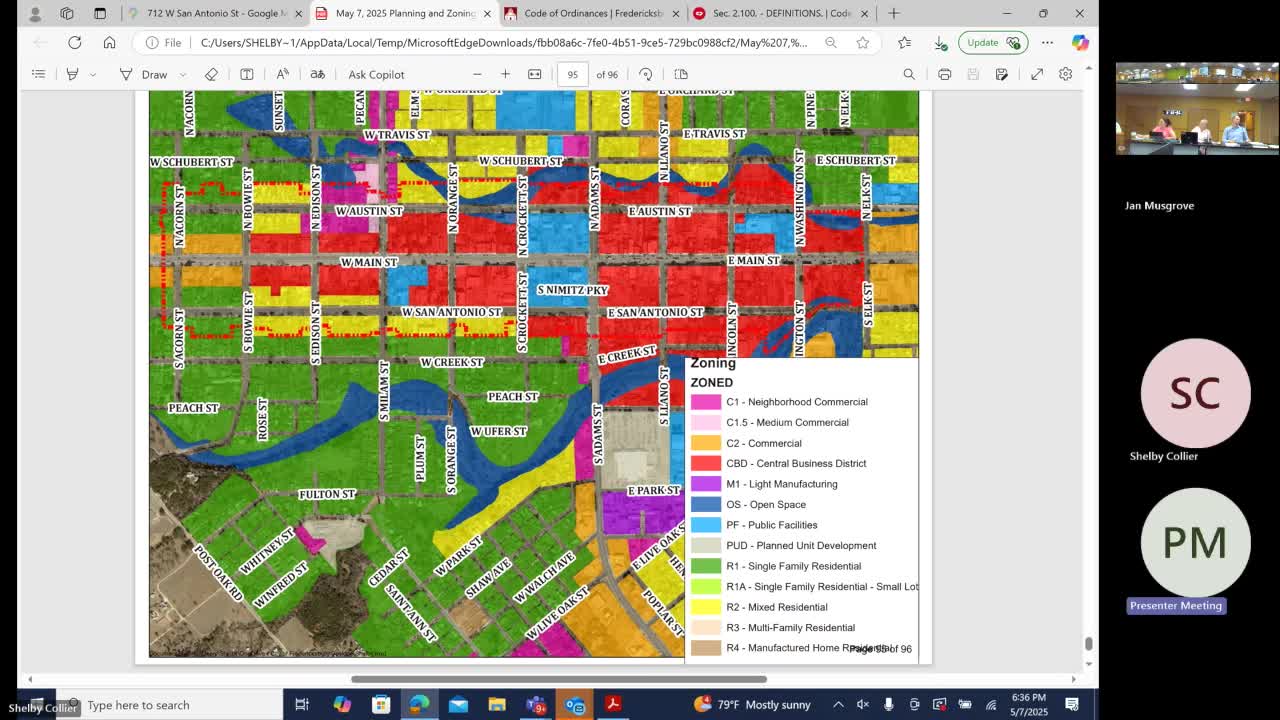
The Planning and Zoning Commission held an extended discussion about land-use controls in Fredericksburg’s Historic Shopping District and Central Business District (CBD), focusing on alcohol-serving establishments, vape and smoke retailers, gaming-type uses and the overall commercial mix on Main Street.
Shelby (planning staff) outlined the current overlay tool (the Historic Shopping District), which overlays multiple underlying zoning districts and currently requires conditional-use permits mainly for standardized businesses. Shelby told the commission that the overlay itself does not negate the underlying zoning and that many uses allowed by the underlying zones (including several alcohol-related categories) remain permitted by right unless the zoning ordinance is amended.
The commission and staff discussed technical steps that could limit proliferation of specific uses in the CBD. Legal counsel (Nick and Attorney Mick) cautioned the commission that any ordinance restricting by-right uses should be supported by findings tying the restrictions to impacts on surrounding properties (for example, studies linking certain uses to public-safety or nuisance outcomes) to reduce legal risk. Nick noted that the commission could move specific alcohol-related uses from “permitted by right” into the conditional-use-permit category in the CBD, which would trigger a public review where commissioners could require conditions such as parking, hours, noise or limits on production.
Police Chief (name not given) briefed commissioners on enforcement data and trends, saying public-intoxication and DWI arrests have been the department’s top arrest categories for several years and that late-night operations (permits that allow sales past midnight) are associated with more custodial incidents. The chief reported that open-container and late-hours rules are enforceable in the Central Business District and that the department can provide time-of-day arrest breakdowns and other data to inform ordinance changes.
Staff outlined work already under way: a block-by-block business inventory of Main Street from Elk to Acorn (including business type and square footage) and a countywide tally of TABC permits (staff cited about 252 active permits countywide, noting that number includes late-hours permits and multiple-permit holdings). Commissioners requested additional data from police (hourly arrest data and visitor/local breakdowns), more detailed TABC permit locations for the downtown polygon, and research into how the federal National Register of Historic Places overlay and local historic-shopping-district rules could be used to regulate or condition uses.
Commissioners gave staff direction to prioritize research on alcohol-related uses (cocktail lounges, tasting rooms, liquor sales, club/venue uses) in the CBD and to return with draft language, legal analysis and supporting data. Staff said it would prepare draft ordinance language, identify legal risks and potential conditions (hours, parking, noise, distance/separation requirements), and provide a business inventory and enforcement data to the commission for future consideration. Several commissioners asked that staff present preliminary findings at an upcoming meeting and suggested possibly taking the matter to a joint work session with city council.
No ordinance changes were adopted at the meeting; the commission’s action was to direct staff to study options and return with findings and proposed code amendments.