Get Full Government Meeting Transcripts, Videos, & Alerts Forever!
Get email alerts on the Social Services Food Security topic
No spam. Unsubscribe anytime.
Oberlin Community Services says demand for food and housing aid rose in 2024; warns of federal, state cuts
Summary
At an April 21 City Council meeting, Oberlin Community Services reported year-over-year increases in food pantry visits and emergency housing assistance and urged local advocacy as federal and state funding face cuts.
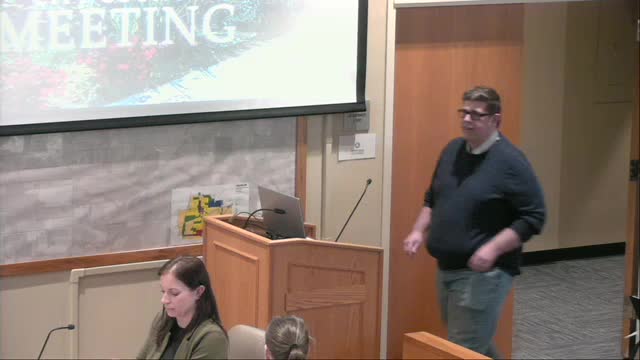
Oberlin Community Services told the Oberlin City Council on April 21 that demand for its food and emergency-assistance programs rose in 2024 and has remained high so far in 2025.
The presentation by Jason Hawk, a representative of Oberlin Community Services, said the agency served 2,460 unique households in calendar year 2024 and distributed food to 7,429 people that year. Hawk told council members that the pantry recorded 17,831 tracked pantry visits in 2024 and that the agency received nearly 250 tons of food into its warehouse over the course of the year. He said 563 unique families from the 44074 ZIP code used the pantry during 2024.
The figures show a sustained increase in use since the pandemic. “The answer is going to always be yes,” Hawk said when describing the agency’s policy of trying to meet requests for help. He also urged council and the public to contact state lawmakers about proposed budget cuts to food programs. “Writing your state general assembly person is probably the best thing that you can do,” Hawk said, naming several legislators serving Lorain County.
Why it matters: OCS is a primary local safety-net provider for food and short-term housing assistance in southern Lorain County. Hawk warned that recent federal and likely state funding cuts could reduce supplies reaching local food banks and increase pressure on the nonprofit network that supplies OCS.
What OCS reported - Food pantry use: 2,460 unique households in 2024; many households use the pantry multiple times (the average number of visits per family listed was 7.25). OCS reported that the most common frequency is one or two visits per year. - People served: 7,429 individuals received food through OCS in 2024. - Pantry visits: 17,831 tracked pantry interactions in 2024 (this figure includes deliveries to institutional recipients and curbside/choice pantry visits but excludes some pop-up distributions and Meals on Wheels, which are tracked separately). - New clients: 1,164 families who used OCS in 2024 had no prior record in the statewide food-bank registration system, indicating a first-time use of a food pantry. - Emergency financial assistance: OCS handled 901 requests for financial help in 2024; 506 of those were from the city of Oberlin. Hawk said emergency assistance is limited to defined ZIP-code service areas and is intended to prevent eviction and stabilize households.
Partners and operations: Hawk described a network of partners that feed and support OCS operations, including Second Harvest Food Bank (the agency supplies the bulk of OCS food), Mercy Health (provides Meals on Wheels), United Way (contributes emergency funds), Legal Aid Society of Greater Cleveland (monthly brief clinics), the Bonner Center at Oberlin College (volunteers), OSU Extension (nutrition education), and other counseling and workforce providers that lease space at OCS’s Cooper Center location. Hawk said Second Harvest provided 444,000 pounds of food to OCS in fiscal year 2024.
Funding risks and advocacy: Hawk outlined two federal budget moves he said would reduce food available to food banks: a roughly $1 billion reduction split across two programs that had supported food-bank supply and farmer payments, and a separate cut he said already halted a 43,000-pound USDA shipment to Ohio food banks. He said OCS also expects to lose about $30,000 in FEMA funding this year and that the Ohio General Assembly’s proposed biennial budget currently would provide substantially less than the Ohio Association of Food Banks sought. Hawk and councilmembers urged residents to contact their state legislators about the budget.
Council questions and follow-up: Councilmembers asked whether OCS tracks demographic data and new residents; Hawk said demographic fields are collected voluntarily through the Ohio Association of Food Banks system and many clients decline to provide them, but he said he could supply sampled demographic data on request. When asked how councilmembers could help with the state budget, Hawk named specific state legislators representing Lorain County and repeated his recommendation to contact them by letter or phone while the Senate review was pending.
Practical information: Hawk said OCS operates at 500 East Lorraine Street in Oberlin. Office hours are 9 a.m.–5 p.m. Monday–Thursday and 9 a.m.–4 p.m. Friday. The food pantry hours are 1:30–4:30 p.m. Mondays and Wednesdays and 1:30–3:30 p.m. Fridays; Hawk said staff will assist visitors who arrive during operating hours even if the pantry window is closed.
Next steps: Hawk said OCS is in the third year of a three-year city grant cycle, plans to apply for more city funding later in 2025, and will continue to monitor state and federal budget developments that could affect food-bank supply and emergency-assistance funds.