Get Full Government Meeting Transcripts, Videos, & Alerts Forever!
Get email alerts on the Short Term Rentals topic
No spam. Unsubscribe anytime.
Board of Zoning Appeals approves special exception for short-term rental at 501 East Richardson Ave.
Summary
The Board of Zoning Appeals approved a special exception allowing short-term rental use at 501 East Richardson Avenue in Summerville after staff said the property meets UDO Section 3.3 criteria; staff will schedule an inspection and the applicant was told to apply for the lodging conditional use permit and business license.
At a meeting of the Board of Zoning Appeals in Summerville, members voted to approve a special exception request to allow short-term rental use at 501 East Richardson Avenue.
The decision allows the property owner to pursue a lodging conditional use permit required by the town, subject to inspection and compliance with tax and residency rules cited by staff. Town planning staff said the request was reviewed under UDO Section 3.3 (the use chart) and found likely to meet the special-exception criteria for a GR-5 zoned lot.
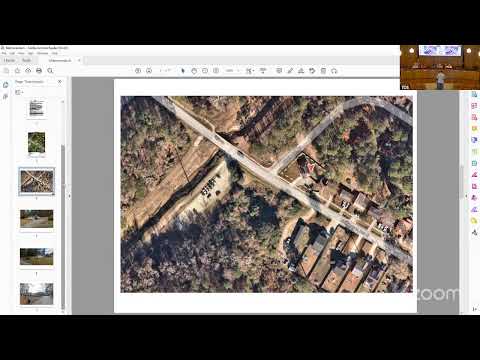
Staff member, town planning staff, described the property during the meeting as a corner lot of approximately 0.22 acres buffered by two large wooded parcels and the Sawmill Branch. "This is a special exception request to allow for short term rental use at 501 East Richardson Avenue," the staff member said, and added that short-term renting is permitted in GR-5 zones only when a special exception is granted by the Board of Zoning Appeals.
The staff member said the owner must be taxed at the 4% Dorchester County lodging tax rate and that the town typically requires proof of residency — a driver's license with the address and documentation showing residency for about 183 days or more — to establish the property as a primary residence for lodging-permit purposes. "He has to be there 51%," the staff member said when discussing primary-residence expectations.
Applicant Mark Lynch said he splits his time between the area and the West Coast for family reasons. "I have kids back on the West Coast, so I ... about 6 months on, 6 months off," Lynch said when asked how residency would work.
Board members discussed options for property owners, including the ability to use long-term renting (30 days or more) without the lodging conditional use permit, and staff reiterated that properties in more mixed-use commercial areas may be permitted for short-term rentals by right. The staff member noted that GR-5 lots are generally smaller (minimum lot size about 8,500 square feet) than GR-2 lots (about 20,000 square feet), which can make proximity to neighbors a concern in some cases.
The board moved to approve the special exception; one board member moved and another seconded (names not recorded in the transcript). The motion carried on a show-of-hands vote; the transcript records the chair saying, "All in favor, raise your right hand." The transcript does not record a roll-call tally. Staff said they would "email you tomorrow with the next steps, and we'll schedule the inspection for the lodging conditional use permit." The applicant was told he may apply online for both the lodging permit and his business license and to contact staff if he has trouble finding the applications online.
During the same meeting staff also described enforcement work on nonpermitted short-term listings. The town recently hired a zoning code enforcement officer, Lee, and uses a tool called Rentalscape (a data-scraping program) to identify illegal or nonpermitted listings. The staff member said the town had a list of about 200 noncompliant listings and that Lee had reduced that number "to maybe just, you know, in the single digits." The staff member added that many statutory citations must be issued in person, which previously limited enforcement capacity.
The board's approval allows the applicant to proceed to the inspection and permit stage; staff will follow up with procedural steps and the applicant must secure the lodging conditional use permit and comply with county tax rules and town lodging conditions to operate as a short-term rental.
Less critical details discussed included required notice procedures (staff said legally required signs were posted and no neighbor feedback had been received) and the $100 fee for the special-exception process that some owners opt to avoid by choosing long-term renting instead.