Get Full Government Meeting Transcripts, Videos, & Alerts Forever!
Get email alerts on the Local Option Sales Tax topic
No spam. Unsubscribe anytime.
Council votes to phase in local-option sales tax credit at 50% to help close budget gap
Summary
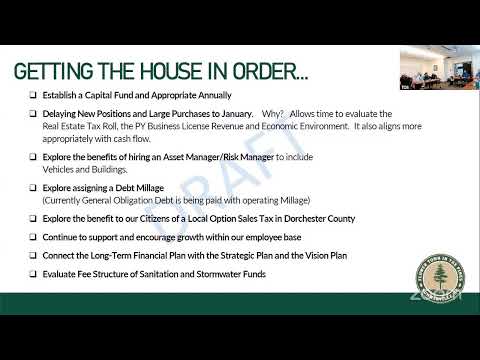
At a special budget workshop, council approved a two-year, 50% phase‑in of previously refunded municipal revenue from the local‑option sales tax (reducing the property‑tax credit the town has been returning) as part of a package of revenue changes to close a roughly $4.5 million budget shortfall.
The Somerville Town Council voted during a special budget workshop to begin phasing in the municipal share of the local‑option sales tax this fiscal year, keeping 50% of the municipal revenue that the town has been refunding as part of the property‑tax credit calculation.
Council members said the move is intended to generate recurring revenue to help close a roughly $4.5 million gap between proposed expenses and expected revenues ahead of first reading of the budget in two weeks.
Why it matters: Council staff and finance staff told the body that the town has been refunding more of the municipal revenue than the state statute requires, leaving Somerville keeping only about 29% of the municipal revenue that the law allows. Phasing the municipal share back toward the statutory calculation would shift some of that returned credit into the town’s general fund and reduce future pressure on operating and capital budgets.
Finance director Rhonda Roberts summarized the mechanics and the two‑year phase‑in the staff recommended, saying the town now keeps “29% of what we are allowed to keep under statute,” and proposing a 50% phase in this year with the remainder the following year. Roberts told council staff had studied the departmental priorities and revenue lines and was presenting revenue options to close the gap.
Council debate focused on fairness and timing. One council member argued that residents in neighboring Dorchester County have effectively subsidized municipal services because the town’s prior practice provided a larger credit than statute required; others urged a slower phase‑in to reduce immediate pressure on households that might face higher property tax bills as a result.
A motion to begin a 50% phase‑in this year was made, seconded and adopted. During the voice vote the mayor called for ayes; one council member stated on the record that they opposed the motion. Council instructed staff to prepare ordinance language and numbers for first reading at the council meeting two weeks hence.
What’s next: Staff will show the revised tax-credit factor calculation on the draft budget for first reading, and council expects to take a second reading and hold the public hearing at the June meeting.