Get Full Government Meeting Transcripts, Videos, & Alerts Forever!
Get email alerts on the Historic Preservation topic
No spam. Unsubscribe anytime.
Board resists converting historic Reformed Episcopal Church’s main roof to shingles; approves shingle on small outbuilding with color to be reviewed
Summary
After debate over cost and preservation, the Board denied shingle replacement on the main historic building’s roof and allowed a shingle roof on a smaller outbuilding pending color approval.
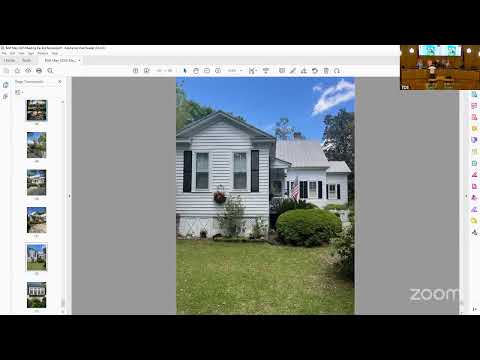
The Board of Architectural Review declined to approve replacing the main house roof at the Reformed Episcopal Church property with shingles, voting instead to require a metal roof on the primary historic building, while allowing shingles on a smaller secondary building subject to later color approval.
Representatives for the church explained the existing metal roof is beyond repair and that a full metal replacement would cost roughly $170,000 versus about $50,000 for shingles. Church representatives said funds are limited across six buildings on the property. Roofer David Rosado attended to answer technical questions and to describe product options.
Board members repeatedly emphasized the prominence of the main house on South Main Street and argued for preserving the building’s character. One board member said replacing the primary roof with shingles would be “inappropriate” for such a visible historic resource, and the board’s motion rejecting shingles on the main building carried by majority vote. The board did agree, however, to allow a shingle replacement on a smaller outbuilding, with the condition that the applicant return with true samples and final color for board approval.
Why it matters: The property—dating to 1901 and formerly part of Pinewood School—occupies a prominent location on Main Street. The materials and color of a roof on a prominent historic structure affect the building’s appearance and the character of the historic district, which the BAR is charged with protecting.
Details: During discussion board members noted the prior replacement of a carriage‑house roof with shingles decades earlier and expressed sympathy for the church’s budget constraints, but favored preservation for the most visible building. Members discussed possible conservation alternatives (coating and fabric repairs) but described those as unsuitable where substrate is already wet and failing. The board asked the applicants to return with metal roofing samples for the main building and with shingle samples and color options for the smaller building.
Outcome: Motion that the main building not be reroofed with shingles (i.e., require metal) passed; separate motion to permit shingles on the small outbuilding passed with the condition that final shingle color be submitted for board approval.