Get Full Government Meeting Transcripts, Videos, & Alerts Forever!
Get email alerts on the Water Sewer Rates topic
No spam. Unsubscribe anytime.
Utility committee asks staff to draft ordinance for 20% wastewater rate increase
Summary
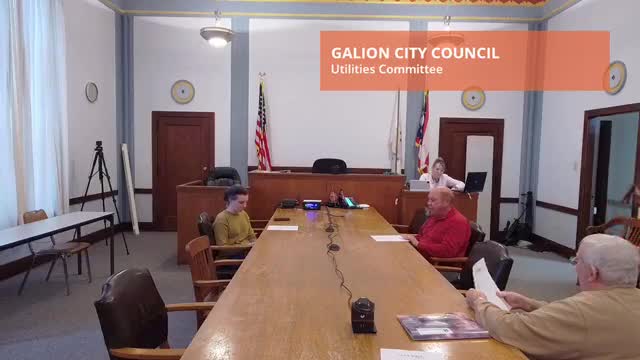
The Galion City Council utility committee voted May 6 to ask staff to draft an ordinance that would raise wastewater rates by 20% and forward the draft to full council.
The Galion City Council utility committee voted May 6 to ask staff to draft an ordinance that would raise wastewater rates by 20% and forward the draft to the full council for consideration.
The request, approved by committee voice vote, followed a lengthy discussion of utility reserve shortfalls, major capital needs and options to avoid continued transfers from the city’s general fund. The committee debated three rate options — commonly described in the meeting as 15%, 20% or 25% increases — and explored non-rate alternatives such as using a local “freeze foundation” allocation for capital projects or taking short-term debt.
Utility Committee chair (name not specified) opened the discussion by noting the council’s limited formal authority over water rates but saying the committee has traditionally tied water and sewer policy together: “technically, council doesn't have anything to do with the water rates, but we've always made a kind of a tie,” the chair said. The chair and other committee members said a 20% wastewater increase would reduce or eliminate planned transfers from the general fund and begin to rebuild utility reserves.
Committee members raised several non-rate options. Some suggested requesting part of next year's allocation from the meeting transcript's “freeze foundation” be used for capital improvements; the committee discussed a commonly cited rule in the foundation’s probate document that a portion of the award may be used for an approved capital improvements plan. Members also discussed taking short-term debt (five to ten years) to fund multiple capital projects rather than using the foundation allocation as an annual draw.
Officials identified several near-term capital costs driving the need for revenue: a potentially urgent repair or replacement at the Ammons dam complex, a gap in funding for a pump-house project, and the high cost of replacing or upgrading water meters. One committee member said the project that received a state grant was a roughly $2,000,000 job for which the city received $500,000, leaving an estimated funding gap of about $1.5 million. The engineer's options for the Ammons dam presented to the committee included a lower-cost intervention (discussed in the meeting as about $350,000), more substantial repairs (given in the meeting at roughly $620,000) or full replacement (roughly $800,000); the committee noted those estimates are about two years old.
Committee members said the Ohio Department of Natural Resources (ODNR) has escalated the priority of repairs at the Ammons site and discouraged short-term fixes such as cutting a hole in the dam. The committee planned an on-site meeting next week with the city engineer and ODNR representatives to confirm the condition and scope before finalizing project plans.
Members also discussed a long-term meter-replacement program. The committee estimated new metering at roughly $2 million to $3 million and acknowledged the city has been denied federal funding twice for that work. One member said meter replacement would be transformational but is unlikely to be fully funded from grants.
After discussion the committee voted to ask staff to draft an ordinance reflecting a 20% increase for wastewater rates and place that draft on the next council agenda. The motion was made by the Utility Committee chair (name not specified) and seconded by Councilmember Mike Richard; committee members voted in favor. The committee also heard legal counsel advise that any rate change must follow state-required readings and cannot be retroactive in a way that negatively affects residents.
Committee members said the 20% figure was chosen as a pragmatic middle ground: higher than the 15% option (which members said would largely “keep even”) but short of the larger increases some models had suggested. Several members urged pairing a modest rate increase with one-time foundation or borrowing strategies to fund large capital projects so future councils would not face excessive immediate increases.
The committee asked staff, including Julie (city staff), to prepare a draft ordinance showing the proposed rate changes and associated rate schedules for forwarding to the full council. The committee indicated it prefers an implementation date aligned with the city’s fiscal year processes so collections support the next budget cycle.
The utility committee plans to present the ordinance to the full Galion City Council at the earliest available meeting and to continue technical work on Ammons dam with ODNR and the city’s engineer. The committee emphasized that details such as exact project budgets, final grant amounts and meter-replacement financing remain to be determined and will be brought back to committee and council for decisions.