Get Full Government Meeting Transcripts, Videos, & Alerts Forever!
Get email alerts on the Cdbg Dr Funding topic
No spam. Unsubscribe anytime.
Detroit council committee advances $346.9 million CDBG-DR plan for stormwater, sewer repairs and housing
Summary
Detroit officials presented a draft plan to spend $346,864,000 in Community Development Block Grant — Disaster Recovery funds on infrastructure, housing and mitigation projects. Council voted to send the action to formal consideration with a recommendation to approve.
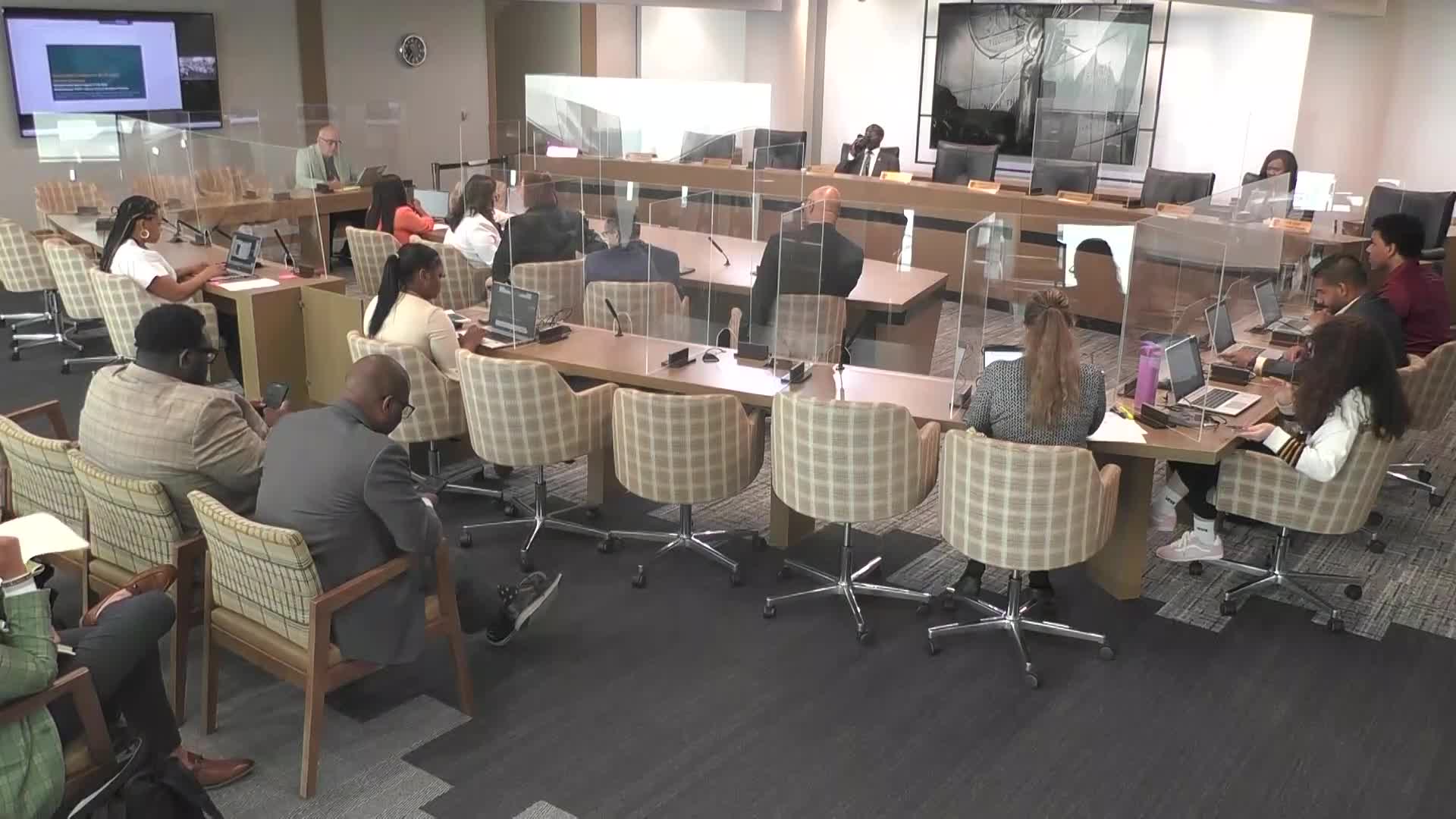
Detroit council committee members advanced a plan on May 15 to allocate $346,864,000 in Community Development Block Grant — Disaster Recovery (CDBG-DR) funds toward a mix of infrastructure, housing and mitigation projects tied to the August 2023 storm.
The proposal, presented by Julie Schneider, director of the Housing and Revitalization Department (HRD), calls for about 72% of the funds for infrastructure projects — including a $175 million sewer alley repair program and $25 million for the Brightmoor green stormwater infrastructure project — about 22% for housing (roughly $75 million), $17 million for compliance and administration, and $2 million for planning. Schneider said the funds respond to an unmet needs calculation based on federal assessments and are intended for long-term recovery rather than immediate FEMA relief.
The plan matters because the August 2023 storm damaged roughly 6,000 homes in the region and about 5,000 in Detroit; Schneider said infrastructure limits, such as insufficient stormwater capacity, amplified housing impacts. “These CDBG-DR funds are what's considered long-term recovery funds,” Schneider said. “The unmet need calculation is what creates the amount of the appropriation.”
Council members and agency staff pressed for detail on how dollars would be used on the ground. Sam Smalley, deputy director of the Detroit Water and Sewerage Department (DWSD), described the sewer alley program as a large-scale approach to private sewer lateral defects: “One third of the sewer lateral connections to the city's sewer system have a significant defect,” he said, and DWSD has over 30,000 lateral notifications on file. Rather than try to aid individual homeowners through the cumbersome eligibility and documentation process used in prior grants, Schneider said the proposed area-benefit approach aims to serve roughly 10,000 to 12,000 lateral connections across neighborhoods.
HRD and DWSD officials said mold remediation funded directly by CDBG-DR is not eligible. Schneider and Smalley explained that mold cleanup is not an eligible standalone repair activity under the proposed program, and an individual household could not be served directly under the area-benefit sewer activity. “Mold remediation alone is not an eligible activity with these funds,” Schneider said.
The proposal includes targeted projects: a Brightmoor Green Stormwater Infrastructure project that would create a roughly 30-acre pond to hold and treat stormwater before releasing it to the Rouge River, and a Jefferson Chalmers flood mitigation project budgeted at $20 million that would study and potentially install stop-log closures at canal mouths. Ken Kuzel, an engineer in the mayor's office, said the stop-log concept originated in a U.S. Army Corps of Engineers floodplain study and would be taken to a feasibility phase under the CDBG-DR plan; he estimated the feasibility study would take about two years and that the city would solicit a consultant by RFP.
Housing allocations include about $34 million for affordable housing, $31 million for public housing investments and $10 million for down-payment assistance; HRD estimated down-payment aid could create roughly 400 new homeowners. Arthur Jemison, executive director of the Detroit Housing Commission, said the commission would use funds to rehabilitate and expand units at several developments, including Parkside, Sheridan and Brewster.
Staff described coordination and compliance: Schneider said HUD has signed a grant agreement and the city must authorize the mayor to accept it; HUD rules impose a six-year period to spend the funds from the grant agreement date. Schneider also noted the program includes enhanced compliance and that HRD will add staff and publish policies and procedures for procurement, labor standards and environmental review. Josh Roberson, deputy director of the Department of Neighborhoods, committed to outreach beginning in early June to push homeowner education materials.
Council action: Councilmember Fred Durhall moved to send line item 7.3 (the CDBG-DR action plan) to formal session “with the recommendation to approve.” The motion carried with no objections during the committee meeting, and the measure was advanced for formal consideration.
Questions and next steps: Councilmembers requested district-level maps and schedules for sewer alley work and asked HRD and DWSD to supply schedules, impact estimates and quarterly updates. Kuzel and other staff committed to study alternatives to stop logs (including seawall options and property acquisition estimates) and to include those alternatives in the RFP for the consultant study. Officials also said they would provide an estimated schedule of other stormwater projects in the pipeline, noting timelines vary from near-term completions to multi-year state-led projects (for example, MDOT projects tied to I-94 work).