Get Full Government Meeting Transcripts, Videos, & Alerts Forever!
Get email alerts on the Transportation Road Reconstruction topic
No spam. Unsubscribe anytime.
City staff, MDOT seek Muskegon City support for Apple Avenue redesign and possible turnback
Summary
City public-works staff and MDOT asked the Muskegon City Commission to support a near-final MDOT design to rebuild Apple Avenue and a separate resolution to accept a possible turn back of the road to city ownership, with construction planned for summer 2026.
City public-works staff and representatives of the Michigan Department of Transportation asked the Muskegon City Commission to signal support for a near-final MDOT design to rebuild Apple Avenue and for a separate resolution that would accept a future “turn back” of the road to city ownership.
Dan Vanderheide, the city’s director of public works, told the commission that MDOT obtained funding to rebuild Apple Avenue and that construction is planned for summer 2026. He said the reconstruction follows about two years of public engagement and that MDOT is asking the city for a public commitment in the form of two resolutions, which will be on the commission’s consent agenda at the next general session.
Why it matters: The project would change traffic lanes through much of the corridor, add a 10-foot shared path on the south side, replace water and sewer segments while the road is open, and carry a near-term city cost the staff estimates at about $3.8 million split over the coming fiscal year and the next. A turn back would give the city more flexibility on future design changes but would also shift long-term maintenance and rebuild costs to the city.
Key details and design changes Dan Vanderheide said the current design keeps five lanes near the highway, provides a three-lane section on the east end and a two-lane section through the downtown portion, with the principal recent change moving the two- to three-lane transition point from Wood Street to Terrace. Vanderheide said that change was made after public-safety input to ensure a continuous three-lane section for eastbound emergency response.
Vanderheide described other components the city is being asked to fund: about $500,000 from the city’s water fund for water-main replacements west of Getty (not the lead-service-line replacements), sewer consolidation on the east end (two old sewers combined into one new sewer with comparable capacity), a mostly south-side 10-foot shared path, and the statutory local participation required under Act 51. Vanderheide said the city’s estimated share for the items it is being asked to pick up is approximately $3,800,000; that amount would be split across two fiscal years.
MDOT’s position and flexibility under a turn back Mark Frederickson, Michigan Department of Transportation (MDOT) Muskegon TSC, said MDOT staff have been receptive to the city’s engagement and that MDOT will finalize design and bid the project in late 2025. Frederickson said MDOT would proceed with reconstruction even if the city declined a turn back; some design elements, however, would remain constrained by MDOT standards unless the city accepted ownership and the related flexibility.
Frederickson said MDOT’s standard approach is to maintain certain lane widths and design standards, and that some pedestrian treatments (for example, certain rapid-flashing-beacon installations) typically require proven, data-driven pedestrian counts before MDOT will fund or install them. He said if the city accepts a turn back and owns the road, “you could restripe it differently” and pursue some treatments sooner or under different design parameters.
Signals and pedestrian crossings Vanderheide and MDOT staff discussed traffic signals at Terrace and Pine. MDOT’s traffic study indicated the signals are not necessary for current conditions and might only be needed decades in the future; MDOT prefers keeping them rather than removing and reinstalling later. The city prefers stop signs “for the foreseeable future,” Vanderheide said, and identified signal removal as one of the items where city ownership would allow different, locally chosen treatments.
Costs, maintenance and trade-offs Commissioners asked about the ongoing maintenance and financial impact if the city accepts a turn back. Vanderheide said the city now receives about $100,000 per year from MDOT as reimbursement for maintaining that stretch; that amount may decline immediately after construction because the rebuilt pavement will need little maintenance initially but would become the city’s long-term responsibility for future rebuilds. Frederickson said MDOT surface courses typically require major resurfacing in roughly 15–20 years, and long-term maintenance responsibilities would transfer with ownership.
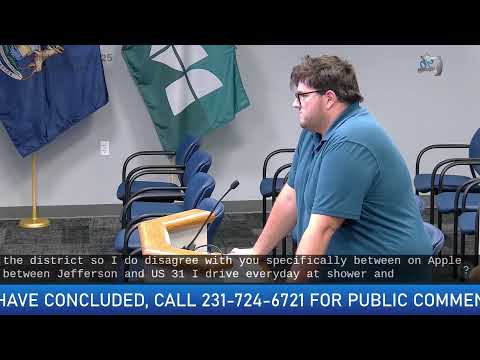
Public comment and differing views Public commenters joined the discussion on the scope and safety of lane reductions. Ratan Country (resident) said he opposed any narrowing of travel lanes; he told the commission that recent lane reductions during construction already slowed traffic and that further narrowing would “hurt traffic.” Zach Bradfield (District resident) said he supports narrowing through the downtown stretch, arguing the existing width encourages higher speeds and that narrowing would calm traffic and improve pedestrian safety.
Next steps and formal action pending Vanderheide said the two separate resolutions — one expressing support for the design and associated city costs and one expressing the city’s willingness to accept a turn back subject to formal agreements — will be placed on the city commission’s consent agenda at tomorrow’s general session. Vanderheide and Frederickson said final, legally binding agreements and any precise cost allocation will be prepared after MDOT completes the final design and the project is bid. No formal vote on the resolutions or a turn back occurred during the work session.
Excerpted direct comments from the meeting: Dan Vanderheide, director of public works: “MDOT was very receptive to it, and they began to incorporate it into their project and their engagement processes.” Mark Frederickson, MDOT Muskegon TSC: “If you owned it, you could restripe it differently than that.”
What to watch: The commission’s consent agenda at the next general session will include the two resolutions of support; if adopted, staff and MDOT plan to finalize design and move the project to bid later in 2025 with construction planned for summer 2026.