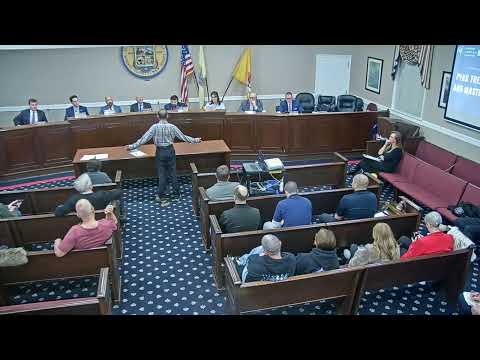
Parsippany-Troy Hills officials outline multi‑million dollar PFAS treatment plan; lead-service replacement disputes continue
Loading...
Summary
Town officials and consultants presented a PFAS treatment feasibility study that recommends centralized treatment and estimates initial capital costs in the millions. Separately, residents pressed the council over the township’s phased lead and galvanized service-line replacement program and contested phase assignments.
Town water officials and consultants told the Parsippany-Troy Hills Township Council on March 4 that new federal and state limits for PFAS will require costly treatment work across multiple wells and that centralized treatment plants could reduce long-term operating costs.
Substance of the presentation: Water Superintendent Sean Andres and Suburban Consulting Engineers’ project manager David Shandra said the EPA’s April 2024 maximum contaminant level (MCL) for PFOA and PFOS — 4 parts per trillion — means several township wells will need treatment. The consultants evaluated wells against criteria including current capacity, PFAS concentration, site feasibility and existing well life, and recommended grouping wells for centralized treatment where practical.
Cost estimates and approach: The study identified a near-term priority cluster (wells 9, 10 and 18 in consultants’ notation) with an estimated initial cost of about $9.8 million for a centralized treatment facility and recurring replacement/reload media costs requiring ongoing annualized spending. The report showed scaled capital estimates across priority clusters (multi‑million dollar projects for each cluster) and media-replacement cycles that will factor into the water department’s capital plan.
Officials stressed the trade-offs of treatment technologies. Consultants discussed granular activated carbon (GAC) contactors and ion-exchange systems as proven treatment choices; they noted carbon contactors have a taller footprint while ion-exchange can have a smaller footprint but different lifecycle and waste-handling characteristics. Suburban and the water department have two plants in late-stage commissioning as near-term pilot/full-scale projects (an ion exchange installation and a carbon contactor installation) that will provide operational data.
Why it matters: The township’s water allocation and “firm capacity” — the ability to meet peak daily demand — must be preserved while treatment is added. Council members asked whether added treatment and other infrastructure work could limit firm capacity; officials noted interconnections with Jersey City MUA and plan to combine capital investments and replacements to manage system reliability.
Lead-service replacement dispute: Multiple residents, including Kim Anderson and James Anderson of Mount Tabor, told the council they had been told their properties were in different phases of the township’s mandated lead and galvanized service-line replacement program. The Andersons said the contractor’s work and earlier decisions put them in phase 1 and that later communications created confusion and enforcement threats. Water staff said the Anderson property was included in phase 1 and that, after the original contractor was removed, remobilizing that contractor to perform a single house replacement would be costly to ratepayers; the township offered the Andersons 90-day opt-out language that lets residents replace service lines themselves but cautioned that widespread opt-outs would jeopardize compliance with the state-mandated replacement timeline (2029 target).
Officials’ next steps: Water staff will provide the council with written correspondence showing the Anderson family’s opt-in/opt-out status and said phase 2 design work is under way with likely bids toward the end of summer. The water department and consultants recommended the council incorporate the PFAS treatment schedule into the township’s capital plan; the water superintendent said his capital request for the year will be larger than prior years to accommodate treatment and infrastructure work.
What was said in the meeting: “We're ahead of the game that we're this far,” Suburban’s presenter said about Parsippany’s treatment projects. Superintendent Sean Andres described the need to balance compliance with capacity and to avoid a precedent of moving properties between phases that could jeopardize meeting the 2029 lead-service replacement deadline.
Funding and grants: Consultants noted that federal and state grant opportunities and ongoing litigation against major manufacturers may help offset costs, but they cautioned the total local capital need will still be substantial and will compete with other infrastructure priorities such as water mains that have reached or exceeded expected life.
Timing: Consultants and the superintendent said the new federal MCL is effective and that utilities face aggressive compliance timelines; the council was told the treatment program design, piloting and phased construction will unfold over multiple years and will be folded into the annual capital-improvement planning process.