Get Full Government Meeting Transcripts, Videos, & Alerts Forever!
Get email alerts on the Veterans Claims Consultants Regulation topic
No spam. Unsubscribe anytime.
Committee advances SAVE Act to regulate private claims consultants for veterans' benefits
Summary
The Senate Veterans, Military and Homeland Security Committee passed House Bill 108, the SAVE Act, creating registration, disclosure, fee caps and consumer protections for private claims consultants who assist veterans pursuing VA benefits; the vote was 5-4.
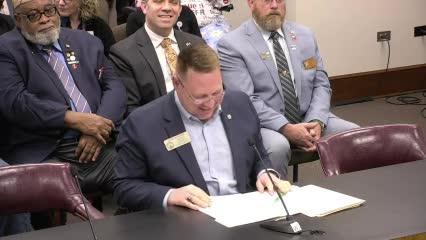
Senator Bonner, chair of the Senate Veterans, Military and Homeland Security Committee, presented House Bill 108, called the SAVE Act, as a state-level regulatory framework for firms that assist veterans with VA claims.
The bill would require written contracts and disclosures, prohibit up-front fees (fees must be contingent until an award is received), cap fees at five times the increase in the veteran's benefit, bar promises or guarantees of outcomes, require background checks, prohibit private entities from using international call centers or directly accessing veterans' medical and financial records, and bar private firms from employing doctors to perform secondary medical examinations for claims processing. The legislation also makes the companies subject to the Georgia Fair Business Practices Act for enforcement.
"What we seek to do in this bill is set up a structure so that all of these companies are accountable," Bonner said, describing hearings held across the state and the committee's effort to balance veterans' access to services with consumer protections. He told the committee there are roughly 670,000 veterans in Georgia and about 49,000 pending claims, and he argued the bill creates guardrails while allowing a free-market option for veterans who choose to pay for expedited services.
Supporters and critics offered competing concerns. Senator Harberson said the backlog of claims and veterans' unmet needs persuaded him to support a regulated option in the interim, even though he described unease about asking veterans to pay for earned benefits. Several senators and audience organizations argued veterans should never have to pay for benefits they earned; Senator Anderson and other members questioned whether private companies would be able to become accredited with the VA (the transcript and committee record note that VA accreditation is an individual designation, not a company accreditation).
Representative input and stakeholders cited in the record include Veterans Guardian, the VFW, American Legion posts and the Paralyzed Veterans Association; the Department of Veterans Service and local veterans service organizations were listed among entities that provide free assistance and will be included in mandated disclosure forms.
Committee members discussed enforcement and private cause-of-action under the Fair Business Practices Act; the author said the act applies and enforcement resources were available through the attorney general's office. The bill does not carve out a private cause of action from the Fair Business Practices Act.
After debate the committee voted 5 to 4 to pass the SAVE Act to the next stage. Senator Hickman seconded the motion. The transcript records a roll-call-style count given aloud by the chair: five in favor, four opposed.
Why it matters: the bill creates a state regulatory structure for an industry that assists veterans with VA claims by limiting fees, requiring disclosures and imposing consumer protections. Supporters said the measure provides a regulated pathway for veterans to pay for faster service while still preserving free options; critics said it risks legitimizing paid services and may not address the underlying federal backlog.
Votes at a glance: House Bill 108 (SAVE Act) ' Motion: pass; mover: not specified; second: Senator Hickman; outcome: approved 5-4.