Get Full Government Meeting Transcripts, Videos, & Alerts Forever!
Get email alerts on the Bus Rapid Transit topic
No spam. Unsubscribe anytime.
Senate committee approves five-year bus rapid transit pilot with camera enforcement in Atlanta
Summary
The Senate Transportation Committee approved House Bill 638 to authorize a bus rapid transit (BRT) pilot in Atlanta with camera enforcement for parked vehicles that block bus-only lanes; the measure includes initial warnings, fines, a five-year sunset and limits on driver license penalties.
The Senate Transportation Committee voted to advance House Bill 638 (LC394730S), a measure authorizing a bus rapid transit pilot in Atlanta that would establish bus-only lanes enforced by cameras to deter parked vehicles that block service.
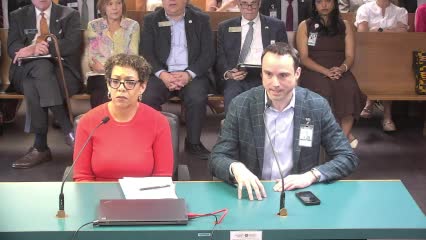
Representative Silcox, sponsor of the bill, told the committee the measure is intended to let buses move without impediment and to make transit faster and more attractive. "Bus rapid transit or BRT stands for bus rapid transit," she said. "The idea of this is that these buses would be rapid because nothing would impede their lane." The sponsor said MARTA will carry out public education, begin with warnings, then issue citations after a six-month grace period, and use citation revenue only for MARTA public-safety initiatives.
Jennifer LaRosa, MARTA government-relations, described enforcement technology as short video captures of stopped or parked vehicles; she said there is a human review process "very much to the red light camera process." The committee discussed camera operation, whether the footage would be subject to human review before notices are mailed and where cameras would be placed; a staff member confirmed some text addressing review appears in the draft and senators asked for a floor amendment to make review procedures explicit.
The bill provides that violations will not incur points on a driver's license, will not block tag renewal and will not result in arrest. Fines were described as modest and comparable to existing distracted-driving civil penalties; MARTA will offer a transit-safety class that can waive a first violation. The sponsor said the pilot includes a five-year sunset so the program would expire in 2030 unless renewed.
Committee members raised questions about ridership levels, lane utilization, enforcement, and whether the lanes would take existing vehicle capacity; MARTA said some sections repurpose existing lanes while others add capacity, and that the pilot route is under six miles round trip. Several senators voiced security and camera concerns and requested annual reporting on citation counts and use of funds.
The committee moved the bill on a motion by Senator McClure, seconded by Chairman Dixon, and approved the measure by a 7–2 recorded vote. The sponsor named Senator Still as the Senate floor carrier.