Get Full Government Meeting Transcripts, Videos, & Alerts Forever!
Get email alerts on the Private Water Service Irrigation Wells topic
No spam. Unsubscribe anytime.
Committee approves substitute allowing homeowners to drill irrigation wells; Piedmont Water raises operational concerns
Summary
After testimony from Piedmont Water and county leaders, the committee adopted a committee substitute that would permit property owners in certain surface-water service areas to drill wells for irrigation use, with limits. The substitute passed the committee as amended; sponsors said the change gives homeowners an option while preserving private-
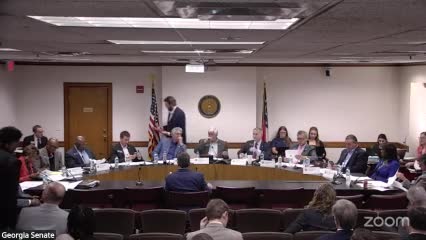
The Senate Regulated Industries and Utilities Committee approved a committee substitute on Oct. 12, 2025, providing private property owners in surface-water service areas an option to drill wells for irrigation use without authorizing sale of that water to others. The substitute, LC550632S as amended, passed the committee after senators debated competing concerns about private investment, customer protection and local public-health rules.
Adam Schaefer, chief executive officer of Piedmont Water Company, urged the panel to reject the original House bill and warned against imposing a public-utility regulatory framework on private water providers. “This legislation would force us to reassess our planned projects, which would negatively impact our customers,” Schaefer said, adding that Piedmont is one of two private companies in Georgia that invested private capital to develop surface-water sources.
Schaefer and other witnesses said the company provides fire protection and storage capacity across 71 water systems and 10 sewer systems in 14 counties and that substantial capital investments — including a $15 million surface-water treatment plant built in 2022 — affect customer rates. He described tiered pricing that aims to conserve water and said approximately 85% of Piedmont’s customers use 5,000 gallons or less per month; a smaller group of high-irrigation users account for large seasonal demand spikes.
Representative Rhodes, who offered a committee substitute to the original House bill, said the revised language would not impose price controls or interfere with Piedmont’s contract with large customers. Instead, the substitute would allow homeowners to drill wells for irrigation on their own parcels, subject to environmental and county health rules and with a prohibition on reselling the water. Rhodes described the approach as giving homeowners “another option” without converting private systems into public utilities.
Committee members asked detailed technical questions about fire-flow capacity, storage tanks and hydrant management. Schaefer said Piedmont maintains nine overhead storage tanks on systems with fire protection, totaling about 1.3 million gallons, and that fire protection design focuses on storage and pressure as well as source generation. The company said it inspects hydrants and provides meters to builders who temporarily draw water for construction.
Senators also discussed how separating irrigation water from potable household service would affect sewer billing: Piedmont staff noted that wastewater charges rely on metered water use and that the company would need a reliable method to document that a given well is used only for irrigation and not for household potable use. Committee discussion resulted in an amendment clarifying that wells authorized by the substitute are intended for irrigation (nonpotable) use and cannot be used to supply neighboring parcels or be sold commercially.
After floor discussion the committee approved the substitute as amended on a committee vote. Sponsors and Piedmont representatives said they would continue discussions about implementation details — including county health department reviews, how utilities would measure wastewater flows if customers use private wells for irrigation, and protections for existing private capital investments.
The committee’s action creates a legislative pathway allowing homeowners in affected surface-water territories to pursue on-parcel irrigation wells while leaving regulation of rates and overall water-service oversight outside the scope of the substitute. Sponsors said the language is intended as a compromise to address constituent complaints about high summer irrigation bills while preserving private infrastructure and existing contracts.