Get Full Government Meeting Transcripts, Videos, & Alerts Forever!
Get email alerts on the Medical Licensing Radiologist Assistants topic
No spam. Unsubscribe anytime.
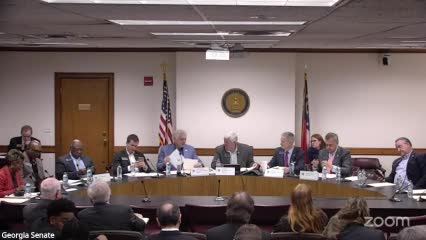
Georgia committee hears debate on licensing radiologist assistants; bill tabled for revisions
Summary
The Senate Regulated Industries and Utilities Committee took testimony on House Bill 571 on Oct. 12, 2025, a measure that would create a state licensure pathway for radiologist assistants and set a July 1, 2025, effective date; after more than two hours of questions and testimony the committee voted to table the bill to allow sponsors and stakeholders to revise language.
The Senate Regulated Industries and Utilities Committee took testimony on House Bill 571 on Oct. 12, 2025, a measure that would create a state licensure pathway for radiologist assistants and set a July 1, 2025, effective date; after more than two hours of questions and testimony the committee voted to table the bill to allow sponsors and stakeholders to revise language.
The measure would add an article to state code authorizing the Composite Medical Board to license radiologist assistants, define permissible procedures and supervision levels, and create an advisory group to help the board set scope and protocols. Supporters said licensure would give hospitals confidence to hire assistants, expand a midlevel career path for radiologic technologists, and speed access to diagnostic procedures. Opponents and several committee members said the bill’s timing and supervision language could limit access in rural areas.
Becky Ryals, representing the Georgia Radiological Society and the Georgia Society for Radiologic Technologists, said the board concluded licensure was appropriate because radiologist assistants complete radiologic technologist training plus an additional two years of education and clinical training. “The composite medical board felt that their training was commiserate with other mid levels in Georgia,” Ryals said, describing how a protocol agreement would match an assistant’s documented competencies to the supervising radiologist’s specialty.
Dr. Bill Harrington, retired radiologist and former leader at the American College of Radiology, told the committee the role provides an upward career path for technologists and helps address workforce shortages. “If you’re a radiologic technologist…there’s no place to go,” Harrington said. He noted that Medicare and CMS created billing codes that place radiologist assistants within existing midlevel payment frameworks, but that federal and state administrative steps remain.
Dr. Ali Sheikh, medical director of radiology at Houston Medical Center and other regional hospitals, urged broader allowance for general supervision in order to preserve after-hours access in rural hospitals. “This bill in its current form is very restrictive and will be detrimental to the citizens of Houston County and the surrounding counties that we service,” Sheikh said, adding that his practice’s radiology assistant had performed more than 2,500 minor invasive procedures under general supervision without safety concerns.
Committee members asked whether current, practicing radiologist assistants in Georgia already meet the bill’s proposed qualifications. Ryals said fewer than 100 radiologist assistants currently practice in the state and that most have the registry credential from the American Registry of Radiologic Technologists (ARRT). Committee members pressed the sponsor about the bill’s July 1, 2025, effective date and whether the Composite Medical Board and its advisory group could form and process dozens of initial license applications in the time allotted; supporters said they believed the board and stakeholders could meet the timetable but acknowledged the timeline is tight.
Several senators also questioned language that would allow the board discretion to issue licenses even where applicants meet listed qualifications; one member flagged that the bill uses “may issue” where members expected a mandatory (“shall”) issuance when statutorily qualified. Supporters said the “may” language preserves the board’s authority to deny licensure for conduct-based reasons.
After testimony and amendments were discussed, a majority of committee members voted to table House Bill 571 so the sponsor and interested parties could negotiate changes, including proposed amendments to permit more procedures under general supervision, to adjust the effective date, and to refine licensure issuance language. The committee asked sponsors to circulate revised language quickly for possible action at the next meeting.
If revised language returns to the committee, sponsors and medical-board representatives said they would focus on: (1) explicit definitions of personal/direct/general supervision aligned with CMS guidance; (2) a phased approach to scope expansion tied to case logs and board protocols; and (3) clarifying licensure issuance criteria and the role of the advisory group.
The committee did not vote on final passage; the action taken was to table the bill for further drafting and stakeholder negotiation.