Get Full Government Meeting Transcripts, Videos, & Alerts Forever!
Get email alerts on the School Safety topic
No spam. Unsubscribe anytime.
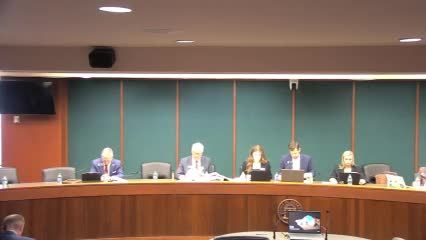
Senate Judiciary committee advances substitute to school-safety bill after removing student "threat" database and mandatory threat teams
Summary
The Senate Judiciary Committee voted unanimously to pass a committee substitute for House Bill 268 that trims contested provisions from the House version and adds a package of safety, training and records-transfer requirements intended to speed law-enforcement response and early intervention in potential school violence.
The Senate Judiciary Committee on an unanimous voice vote advanced a committee substitute for House Bill 268, a wide-ranging school-safety measure that its backers described as a compromise worked out between the House and Senate.
The substitute removes two provisions that drew the most public opposition — an S3-style central threats database and a mandate for threat-management teams in every school — and keeps a mix of infrastructure, training and records reforms intended to help identify and respond to students at risk of violence.
Sponsor and House presenter Rep. Holt Persinger and committee lead Chairman Kauser told senators the substitute reflects work across chambers and stakeholders. "We believe that this final product is an agreed upon, solution from both bodies," Kauser said during his summary.
Why it matters: supporters said the bill combines physical safety steps with mental-health and information-sharing practices that aim to give first responders and school staff timely, usable information while addressing parents' privacy concerns.
What the substitute does: the bill requires standardized digital school mapping developed under GEMA (the Georgia Emergency Management and Homeland Security Agency) so first responders can locate entries, classrooms, stairwells and critical equipment quickly during an incident. It also authorizes an emergency notification system for schools and requires quicker transfer of education records when a student enrolls in a new school: the bill requires the prior school to transfer a student's education record and any Individualized Education Program (IEP) "within five business days" of notice.
The substitute specifies the contents of those transferred records, including academic transcripts, attendance, disciplinary records (suspensions, expulsions), notices of criminal actions or adjudications for serious delinquent conduct, chronic disciplinary problems, behavioral-correction plans and psychological evaluations where applicable. The bill also directs that records subject to federal protections (for example, education and health records governed by the Individuals with Disabilities Education Act and federal privacy law) be handled consistent with those laws and requires a chief privacy officer to advise on compliance.
Mental-health and training measures include a state-funded student advocacy specialist for each school system (staffing scaled: one specialist for systems under 18,000 students; two for 18,000–36,000; three or more for systems above 36,000 students, with local boards permitted to fund additional positions). The substitute requires two hours of student behavioral-health awareness training for school personnel and two hours per student annually: one hour of suicide awareness and prevention and one hour of youth-based violence prevention, including instruction on observable signs and how to report concerns.
The bill also requires local boards to operate a 24/7 anonymous reporting system that can be accessed via a mobile app or crisis center staffing; anonymous reports must be forwarded promptly to the appropriate school-based team. A separate provision directs law-enforcement officers to submit written reports to school officials of official encounters with school-age youth that may occur off campus so schools can be aware of off-campus incidents that may signal risk; the bill text in committee did not state a single, precise age range for that requirement.
The substitute retains tougher penalties for terroristic threats directed at schools. The presentation described threat-making that causes evacuations or seeks to terrorize school populations as punishable at enhanced levels; the sponsor’s summary said such conduct can be a felony with penalties that can include fines of up to $1,000 and imprisonment of one to five years in the circumstances described in committee testimony.
Dissent and changes: committee members and the sponsor said the S3-style database and mandatory behavioral-threat-assessment teams were removed after parents and other testifiers raised privacy and due-process concerns, including whether records would be permanent or rotatable. Several senators said they supported retaining voluntary threat-assessment practice and GEMA training but opposed a compulsory statewide database that would track students’ prior noncriminal behavior.
Procedure and next steps: Senator Steele moved the committee substitute; the pro tempore seconded. "All those in favor of the motion, please raise your hand. It is unanimous," the chair said after the vote. The bill now moves on for consideration by the full Senate.
Ending: supporters said the substitute is designed to strike a balance between protecting student privacy and giving schools and first responders better tools; opponents who raised privacy and process concerns argued the removed database and mandatory threat teams deserved more careful study before becoming law.