Get Full Government Meeting Transcripts, Videos, & Alerts Forever!
Get email alerts on the Prosthetics Coverage topic
No spam. Unsubscribe anytime.
Senate committee hears bill to require private insurers to cover secondary prosthetics, orthotics
Summary
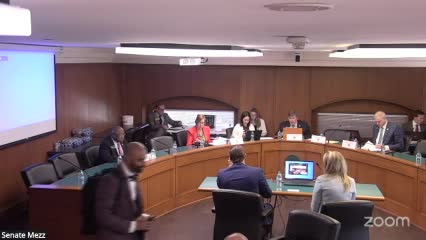
The Senate Insurance and Labor Committee held a hearing on House Bill 87, introduced by Representative David Clark, to require private health insurers to cover orthotic and prosthetic devices used to support basic activities such as bathing, toileting, exercising and walking.
The Senate Insurance and Labor Committee held a hearing on House Bill 87, introduced by Representative David Clark, to require private health insurers to cover orthotic and prosthetic devices used to support basic activities such as bathing, toileting, exercising and walking.
Representative David Clark said the bill “will make life better for Georgians with limb loss or limb differences” and described constituent cases, including a six‑year‑old named Elliot, whose family raised the need for coverage of a running prosthesis and an everyday prosthesis.
Clark said the change is not intended to create a new state program but to require private insurers to provide coverage when a device is “medically necessary” and prescribed in line with the bill’s definitions. He said insurers and advocates negotiated language and that some items (a state plan and Medicaid coverage) were carved out in the substitute: “We just removed the state health care benefits…so this is just covering with insurance companies,” he said.
The bill text shown to the committee sets an effective test for covered policies: “All health benefit policies renewed or issued after 01/01/2026 shall include coverage for orthotic devices and prosthetic devices that are medically necessary for” enumerated activities of daily living, a committee member read aloud during the hearing.
Rachel Oyer, who identified herself as representing the Georgia Society of Orthotists and Prosthetists and as team lead for the So Everybody Can Move initiative, told the committee that current policy language has allowed denials when providers list the activity a device will enable. Oyer said the proposed language would permit orthotists and prosthetists, working with a referring physician, to document activities of daily living as part of medical necessity determinations. “Currently, prosthetist and orthotist cannot list any activity that a patient would use the device for, or it would be denied as deemed not medically necessary,” she said.
Committee members pressed for cost figures. Oyer and advocates gave ranges from examples in testimony: a running blade for a child was described in testimony as billed to insurance at $70,000; advocates estimated more routine secondary devices (for example a “shower leg”) at roughly $2,000. Oyer told the committee the change would be a frequency (low‑utilization) benefit and insurers retained the right to deny claims that do not meet medical necessity.
Abigail Thompson Garcia, director of government relations and advocacy for the Shepherd Center, said the hospital supports the bill as a measure that will “allow patients who have limb loss to participate in their community” and noted the bill contains coverage limits, reporting requirements and data collection provisions to constrain fiscal exposure.
Several committee members asked whether the bill would cover state employees or people on Medicaid. The chair read a carve‑out (lines 16–25) and a staff member confirmed that, under the current substitute, the State Health Benefit Plan and Medicaid are not included. Representative Clark said discussions on that exclusion are ongoing.
No formal motion or vote took place. The committee operated as a hearing only because a quorum was not present; members stated the intent to limit testimony to move through the four bills on the agenda.
Ending: The hearing on HB 87 concluded without a committee vote. Sponsors and proponents said they will continue negotiations on precise definitions of medical necessity and on whether to extend coverage to state plans and Medicaid in later drafts.