
Manatee County holds second public workshop on extraordinary‑circumstances impact‑fee report
Get AI-powered insights, summaries, and transcripts
Subscribe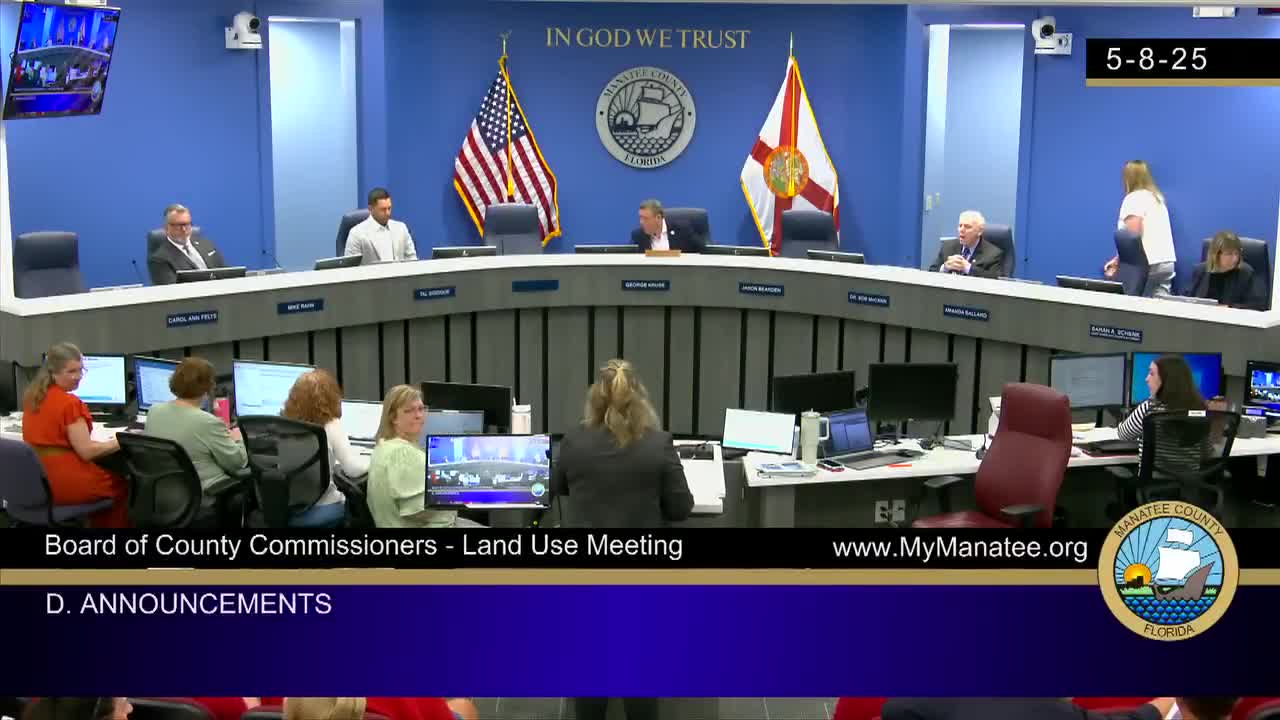
Summary
County staff and consultant presented data they say could justify exceeding Florida'—0% statutory cap on impact‑fee increases; workshop drew limited public comment and no formal vote.
Manatee County held the second of two statutorily required public workshops on May 8 to present a supplemental report arguing "extraordinary circumstances" exist that would allow the county to exceed the 50% statutory cap on impact‑fee increases. Nicole Knapp, director of Development Services, said the workshop was narrowly focused on the extraordinary‑circumstances report and that the formal fee update will be presented later at Planning Commission and board hearings in May and June.
Benesch consultant Niegenkamp (presented as "Neigenkamp") told the board the county's last full impact‑fee update was in 2015 and that rapid population growth and sharp construction‑cost inflation since then are driving the analysis. "This study''is to reflect the most current data and potentially exceed the 50% limit," Neigenkamp said during the presentation. He showed county permitting and cost indices that, he said, indicate residential permitting and per‑lane transportation costs are substantially higher than used in the prior study.
Neigenkamp''s slides estimated a gap between identified road projects and currently available revenue, and showed modeled increases in calculated, unconstrained fee levels across transportation, law enforcement, parks and libraries. Knapp reminded the public the fee update itself will be considered separately at upcoming Planning Commission and Board of County Commissioners meetings and that the adopted fee schedule would become effective later in the year if approved.
Public comment at the workshop was brief. One caller thanked county staff for recent stormwater work; another area resident said he appreciated the county's communication about a drainage project. No formal action was taken; the workshop satisfied the Florida statute's public‑workshop requirement that precedes any request to exceed the statutory phased cap.
The county will continue the impact‑fee process with presentations to the Planning Commission and the Board (first reading May 22, second reading June 5, per staff). The fiscal and legal threshold to exceed the cap requires later formal findings and a two‑thirds vote of the governing body.