Get Full Government Meeting Transcripts, Videos, & Alerts Forever!
Get email alerts on the Child Friendly City topic
No spam. Unsubscribe anytime.
Students’ ‘child‑friendly La Mesa’ resource map prompts council to form ad hoc committee to study youth engagement
Summary
Student presenters from San Diego State and the La Mesa Hope Alliance showed a youth resource map and urged institutionalizing youth input; council agreed to create an ad hoc committee to study how to sustain and scale the work and to consider placing the resource map on the city website.
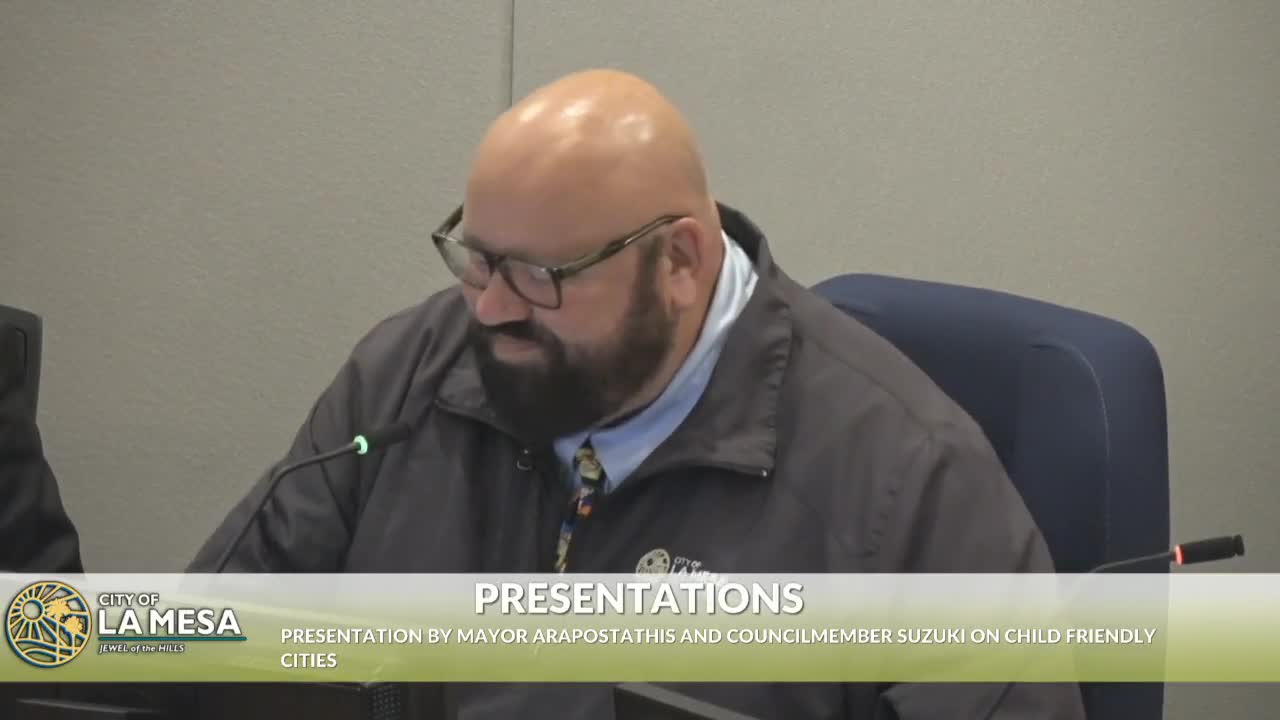
Student researchers and local volunteers presented a “child‑friendly La Mesa” initiative and a public resource map at the May 13 La Mesa City Council meeting, and the council voted to form an ad hoc committee to investigate next steps and report back.
What was presented Students from San Diego State University and members of the La Mesa Hope Alliance described the Young People's Environment, Society, and Space Research Center’s semester project: a searchable resource map with nearly 200 community resources, filters by category and service, and user submission and gap surveys. Presenters — identified as Violet Navarette, Athena Eubanks and Chance Kernan — said the tool was designed to make services visible, to collect feedback, and to help include youth voice in municipal planning. “Every child deserves to grow up in a community where they feel safe, healthy, and like they belong,” Violet Navarette told the council.
Council response and motion Councilmembers praised the students’ work and asked staff to consider how the city could host and sustain the online map. To pursue the idea more deliberately, council approved an ad hoc committee to investigate next steps; the committee will be comprised of the councilmember proposers (the mayor and Councilmember Suzuki were identified by speakers as leading this effort) and will report back to the council with recommendations for maintaining the resource map, expanding youth participation and assessing existing youth engagement platforms such as the youth advisory commission.
Why it matters Presenters argued the city already has many services for young people but lacks a coordinated, data‑driven approach that centers youth in planning and service delivery. The resource map and self‑assessment tools were offered as practical first steps; presenters asked the council to host the map on the city website and to assess institutional ways for youth to participate in decision‑making.
Next steps The ad hoc committee will inventory existing youth platforms, evaluate hosting the SDSU‑created resource map on the city website, and recommend ways to maintain the database (students said SDSU could host during semester work and Hope Alliance has offered to manage the resource inputs). Council direction included exploring UNICEF child‑friendly city resources and best practices where appropriate while preserving oversight and local control.