Get Full Government Meeting Transcripts, Videos, & Alerts Forever!
Get email alerts on the Parkways And Infrastructure topic
No spam. Unsubscribe anytime.
City Council upholds denial of appeals; Palm Avenue infrastructure project to proceed with 13 tree removals
Summary
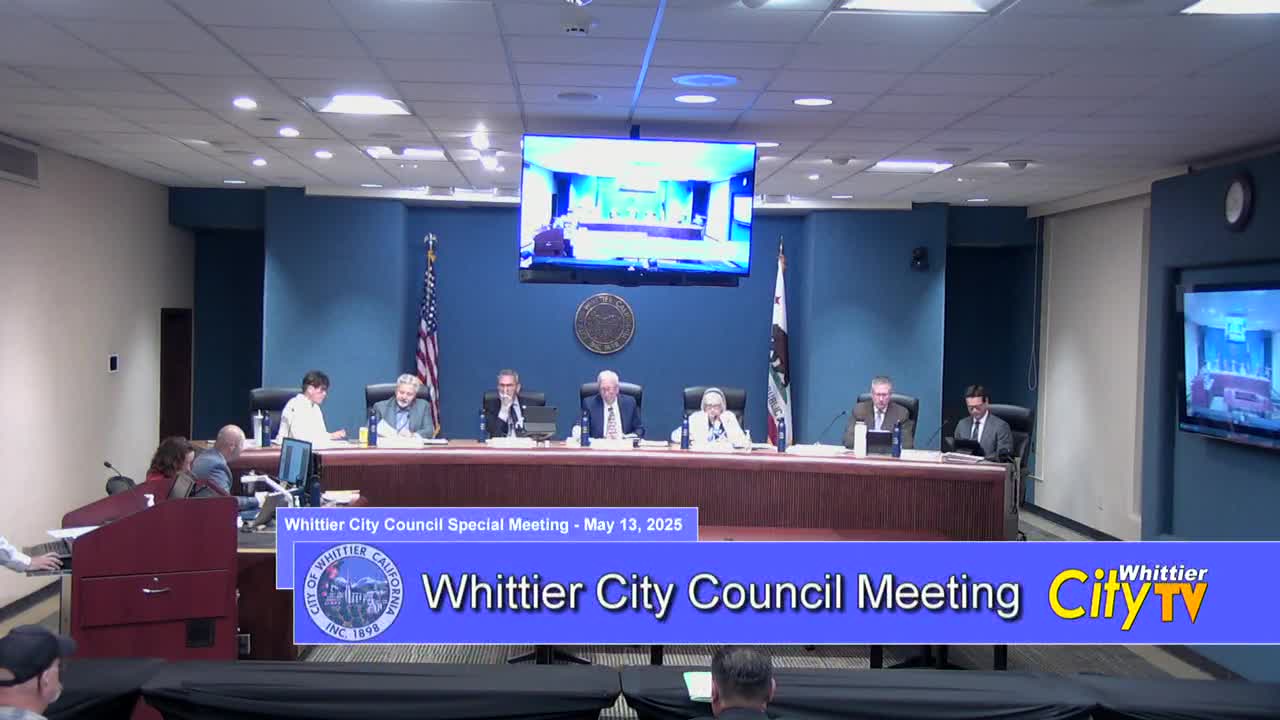
The Whittier City Council on May 13 upheld the Parks and Recreation Commission’s denial of appeals against removing 13 Aleppo pines as part of the Palm Avenue infrastructure improvement project, allowing construction work adjacent to those trees to proceed.
The Whittier City Council on May 13 upheld the Parks and Recreation Commission’s denial of appeals against removing 13 Aleppo pines as part of the Palm Avenue infrastructure improvement project, allowing construction work adjacent to those trees to proceed.
The decision matters because the project—awarded last year and described by staff as a roughly one‑mile reconstruction to replace water and sewer mains, concrete pavement, curb, gutter and sidewalks—has been paused where it conflicts with mature parkway trees. City staff and a contracted tree risk assessor told the council that root pruning and reconstruction next to the trees would likely destabilize several large specimens.
City staff described the project timeline and the current hold on work near the flagged trees. “Right now today, the project is on hold,” David Montgomery Scott told the council as he summarized the technical findings and the city’s procedural steps. Scott said a contracted, tree‑risk–assessment‑qualified arborist inspected 11 trees and the city arborist concurred and identified three additional trees of concern. The arborists rated those trees’ likelihood of structural failure as moderate to high if the work proceeds without removal or other limiting measures. Scott summarized the arborists’ assessment of target zones: “Pedestrians are indicated to be on the street infrequently; cars frequently; homes are a constant.”
Residents who live on or near Palm Avenue urged the council to save the Aleppo pines. Connie McCormick, one of two appellants who filed tree appeals, said the trees are “part of our urban forest, an integral part of our city’s infrastructure,” and argued that mitigation options should be explored on a per‑tree basis.
City engineers and the contractor described the physical conflicts the work poses. City Public Works staff explained curb, driveway and sidewalk elevations and drainage must meet Americans with Disabilities Act requirements and standard street grades; meeting those standards requires removing existing concrete and, in many locations, cutting or shaving roots to place new subgrade and pavement. Public Works Director Kyle Keesen said the contractor had already trench‑cut the street to replace water and sewer mains and encountered roots in multiple locations.
Arborists gave technical reasons for removal. The contracted arborist, a Tree‑Risk Assessment Qualified professional, and the city arborist cited dieback, trunk and root decay, trunk cavities and significant lean in several trees; they also noted that many trees were planted in the 1940s and now measure roughly 80 feet in height with trunk diameters up to four to four‑and‑a‑half feet. Scott said those conditions made the trees more vulnerable if roots were cut or the surrounding hardscape removed.
Council members questioned mitigation alternatives and replacement planting. Staff said the Parkway Tree Manual requires replacement planting when a parkway tree is removed and that the contractor will be required to plant replacement trees; the manual’s minimum is a 15‑gallon replacement tree. Staff said replacement plantings will be completed before final project sign‑off and that the project team recommends species with lower mature height (for example, Monterey pine or similar) where appropriate.
The Parks and Recreation Commission had heard the appeals and voted unanimously to deny them; appellants challenged the commission’s procedure for handling the appeals together, an objection that staff and the city attorney said was permitted by the body’s rules and by Robert’s Rules‑style parliamentary practice. After questions and extended public comment the council member moved to uphold the commission decision. The roll call recorded unanimous approval: Council member Warner — yes; Council member Pacheco — yes; Council member Dutra — yes; Mayor Pro Tem Martinez — yes; Mayor Vinatieri — yes.
Council members said they did not relish losing mature trees but prioritized safety and completing longstanding infrastructure work. Councilmember Dutra said the choice was “difficult” but noted the public safety record of tree failures and prior incidents citywide. Councilmember Pacheco and Mayor Pro Tem Martinez both said recent local tree failures and the technical assessments persuaded them that removal was the responsible option where arborists documented decay or likely failure.
Project status and next steps: staff said Big Bend Engineering, the construction contractor, had to demobilize crews while the appeal process proceeded and that final street reconstruction would resume quickly after the council decision; staff estimated the contractor could remobilize and complete the remaining curb, gutter and asphalt work within weeks after trees are removed and the city signs off on the replaced infrastructure. Replacement trees will be planted as required by the Parkway Tree Manual as part of final acceptance.
The council vote ends the current administrative appeals on those 10 appealed trees (10 appealed plus three additional trees identified by staff for a total of 13). It does not change the city’s Parkway Tree Manual or other policies governing parkway trees; several council members suggested the manual could be reviewed in a future study session to clarify appeal procedures and mitigation options. The council directed staff to return to regular project construction and to ensure replacement planting occurs under contract terms.
The council’s decision closes the appeal, allowing the project to move forward in areas where tree‑related work is required; residents who opposed removals said they would continue to press for more tree‑friendly engineering where feasible.