Get Full Government Meeting Transcripts, Videos, & Alerts Forever!
Get email alerts on the Historic Preservation topic
No spam. Unsubscribe anytime.
Council OKs $135,292 from Historic Preservation Trust Fund for district signs, plaques and future surveys
Summary
Riverside Council voted unanimously to spend $135,292 from the Historic Preservation Trust Fund on intersection-mounted historic-district signage, 18 landmark plaques and seed money for future district surveys.
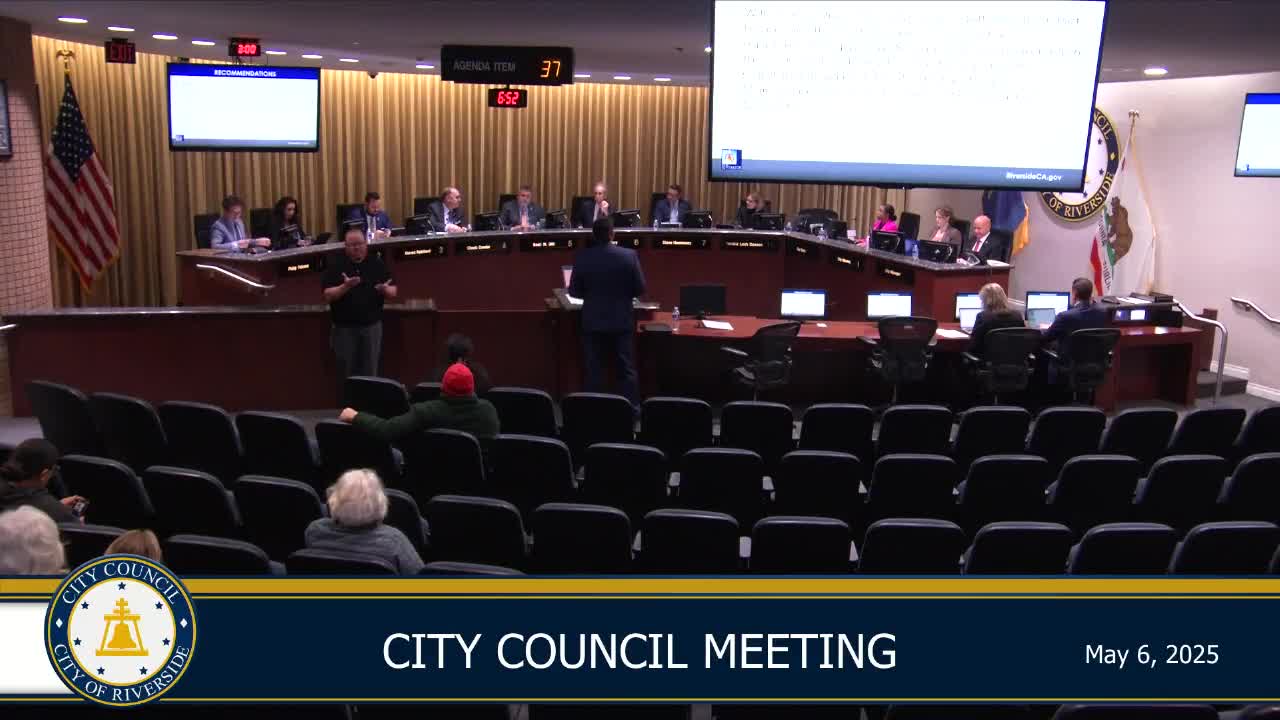
Riverside City Council approved a plan Tuesday to spend roughly $135,292 from the Historic Preservation Trust Fund to update the city’s historic-district signage, issue landmark plaques and reserve funds for future district surveys.
Scott Watson, the city’s historic preservation officer, said the program will mount historic-district markers atop existing intersection signs throughout each district, rather than only marking district boundaries. Staff proposed four design variants tied to the city’s major architectural periods; staff and the Culture Heritage Board will match a design to each district. The council also approved $35,000 to purchase an estimated 18 landmark plaques that property owners may install (owners handle installation costs), and roughly $25,000 to $30,000 in reserve funding for a future historic district survey when a nomination is active.
The Historic Preservation Trust Fund was seeded years ago and contains the remaining balance after earlier expenditures; city staff said council previously directed that no general-fund dollars be used and that grant fundraising is an option for future needs. The Cultural Heritage Board and community volunteers supported the plan; a public commenter who said she recently moved to Riverside urged the council to proceed, noting the signage helps visitors and prospective residents appreciate the city’s historic neighborhoods.
Council members said the program fills a longstanding gap: many residents do not realize they live in a historic district because boundary signs are infrequent. Council voted unanimously to approve the program, record necessary supplemental appropriations, and direct staff to prepare a municipal-code amendment to remove the now-orphaned fund language from the municipal code.