Get Full Government Meeting Transcripts, Videos, & Alerts Forever!
Get email alerts on the Open Government topic
No spam. Unsubscribe anytime.
Council approves changes to Riverside ‘Sunshine Ordinance’ to differentiate policy and advisory bodies
Summary
City Council voted to amend Riverside’s Sunshine Ordinance to clarify which boards must follow a 12-day agenda notice and which advisory bodies may follow the Brown Act’s 72‑hour notice. The ordinance also narrows the 2/3 excusal process and lists ceremonial and certain closed-session matters as exceptions.
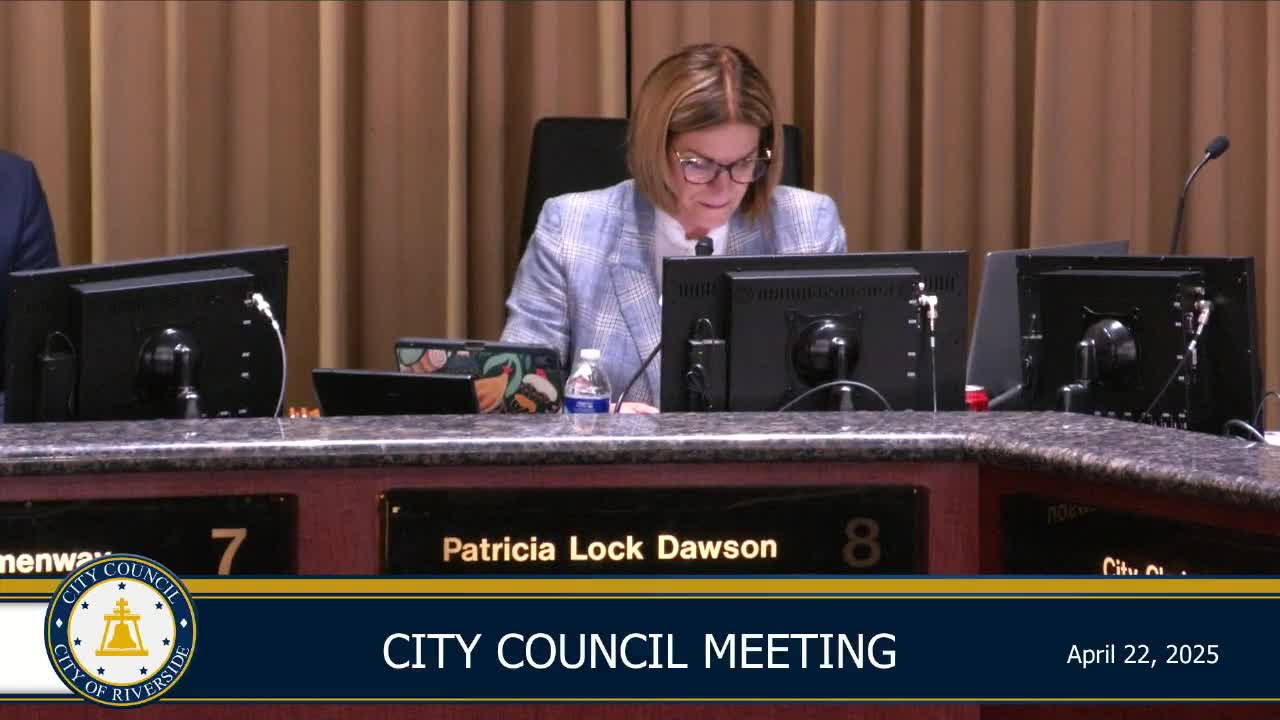
The Riverside City Council voted April 22 to amend the city’s Sunshine Ordinance, clarifying notice requirements for different types of local bodies and creating narrower rules for when the 12‑day agenda posting requirement may be waived.
The ordinance, introduced by staff and recommended by the Governmental Processes Committee, distinguishes “policy bodies” — including the City Council, Planning Commission, Board of Public Utilities, Charter Review Commission and Community Police Review Commission — from advisory boards and commissions. Policy bodies will continue to follow the existing 12‑day agenda posting requirement; advisory bodies will generally follow the Brown Act’s shorter notice requirements unless the council determines otherwise.
Ruth Ann Solera, senior deputy city attorney, told the council that the Sunshine Ordinance (Title 4 of the municipal code) had expanded the Brown Act’s baseline rules in 2015 and 2017 but that some language had created administrative confusion. The city clerk and city attorney presented proposed revisions that staff said would streamline agenda publishing while preserving transparency. Proposed clarifications include:
• A clearer definition separating “policy bodies” from advisory bodies so the public understands which entities must follow the longer posting window.
• A process that maintains the 12‑day rule for policy bodies but allows advisory bodies to post agendas on the Brown Act timetable unless staff or council determine a longer notice is needed.
• Reclassification of ceremonial presentations and technical software/hardware impairments as exceptions to the 12‑day posting rule so they do not require a two‑thirds vote to add to an agenda.
• Expansion of exceptions to include closed-session matters authorized by the Brown Act (for example, labor negotiations, public-employee appointment/discipline, real property negotiations), while preserving the 72‑hour minimum posting where required.
City Clerk staff explained the administrative burden on boards that meet monthly; under the prior rule, agendas and backup materials had to be finalized far earlier than some commissions’ calendars allowed, delaying follow-up requests until subsequent meetings. Council members pressed staff about whether a middle ground — such as a five‑day posting for advisory bodies — might be safer; one caller from the public suggested three business days as an alternative. Councilmembers asked staff to return with a six‑month review of the updated ordinance to evaluate its effect on transparency and administrative workload.
The council voted unanimously to adopt the ordinance revisions and instructed staff to bring the changes back to the Governmental Processes Committee as they are implemented. Several councilmembers said the revisions balance transparency with operational efficiency and urged continued public notice and outreach.
The revisions take effect as ordinance changes to Chapter 4.05 of the Riverside Municipal Code, and staff will implement updated posting procedures and produce guidance for boards and commissions.