Get Full Government Meeting Transcripts, Videos, & Alerts Forever!
Get email alerts on the Financial Health Indicators topic
No spam. Unsubscribe anytime.
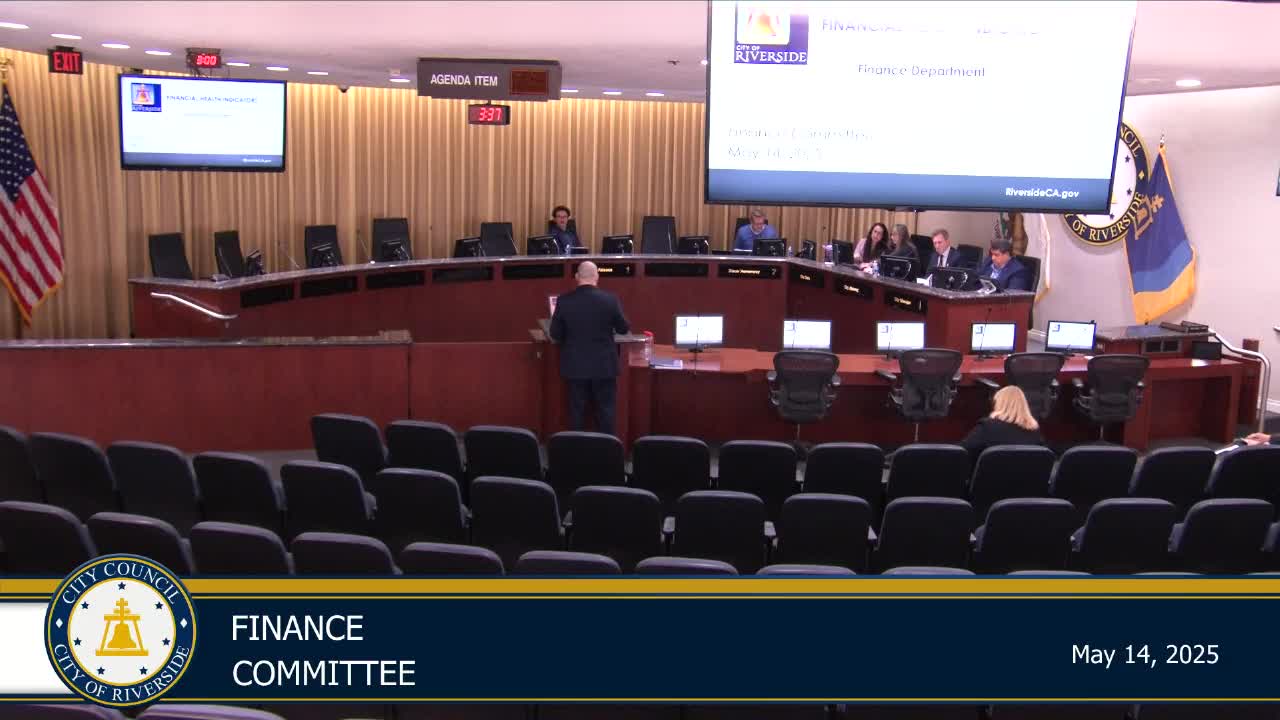
Finance committee recommends city council receive financial health indicators report
Summary
Staff presented 11 financial indicators using audited FY2023–24 data. Committee discussed comparability across peer cities, the role of fee updates and median income benchmarks; a motion was made to forward the report to city council.
City staff presented the Finance Committee with a package of financial health indicators May 14 intended to spot early signs of fiscal stress and inform budget decisions. Ryan Carter, the city controller, framed 11 measures across three questions: can the city pay its bills now, can revenues cover expenses, and can the city pay bills in the future.
Carter said the indicators use audited financial data through June 30, 2024, and compare Riverside with a market basket of full-service cities. “These indicators reflect fiscal year 2024 data and should be viewed as one lens among many for evaluating our financial condition and does not give an overall grade,” Carter said.
Key takeaways presented: Riverside’s general fund reserve ratio was described as strong at about 36%—well above the Government Finance Officers Association recommendation of roughly 17% (about two months of revenues). Carter said the city’s general fund liquidity and other short-term measures show a positive trend, while the city’s operating margin indicated roughly 25% of governmental activity expenses were covered by program revenues (charges, fees and grants). The report noted prior one-time federal grants (CARES, emergency rental assistance, ARPA) elevated grant‑based revenue recognition in earlier years and that those grants have largely subsided.
Discussion and public comment: Caller Jason Hunter, Ward 1, criticized the chosen peer basket and urged inclusion of median income adjustments and comparisons to more locally situated jurisdictions. Council member Falcone and Chair Hemingway asked staff to consider a median‑income component and to provide plain‑language benchmarks that non‑specialist residents can understand; Carter agreed to explore adding median income comparisons and clearer normative benchmarks for future reports.
Action: Council member Falcone moved to forward staff’s recommendation—that the city council receive and file the financial health indicators—and the motion was seconded; the committee recorded the motion for forwarding to the full city council.
Context: The indicators are informational and staff asked the committee to use them alongside budget documents and other financial analyses. Carter noted one widely cited benchmark—the GFOA reserve recommendation—was included because most measures lack a universal industry ‘‘good’’ value and are best interpreted in context and over time.
Next steps: Staff said they will consider adding median-income adjustments and clearer benchmarks in future iterations, and the committee will forward the report to the city council for receipt and filing.