Get Full Government Meeting Transcripts, Videos, & Alerts Forever!
Get email alerts on the Municipal Finance topic
No spam. Unsubscribe anytime.
Riverside Council extends utility credit line to preserve RPU ratings, avoid higher borrowing costs
Summary
City Council approved a three-year, three-month extension to revolving credit agreements for Riverside Public Utilities’ water and electric systems, keeping commitment fees unchanged and citing credit-rating and emergency liquidity benefits.
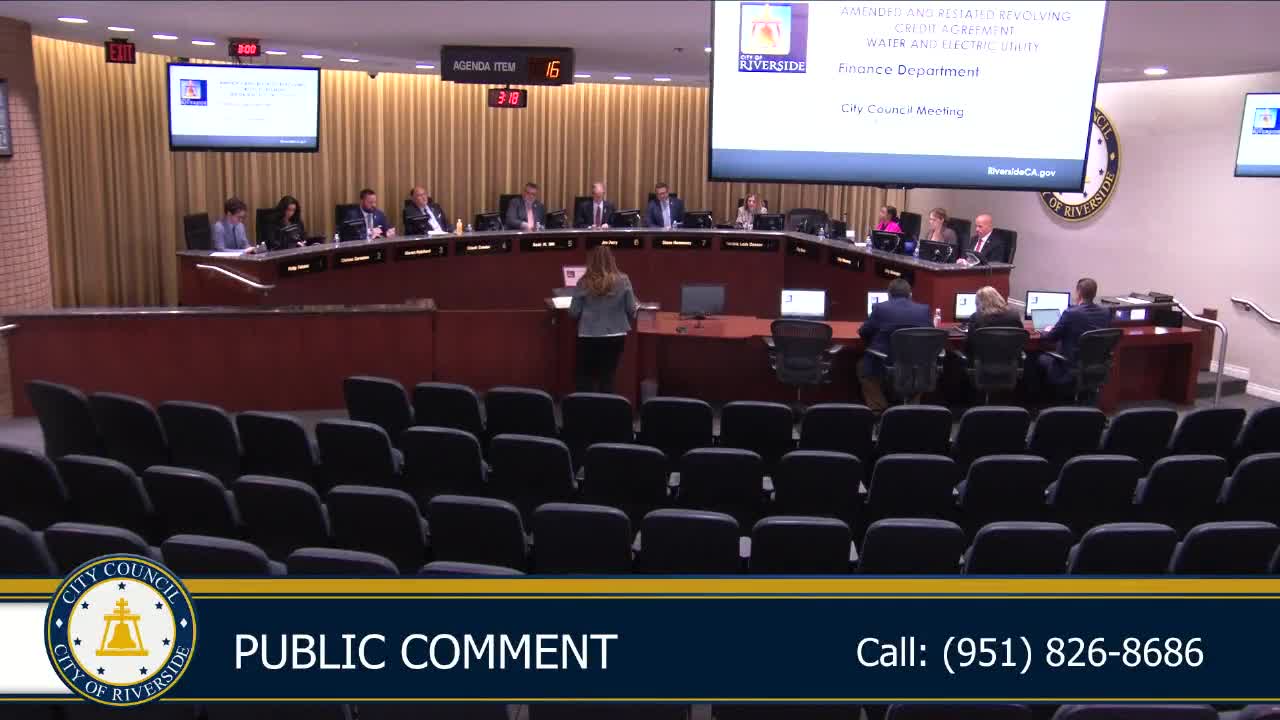
Riverside City Council on Tuesday approved an amendment to extend the city’s revolving credit agreement for its water and electric utilities, a move staff said will help the utilities maintain credit ratings and provide short-term emergency liquidity.
City staff said the agreements, which cover a $35 million electric facility and a $25 million water facility, will be extended for three years and three months with no change to the 20-basis-point commitment fee. The extensions tie the line of credit to the term SOFR index and keep U.S. Bank as the credit provider. "There are no current plans to draw on the [lines of credit], but it is available for emergencies," city staff said during the presentation.
The extension is intended to align with Riverside Public Utilities’ (RPU) cash reserve policies and to support the utilities’ current ratings, which staff said keep long-term borrowing costs lower. Malini Carranza, a staff member with the city who presented the item, said the financing team expects the three-year, three-month extension to cost $413,500 in financing charges rolled into an effective interest cost of roughly 0.21 percent. She told the council that RPU’s 10-year capital program totals about $800 million and that each basis point of increased borrowing cost could add roughly $80,000–$90,000 per $100 million borrowed.
Public comment raised questions about the need for a credit facility for the electric utility. Jason Hunter, a Ward 1 resident, urged the council to reconsider the electric line, saying the utility has substantial reserves and describing earlier staff statements about ratings as overstated. City staff and RPU representatives responded that the facility acts as a buffer and that maintaining it is considered credit-positive by rating agencies.
Council members asked about scenarios that would trigger draws on the facility and about the Board of Public Utilities’ review. Edward Rinkes, assistant manager with RPU, said the line is used as a short-term buffer when cash-on-hand falls toward policy minima and that it has not been drawn historically; Rafael Guzman, assistant city manager, said the Board of Public Utilities gave a unanimous recommendation but had procedural concerns about the timing of reports.
The council voted unanimously to adopt the resolution and authorize necessary signatories. The authorization allows the city manager and other dually authorized officials to execute the transaction documents and to retain the city’s financing team and outside counsel to complete the extension.