Get Full Government Meeting Transcripts, Videos, & Alerts Forever!
Get email alerts on the Sports Stadium Financing topic
No spam. Unsubscribe anytime.
Lawmakers hear bill to divert incremental player income taxes for Portland MLB stadium; opponents warn of risky precedent
Summary
The Oregon House Committee on Revenue on May 15 took public testimony on Senate Bill 110A, which would update a 2003 law to allow a 30‑year diversion of incremental personal income taxes from certain Major League Baseball payrolls into a stadium grant fund and raise program caps to reflect modern costs.
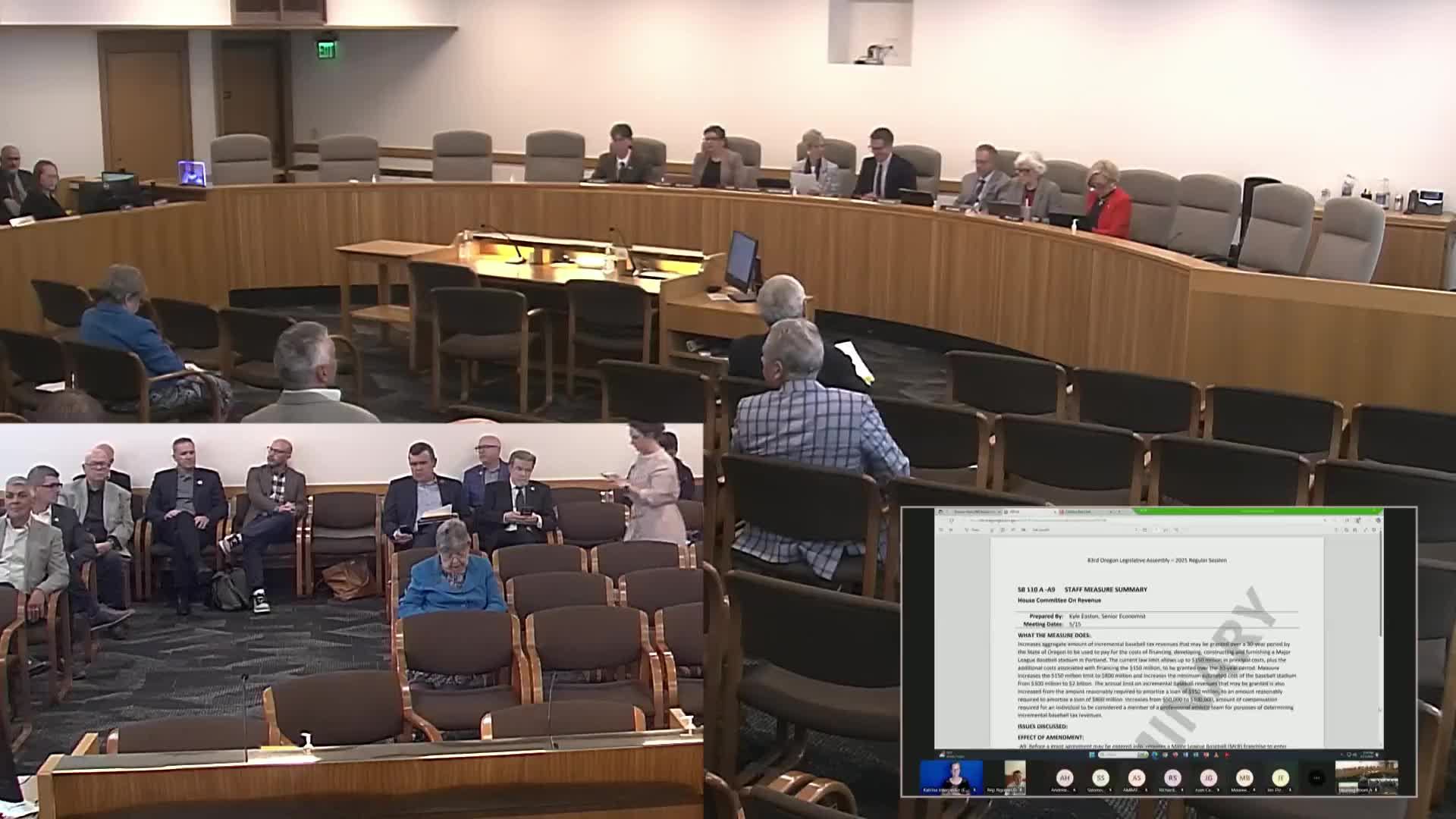
The Oregon House Committee on Revenue held a lengthy public hearing May 15 on Senate Bill 110A, a measure that would modernize a 2003 statute (Senate Bill 5) to enable a Major League Baseball franchise and private developers to use a 30‑year diversion of incremental personal income taxes from high‑paid team employees to finance construction of a stadium in Portland.
Senator Mark Meek, chair of the Senate Finance and Revenue Committee, urged passage and described the bill as a way to secure a Major League Baseball franchise and the “enormous economic and cultural benefits that will come with it.” Meek said the bill would not raise taxes or obligate the state’s general fund; instead, it would allow DAS, with approval of the state treasurer, to enter into grant agreements that divert incremental personal income tax receipts tied to MLB payrolls into a Major League Stadium Grant Fund for up to 30 years.
Key technical changes in SB 110A described during testimony include increasing the maximum principal tied to the program from $150 million (under the 2003 law) to $800 million; raising the minimum stadium cost threshold from $300 million to $2 billion; and increasing the payroll threshold that qualifies team personnel for the incremental-tax pool from $50,000 to $100,000. Proponents said those upward adjustments reflect inflation, higher team payrolls, and modern stadium costs.
“Private capital carries the risk and the public receives the benefits,” Sen. Meek said, describing the proposed financing as privately secured with no repayment obligation for the state. Supporters and presenters—including Garren Royer for the Portland Diamond Project and business and labor groups—argued the package would catalyze private investment, create construction and permanent jobs, and generate new recurring revenue that would flow back to the state after the 30‑year diversion sunsets.
Several witnesses estimated substantial economic activity tied to an MLB franchise; one presenter cited independent studies that project as much as $5 billion in economic activity annually from a team and associated development, and some supporters argued the state could eventually collect $90 million to $100 million annually in taxes once diverted bonds are repaid.
Opponents and several policy economists testified that stadium subsidies have a weak record of delivering net public economic benefits. Jules Boykoff, professor of political science, summarized academic reviews concluding that “the large subsidies commonly devoted to constructing professional sports venues are not justified as worthwhile public investments.” Tax Fairness Oregon and independent economists warned the bill sets a precedent that other teams or industries could seek to replicate, shifting general fund revenues and state services over long periods.
Senator Jeff Golden pressed for a dash-A9 amendment that would require the MLB franchise to enter a perpetual revenue‑sharing agreement paying 1% of the team’s gross revenue to the state general fund; Golden said the A‑9 amendment would return a modest share of long‑term upside to taxpayers. Proponents cautioned that a perpetual gross‑revenue share could undercut the financing model and erode the economic signal the state seeks to send to MLB.
DAS, the state treasurer’s office, and debt management staff answered questions about oversight. Jaime Alvarez, director of debt management for the Oregon State Treasury, said Treasury would examine technical terms in any agreement and ensure no pledge of state revenues beyond what the statute allows. Alvarez said the state’s role is to confirm the terms prescribed in the bill are met in any agreement, and to avoid obligations “outside of what is prescribed within the bill.”
Committee members raised questions about due diligence standards, how payroll and contractor/consultant compensation would be counted for the incremental‑tax pool, the payback period and risk if a team were to stop operating, and the sufficiency of oversight language in the statute. Garren Royer, representing the Diamond Project, walked the committee through the bill’s six activation steps: a city request, a 30‑year team commitment, private capital commitments, assurances that no indebtedness attaches to the state, specified DAS/Treasury oversight, and formation of an advisory committee of elected and appointed officials.
More than 30 witnesses provided testimony for or against the bill. The committee closed the public hearing at the end of the day; no committee vote or formal action was recorded at the meeting. Committee members asked Legislative Revenue Office and Treasury staff follow‑up questions and requested further materials and analysis before any decision.