Get Full Government Meeting Transcripts, Videos, & Alerts Forever!
Get email alerts on the Municipal Elections topic
No spam. Unsubscribe anytime.
Bill to let municipalities set school board term lengths advances amid turnout, cost arguments
Summary
Senate Bill 143 would allow municipal governing bodies to change school board term lengths by ordinance, aligning school board terms with other local office cycles; supporters said the change would boost turnout, reduce off-year elections and lower costs.
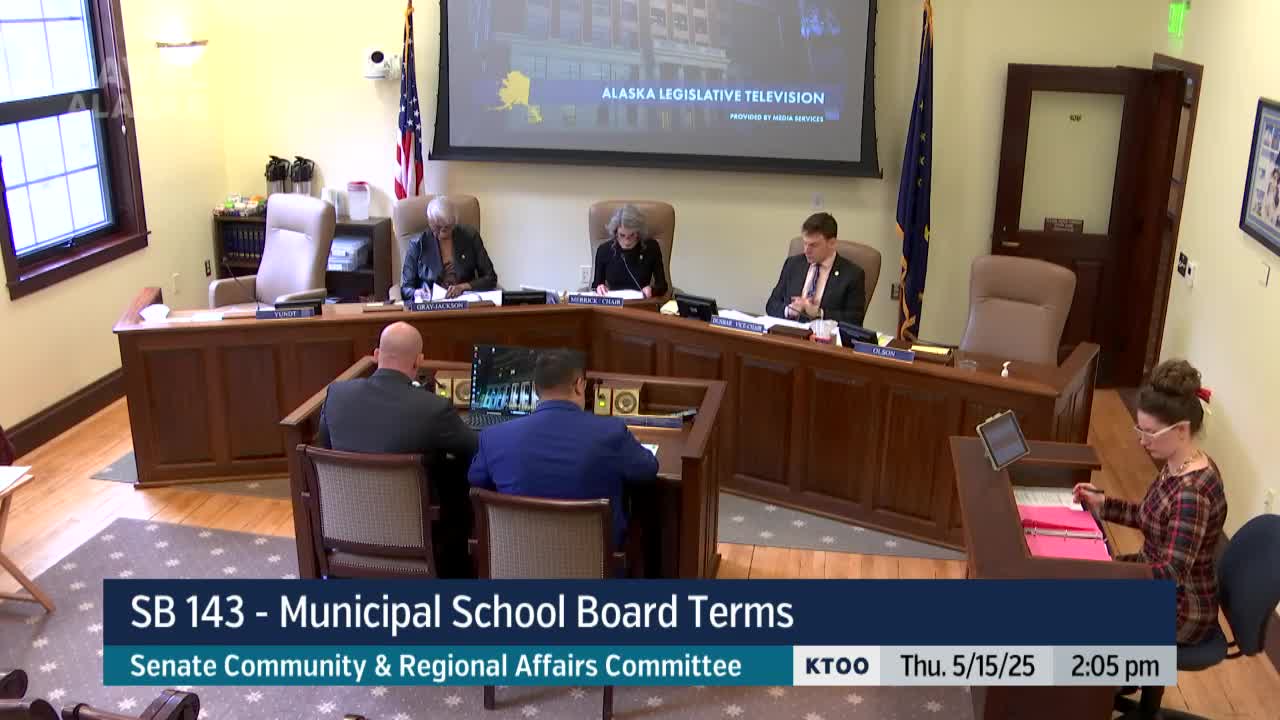
Senator Rob Young presented Senate Bill 143 on May 15, 2025, saying the measure would allow municipal governing bodies to set municipal school board terms by ordinance rather than requiring three-year terms by state law.
"This would allow the local government to make that decision if they wanted," Young said, explaining the change would permit municipalities to align school board terms with mayoral and assembly election cycles and potentially eliminate off-year elections.
George Hayes, deputy borough manager for the Matanuska-Susitna (Mat-Su) Borough, testified in support and outlined three reasons for the change: increased local control, improved voter turnout by aligning elections, and administrative efficiencies that reduce costs. Hayes emphasized the bill does not mandate local action but allows municipalities discretion and requires usual local ordinance processes and public input.
Senator Yount noted turnout differences cited by sponsors: "we've seen turnout on odd years of somewhere from 9 to 14 percent. And then last year on an even year, we were at 48 percent turnout," and said aligning elections could raise participation and save money.
No vote was recorded in this hearing; the committee set the bill aside for further consideration. Sponsor and county officials said any local change would still require public approval consistent with local procedures.