Get Full Government Meeting Transcripts, Videos, & Alerts Forever!
Get email alerts on the Committee Governance topic
No spam. Unsubscribe anytime.
Joint Armed Services Committee staff to review panel statute, broaden interim focus to recruitment, cyber and community impacts
Summary
Committee staff briefed members on May 15 about an interim project to review and modernize the Joint Armed Services Committee statute, which currently contains BRAC‑era language, and to expand oversight to issues such as cyber, counterdrug work, recruitment, housing and childcare impacts on military families.
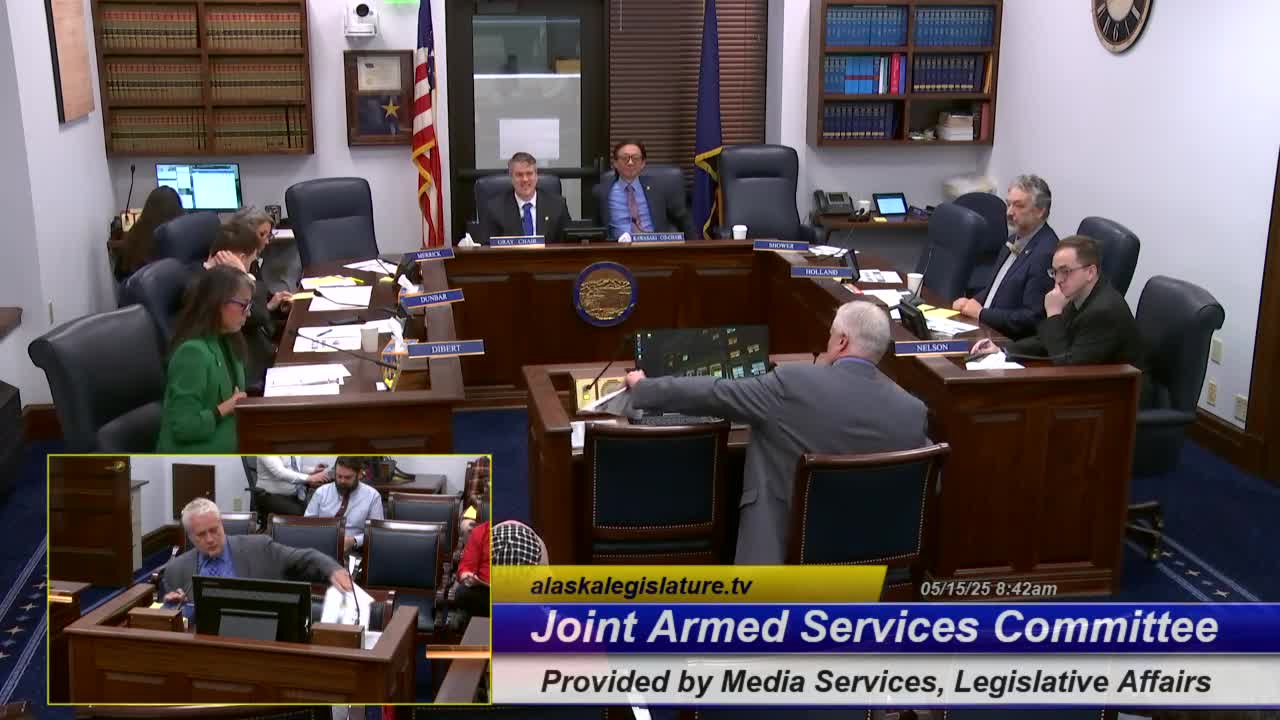
Juneau — Kyle Johansen, staff to the Joint Armed Services Committee, told the panel on May 15 that he will lead an interim effort to review and propose updates to the statute that governs the committee, saying the current language is dominated by Base Realignment and Closure (BRAC) provisions and does not reflect the committee’s contemporary portfolio.
Johansen said the committee’s statutory language ‘‘is dominated by base realignment and closure language’’ and noted that Congress passed legislation in February 2015 requiring congressional approval before a BRAC round could be restarted. He told members the chair asked staff to ‘‘take a fresh look at what the duties and powers of this committee should be’’ and to develop proposed legislation during the interim for introduction next year.
Why it matters: Committee staff framed the review as an opportunity to align the panel’s statutory authorities with current military and community issues raised during the DMVA briefing and in committee conversations, including cyber warfare, counter‑drug activities, recruitment and retention, and community impacts such as housing and childcare.
Johansen outlined planned interim work: inventory existing records for continuity, coordinate with the Legislative Affairs Agency and the legislative library to ensure institutional memory, solicit input from committee members, and draft recommended statutory changes that would be introduced through legislative counsel next year. He said staff also will track a decade‑old project to contact families and fulfill obligations related to past honors work; ‘‘we really wanna put a push… Social media these days, they're tracking down people… and fulfill that mission on the medal of honor and honor these people,’’ Johansen said.
Senator Dunbar praised the effort and noted the statute ‘‘is remarkable the degree to which it doesn't align with what we actually do,’’ stressing that the National Guard is the most direct state connection and that rural recruitment has long been a challenge. Representative Divert emphasized the committee should consider childcare and housing impacts on military families and noted related policy proposals under consideration in the legislature.
Johansen said Legislative Affairs Agency (led by ledge counsel) will staff the work and that the chair, Representative Gray, and future chairs will be involved as the draft language is prepared. He recommended an in‑person interim meeting on the rail belt in October and asked members to provide input during the summer. The committee did not vote on changes at the meeting; the briefing was informational and intended to set the interim work plan.
Ending note: Johansen said staff will collect records from past chairs and coordinate with library staff to preserve committee history and documentation for the statute review process.