Get Full Government Meeting Transcripts, Videos, & Alerts Forever!
Get email alerts on the Public Transit Planning topic
No spam. Unsubscribe anytime.
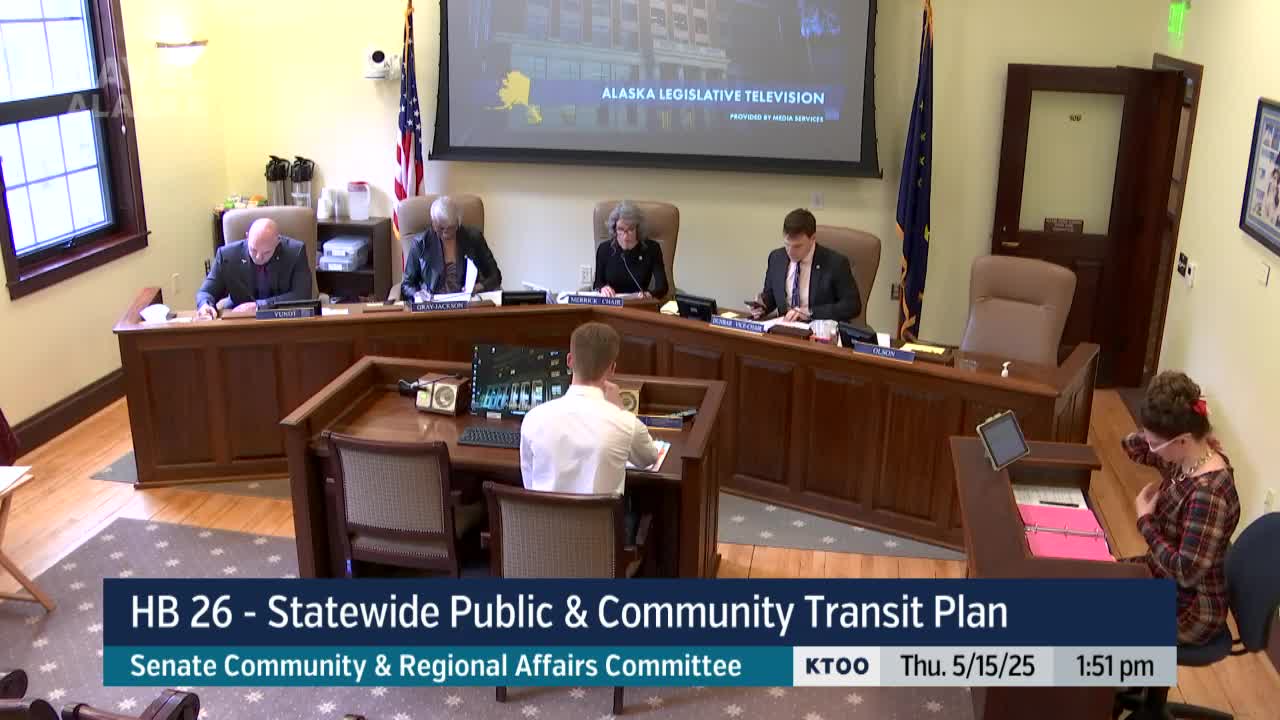
Committee hears bill to require Alaska DOT to plan for public, tribal and community transit statewide
Summary
House Bill 26 would codify coordination between Alaska DOT&PF and public, tribal and community transit programs, expand study of alternative transit to rural and remote areas, and clarify planning steps intended to secure federal funding; invited testimony from disability advocates and tribal transit operators supported the bill.
Halen Behnken, staff to Representative Genevieve Mina, presented House Bill 26 on May 15, 2025, describing it as legislation to require the Department of Transportation and Public Facilities to coordinate with public, tribal and community transit programs in the development of Alaska’s long-range transportation plans and the STIP (Statewide Transportation Improvement Program).
"HB 26 aims to support and secure accessible transportation options for all Alaskans by improving DOT’s public engagement process and broadening the study of transportation options across the state," Behnken said.
Representative Genevieve Mina (House District 19) told the committee the bill was requested by the Governor’s Council on Disabilities and Special Education and the Alaska Mobility Coalition and stressed the importance of including people with disabilities in planning.
Invited testimony came from Patrick Reinhart, executive director of the Governor’s Council on Disabilities and Special Education, who said transportation repeatedly ranks as a top issue for people with disabilities and seniors and described a patchwork of services across the state. Reinhart noted a recent human services grant round received only eight applications and said small programs struggle to apply for mixed-state-and-federal funds. "If we’re just not planning for [rural communities], we’re not planning for the needs of the small communities in the rural and remote communities," Reinhart said.
Jerry Hope, government relations director for Sitka Tribe of Alaska, said the tribe operates a fixed-route public transit system in Sitka and that making transit visible in statute would improve coordination with DOT and tribal entities.
Behnken said HB 26 would expand DOT responsibility to study alternative transportation methods beyond urban areas, noting a 2022 Alaska DOT report included in supplemental materials that identified transit benefits including increased business sales and less congestion. The bill would codify existing federal coordination requirements in state law to better secure federal funding.
No formal committee motion or vote on HB 26 is recorded in this hearing; the committee took invited testimony and public testimony was opened and closed with no commenters in the room or online. The bill will remain under committee consideration.