Lifetime Citizen Portal Access — AI Briefings, Alerts & Unlimited Follows
Michigan Senate introduces and refers multiple bills; three advance to third reading
Loading...
Summary
Senators introduced and formally referred a slate of bills affecting vehicle code, environmental protection, campaign finance, income tax, childcare licensing and reimbursements, and other statutes; the committee of the whole reported three bills to third reading without amendment.
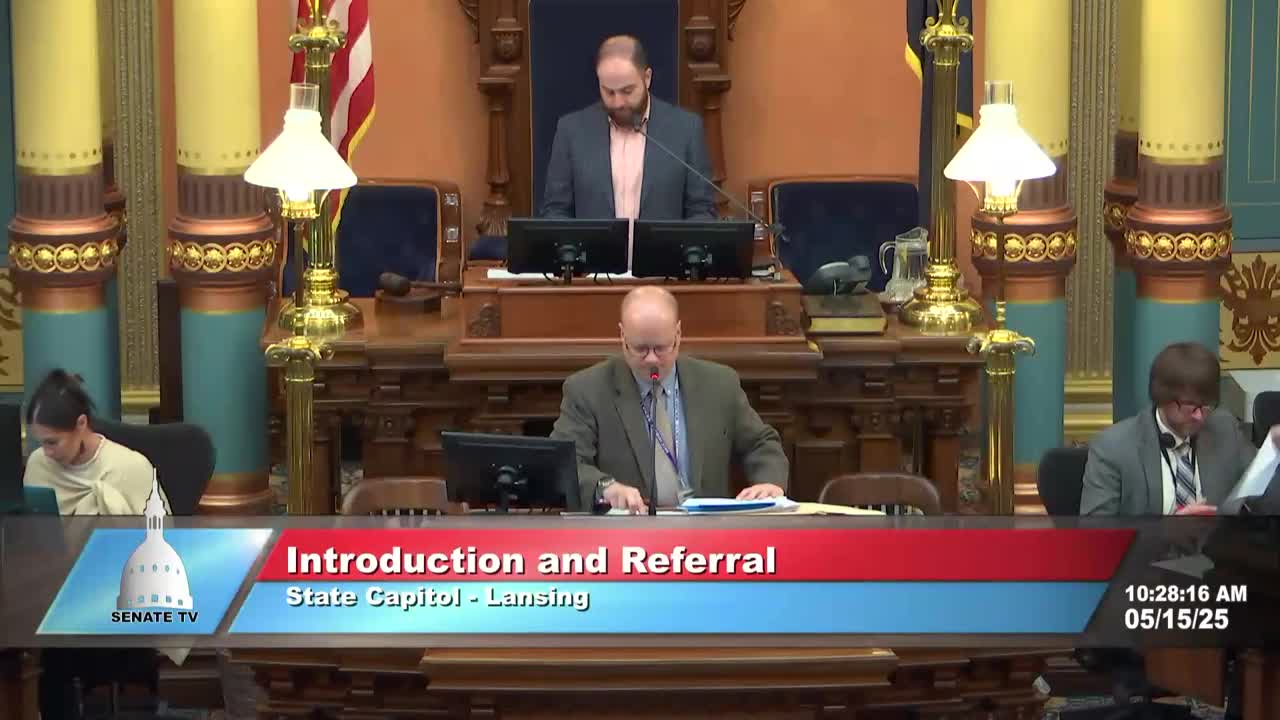
The Michigan Senate introduced and referred more than a dozen bills and advanced three Senate bills to third reading during a floor session, senators said.
The measures introduced on the floor would amend the Michigan Vehicle Code; the Natural Resources and Environmental Protection Act; the Michigan Campaign Finance Act; the Michigan Consumer Protection Act; the Income Tax Act of 1967; the Social Welfare Act; statutes governing licensing and regulation of child-care organizations; and the Child Development and Care reimbursement schedule. House bills transmitted to the Senate included measures affecting food law, the public health code, the drain code of 1956, and the Michigan Liquor Control Code of 1998.
Why it matters: The bills affect a range of state policy areas including transportation rules, environmental protections, campaign finance regulations, tax law, social welfare programs and childcare funding and oversight. Referral to subject committees starts formal review and can lead to committee hearings, amendments and eventual floor votes.
Senators who offered bills included Senator Chang (Senate Bill 305 and Senate Bill 306), Senator Bayer (Senate Bill 307 and Senate Bill 311), Senator Hertel (Senate Bill 308), Senator Santana (Senate Bill 309), Senator McMorrow (Senate Bill 310), Senator McCann (Senate Bill 312) and Senator Anthony (Senate Bill 313). The secretary read first and second readings for the bills and announced committee referrals: SB305 and SB307 were referred to the Committee on Energy and Environment; SB306 was referred to the Committee on Elections and Ethics; SB308, SB309, SB310, SB311, SB312 and SB313 were referred to the Committee on Housing and Human Services. House bills transmitted to the Senate were referred to the committees named on the floor (for example, House Bill 4076 to Natural Resources and Agriculture; House bills affecting the public health code to the Committee on Health Policy).
Floor action was primarily procedural. Minority Floor Leader Senator Lowers moved that several members be excused from the session; the motion was adopted “without objection” as recorded by the secretary. Majority Floor Leader Senator Singh moved other temporary excusals and later moved the Senate resolve into the Committee of the Whole to consider items on the general orders calendar; both motions were adopted without objection and Senator Weber presided as chair of the Committee of the Whole. The committee reported Senate Bills 137, 138 and 139 without amendment and recommended the bills do pass; the secretary announced those bills would be placed on the order of third reading of bills.
Attendance and scheduling: The secretary reported 24 members present, establishing a quorum. Majority Floor Leader Singh moved and the Senate adopted a motion to adjourn; the chamber stood adjourned until Tuesday, May 20, at 10 a.m., as announced on the floor.
No substantive debate on the merits of the introduced bills was recorded in the provided transcript excerpt; the session record shows readings, referrals and committee actions but not floor debate or amendments to the introduced measures.