Get Full Government Meeting Transcripts, Videos, & Alerts Forever!
Get email alerts on the Military Readiness And Capabilities topic
No spam. Unsubscribe anytime.
Alaska DMVA briefs legislature on Guard capabilities, Arctic readiness and statewide support missions
Summary
Deputy Commissioner Craig Christensen told the Joint Armed Services Committee the Alaska Department of Military and Veterans Affairs (DMVA) is prioritizing readiness for potential conflict while maintaining statewide missions including search-and-rescue, refueling operations, counter‑drug support and community projects.
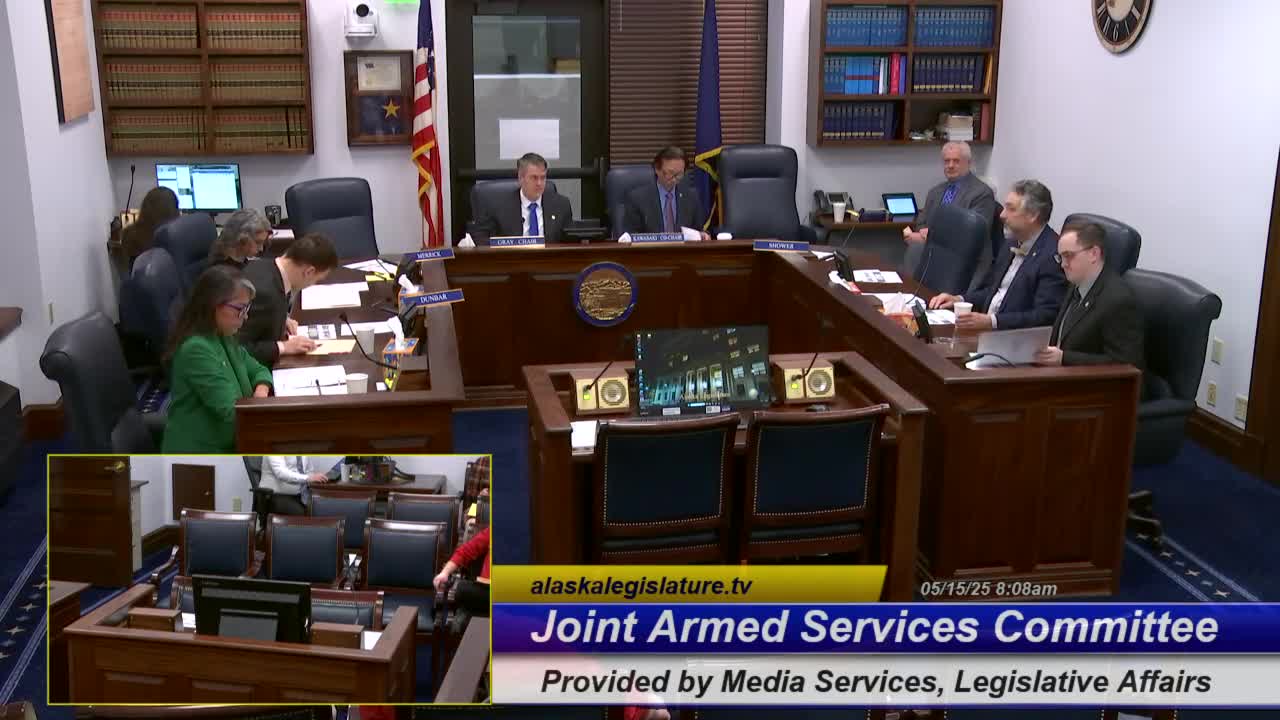
Colonel Craig Christensen, deputy commissioner of the Alaska Department of Military and Veterans Affairs, told the Joint Armed Services Committee on May 15 that the department is focused on preparing the Alaska National Guard and related forces for possible future conflict while continuing domestic missions across the state.
"As most of you know, DMVA is a federal state partnership," Christensen said, describing the department's structure and the role of the adjutant general. He emphasized that Alaska's Guard is highly operational, with numerous 24/7 missions and a strong Arctic training emphasis.
Christensen gave a rundown of the organized militia — the Alaska Army and Air National Guard, the Alaska Naval Militia and the Alaska State Defense Force — and highlighted key capabilities at installations across the state. He said the guard fields airframes including the C‑17, C‑130 and KC‑135 refuelers, and noted expansion plans to add four more refuelers. He described the 176th Wing missions and the state’s ballistic missile defense posture tied to facilities at Fort Greely and Clear Space Force Station.
The deputy commissioner also reviewed domestic operations the Guard performs while training for wartime missions. He said the Guard carried out 148 search‑and‑rescue missions in the past year, that refuelers at Eielson scrambled 750 times and transferred about 10,000,000 pounds of fuel, and that the Guard airlifted more than 20,000,000 pounds of cargo and over 6,000 passengers.
Christensen outlined several partnership and program efforts that link training to community benefit. He described the Innovative Readiness Training (IRT) program, which places military engineering and medical units on community projects; examples cited included road and hazardous‑fuel facility work and delivery of 14,000 pounds of meat to a remote community via FEMA. He also described a counter‑drug program of 18 assigned soldiers and airmen embedded with federal and state law‑enforcement partners; Christensen said those analysts and aviation assets contributed to multiagency investigations that disrupted shipments and seizures of large drug quantities.
On international cooperation, Christensen noted the state partnership program with Mongolia, a relationship he said has lasted more than 20 years and includes recurring exercises. He framed much of the department’s work as preparation: "Everything that I've just talked about is Major General Sachs' preparation for war," Christensen said, adding the department’s hub‑and‑spoke logistics concept and expanded refueling capacity are part of that posture.
Committee members asked for details about specific deployments and local facilities. Christensen said roughly 124 Alaska Army Guard members and about 83 Air Guard members were deployed to overseas areas at the time of the briefing. He confirmed a Black Hawk helicopter detachment had been stationed in Juneau and was conducting training and operational missions.
The committee received the presentation and moved on to the interim agenda. The DMVA presentation was followed by staff briefings on the committee’s statutory scope and interim work plans.