Get Full Government Meeting Transcripts, Videos, & Alerts Forever!
Get email alerts on the State Legislation topic
No spam. Unsubscribe anytime.
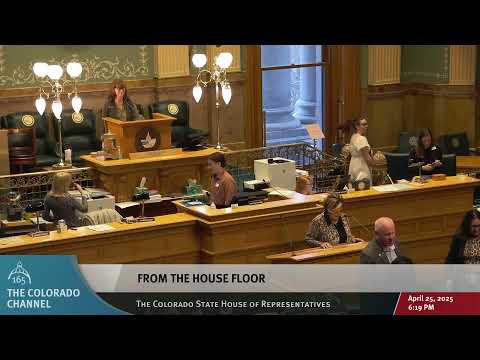
Colorado House adopts wide slate of bills on April 25, 2025; dozens of measures pass
Summary
On April 25 the Colorado House considered and adopted a large group of bills across education, elections, tax policy, workforce and regulatory cleanup. Lawmakers also carried out numerous routine committee reports and companion measures; many passed by recorded voice or machine votes.
Lede The Colorado House of Representatives on April 25, 2025 approved a broad package of bills spanning elections, education accountability, tax-code adjustments, workforce and regulatory fixes, and a handful of ceremonial measures. Members voted on dozens of measures, carried committee reports and adopted technical and policy amendments before adjournment.
Nut graf Most measures on the April 25 calendar were final-read votes or committee-report actions. Several items drew extended debate (notably an elections bill and proposals touching the Taxpayer Bill of Rights), while many were routine cleanups or reauthorizations. The House recorded machine votes on a large slate of bills and sent several passed measures to the governor or the Senate as required.
Body What passed: The chamber approved a long list of bills on third reading and adopted committee reports for many others. Measures enacted included a range of policy areas: a veterans- and workforce-oriented continuing authorization of programs; bills to clarify and adjust tax preferences and credits; bills to update education accountability standards and testing participation; a measure reauthorizing an identity-theft deterrence program; targeted regulatory/cleanup bills related to mining and utility statutes; and grants and pilot programs for community schoolyards and direct-care workforce support. The House also adopted a joint resolution recognizing Sportsman’s Day at the Capitol.
Votes at a glance (selected enacted measures) - House Joint Resolution designating 04/25/2025 Sportsman’s Day (H.J.R. 1028) — adopted (recorded): 60 Aye, 1 No, 4 Excused. (Title read and adopted on the floor.) - Senate Bill 194 (continuation of the Dental Practice Act) — adopted (recorded): 54 Aye, 8 No, 3 Excused. (Several members debated a proposed substantive third-reading amendment and permission to offer it.) - House Bill 13-28 (direct care workforce stabilization and related training/reimbursement provisions) — adopted after committee- and floor-level amendments; sponsors described the bill as creating outreach, training and “know your rights” work for direct-care workers and aligning Medicaid reimbursement for base wages. - Senate Bill 1 (Colorado Voting Rights Act) — adopted after extended floor debate and many floor amendments and motions; members debated scope, home-rule municipal authority and the role of the attorney general in enforcement before the bill was adopted. - Senate Bill 173 (TABOR definition clarifications, fiscal-year spending exclusions) — adopted after protracted floor debate; several members urged returning items to the voters while supporters said the bill clarified long-standing ambiguities. - House Bill 12-35 (jury trial rights in certain forcible-entry-and-detainer proceedings) — adopted; sponsors and opponents debated standards and procedural safeguards, including bonding and timing rules. - House Bill 12-78 (education accountability revisions implementing portions of the statewide review) — adopted; the bill implements multiple task-force recommendations about assessments, accreditation and workforce-readiness measures and includes phased implementation provisions. - House Bill 11-92 (financial literacy as a component of high school completion, as amended) — adopted; committee and floor amendments narrowed requirements, added a resource bank and clarified that practice with FAFSA is expected but completion is not mandated as a graduation requirement. - House Bill 10-61 (community schoolyard grant pilot) — adopted; a two-year pilot fund to help repair and develop schoolyards in underserved areas was approved with a reduced administrative allocation. - Additional regulatory/technical bills and reauthorizations — the chamber also adopted bills to continue or clarify program administration (for example: continuation of the Identity Theft and Financial Deterrence Act), to adjust statutory definitions for mining/utility law cleanups, and to modify a range of tax and licensing provisions.
What drew the most attention - Elections bill (Senate Bill 1): The most extended debate of the day focused on a new state cause of action for vote dilution and suppression and on whether the state — or the attorney general specifically — should be able to intervene in municipal election matters. Supporters said the bill filled a state-law gap left by the weakening of some federal protections; opponents warned it could intrude on home-rule municipal authority and expose local governments to expensive litigation. The House adopted multiple floor amendments and rejected several proposals that would have explicitly protected home-rule authority.
- TABOR and fiscal questions (Senate Bill 173 and related language): Multiple members voiced concerns about moving revenue items outside TABOR’s refund calculation; several speakers urged public transparency and recommended sending certain changes to the voters. Supporters said the bill clarified how damage awards and property sale proceeds should be treated for the fiscal-year-spending cap.
Less contentious items Many bills on the floor were technical fixes, sunset reauthorizations, or small grant/appropriation measures that received minimal debate and passed on recorded machine or voice votes.
Ending After completing the day’s business the House recessed to meet again on Monday, April 28, 2025. The calendar carried forward several bills for second- and third-reading consideration and the chamber’s clerks will publish the official roll-call results and enrolled-bill texts.
Attribution Quotes in this summary were taken from members and sponsors recorded in the session transcript; vote tallies above reflect machine tallies as read into the record.
(See the “Votes at a glance” list above for selected measures and outcomes.)