Get Full Government Meeting Transcripts, Videos, & Alerts Forever!
Get email alerts on the Time Of Day Rates topic
No spam. Unsubscribe anytime.
SMUD officials describe decade‑long rollout of time‑of‑day rates, report about 8% peak reduction and near‑universal customer adoption
Summary
Presenters from the Sacramento Municipal Utility District (SMUD) told the Concord Municipal Light Board about SMUD’s multi‑year rollout of time‑of‑day (TOD) rates, describing technical steps, marketing campaigns and results including an average peak reduction of about 8%, roughly 30 megawatts, and sustained adoption rates around 97%–99%.
Alcides Hernandez, revenue strategy manager at the Sacramento Municipal Utility District (SMUD), and Karen McCord, SMUD marketing lead for time‑of‑day efforts, gave a virtual presentation to the Concord Municipal Light Board on SMUD’s design, rollout and results from its time‑of‑day (TOD) rate program.
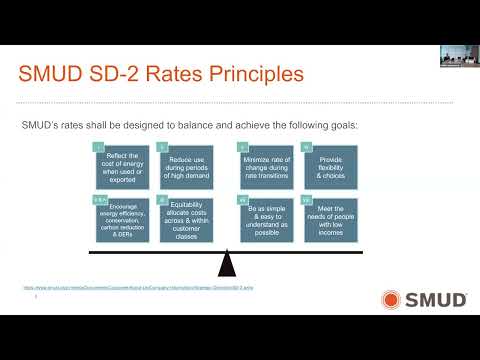
Hernandez said the utility moved deliberately: “It took us nearly 10 years to get to the time of day,” describing a multi‑phase effort that began with advanced metering infrastructure (AMI) deployment in 2009–2012, pilot testing called the Smart Pricing pilot, and a broader rollout that reached most customers in 2018–2019.
The presentation summarized key program features and outcomes. SMUD uses a summer peak window from 5 p.m. to 8 p.m. (June–September) with higher prices in that window and lower prices overnight; the utility also offers a mid‑year alternative flat rate for customers who opt out. SMUD reported a steady, high rate of customer enrollment — roughly 97%–99% on the TOD rate — and said system peak demand has fallen by about 8% on average (roughly 30 megawatts), with estimated financial commodity savings that grew from about $5 million in early years to figures approaching $15 million in recent years when market power costs rose.
SMUD also described complementary tools and programs used to support customers: an online “My Energy” account with hourly usage charts and neighborhood comparisons, an interactive cost estimator on the utility website, targeted multilingual marketing and community outreach (materials translated into 17 languages), and a critical peak pricing (CPP) mechanism invoked on extreme heat days. Hernandez said critical‑peak events have been used in recent years and that the CPP adder can raise peak price by roughly $0.50 per kilowatt‑hour (for example, a typical peak price in the 30–40¢/kWh range rising toward ~$0.90/kWh during a CPP event), while small reductions were applied to off‑peak hours to keep overall signals balanced.
On distributed generation, SMUD said it has two export compensation structures. The full net energy metering (NEM) regime was used until the utility reached its statutory or policy threshold; since a later transition it also offers a successor “solar and storage” export rate that SMUD described as crediting exported energy at a flat rate of 7.4¢ per kilowatt‑hour for certain customers. SMUD added that broader California changes (including building standards identified as Title 24) and behind‑the‑meter solar adoption have influenced overall load and sales forecasts.
Board members asked about technical and customer‑experience issues. Jason (Concord staff) and others asked whether billing cycle cutoffs and seasonal rate transitions created customer confusion; Hernandez said SMUD minimized proration by aligning enrollments with full billing cycles during the initial rollout and that on mixed‑cycle bills customers may now see days billed at two different seasonal rates. Board members also asked whether the 5–8 p.m. window would need adjustment as the grid changes; Hernandez said SMUD plans periodic reviews and acknowledged that higher daytime renewables penetration could warrant future tweaks, but any change would require additional customer education and outreach.
Karen McCord described SMUD’s customer education and retention work: sustained mass media (TV, radio, digital), targeted mailings and personalized enrollment notices, door‑to‑door and community events, multilingual materials, and ongoing summer reminders that the higher seasonal peak rate is in effect. SMUD said it continues summer retention outreach and that field staff and contact center training — including “tailgate” sessions and journey‑mapping of customer touchpoints — were critical to identifying and correcting confusing messaging (for example, ensuring materials clearly say “5 p.m. to 8 p.m.” rather than a possibility customers misread as “5 a.m. to 8 p.m.”).
Questions from Concord board members and staff covered sales/consumption trends, where SMUD said overall retail sales have remained roughly flat in recent years — a result SMUD attributed to energy efficiency, behind‑the‑meter solar, and increasingly strict building standards — and confirmed that TOD shifted load rather than driving broad growth or decline in total annual energy sold. Hernandez also reported a cohort milestone: more than 541,000 customers were transitioned in the main rollout, supporting the high enrollment share reported today.
The meeting concluded with a procedural motion to adjourn. The motion passed on a roll‑call vote recorded as five yes votes (Bianca: yes; John: yes; Chris: yes; Brian: yes; Warren: yes).