Get Full Government Meeting Transcripts, Videos, & Alerts Forever!
Get email alerts on the Briefing Book Meeting Efficiency topic
No spam. Unsubscribe anytime.
Concord committee finalizes briefing book, debates meeting-efficiency recommendations for Town Meeting
Summary
The Town of Concord Conference Town Meeting Study Committee on April 22 agreed to finalize a five-page briefing book to be submitted by May 5 and debated several measures aimed at shortening Town Meeting, including shorter speaker times, expanded consent calendars and broader moderator authority.
The Town of Concord Conference Town Meeting Study Committee on April 22 agreed to finalize a five-page briefing book to be submitted by May 5 and discussed detailed language for the committee report, focusing substantial attention on measures to improve meeting efficiency and moderator guidance.
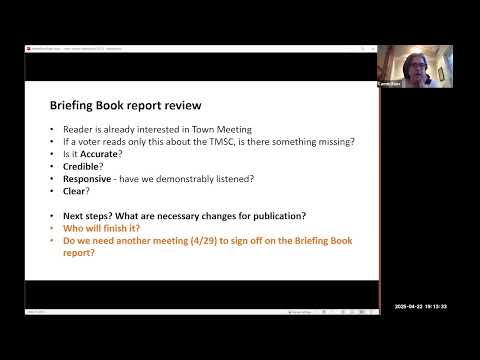
Committee chair Eric Moore said the briefing book must be accurate and credible: "If the voter reads only this about our work, is there something missing from the briefing book report?" Moore asked, seeking consensus that the document reflect the committee's work and public input.
Why it matters: The committee's five-page briefing will appear in the Town Meeting briefing materials that voters receive before the June 2 Town Meeting. Committee members and staff said the briefing and the longer committee report must both show the committee listened to public comments and must be clear about trade-offs: efficiency measures can shorten meeting time but may limit the number of voices heard during deliberation.
Most of the debate centered on a package of procedural ideas the committee had drafted to address repeated speakers and long deliberations. Suggestions discussed included: letting the moderator use discretion to limit repetition, shortening individual speaker times (members debated 1–3 minutes), expanding the consent calendar to bundle noncontroversial items, and giving the moderator clearer authority (including the ability to mute microphones during remote participation).
Committee members were split on whether those ideas should appear in the main body of the committee report as recommendations or be presented as a list of ideas in a supplement. Several members, including Kristen Haggerty and Chase Thompson, said framing the items as ideas or options would preserve moderator discretion: "These are ideas we've talked about, that the moderator may wish to take into consideration," Haggerty said. Others, including Moore, argued the report should show the committee heard a strong body of public feedback and that some concrete guidance would be useful to future moderators.
Members also pressed for clearer rationale and cautions for other recommendations in the report (for example, how expanding pre-meeting public hearings might lengthen staff workloads and require better time budgeting). Phil Swayne and others asked the drafters to add short rationale or caveat sentences for the six secondary recommendations so readers understand implementation trade-offs.
The committee agreed on process steps: Moore will circulate an updated draft quickly for 24‑hour comment, incorporate fixes and deliver the briefing book by the May 5 deadline. Members said the first five pages appearing in the briefing book should be more conversational and reader-oriented, while the committee report can remain archival and written from the committee's perspective.
The meeting ended with instructions to prepare a final committee report that includes an explicit paragraph about how the committee will judge whether its recommendations are effective (for example, suggested follow-up surveys or review in a future year).