Get Full Government Meeting Transcripts, Videos, & Alerts Forever!
Get email alerts on the Ccrc Overlay topic
No spam. Unsubscribe anytime.
New England Deaconess seeks continuing‑care retirement community overlay at Old Marlborough site
Summary
New England Deaconess (Newbury Court) presented a proposal for a continuing‑care retirement community (CCRC) overlay on 12.1 acres across from Emerson Hospital. The proposal would allow up to 200 units, require 20% open space and include an attainable‑unit approach distinct from conventional multifamily affordable programs.
The New England Deaconess Association (Newbury Court) presented a proposal on March 18 to create a continuing‑care retirement community (CCRC) overlay district for 12.1 acres across from Emerson Hospital, saying the change would enable the nonprofit to offer a mix of independent living, assisted living and long‑term care services on the site.
Chris Centros, identified in the meeting as New England Deaconess’s chief executive, and Mark Bobrowski, the project attorney, told the Concord Municipal Affordable Housing Trust that the overlay would be parcel‑specific and require town meeting approval. Bobrowski said the overlay would allow a use on the particular 12.1‑acre parcel that is not currently allowed in the Medical Professional zoning district north of Route 2.
The proposal as presented includes a density cap of up to 200 potential units (about 16 units per upland acre), a requirement that at least 20% of the parcel be set aside as open space (no more than half of that allowed to be wetlands), and height limits that the presenters described as 35 feet for duplex/independent living buildings and up to 85 feet for multi‑unit buildings. Bobrowski emphasized the overlay is limited to the subject parcel and that any other property would require its own town‑meeting vote to adopt the same overlay.
Newbury Court officials framed their case on service and continuity of care. Chris Centros said the organization is a not‑for‑profit provider of senior care that has operated in Concord for generations and that the CCRC model is intended to allow residents to “age in place” through independent living, assisted living and nursing care within the same institutional framework. Company financials cited in the presentation indicated charity care and public‑benefit activity: company‑wide charity care of about $2.7 million in 2023 and site‑level charity care and community support figures (Newbury Court’s local campus reported roughly $1 million in charity care; another campus reported $1–1.5 million). The presenters also noted Newbury Court paid roughly $910,000 in local taxes last year for the existing campus.
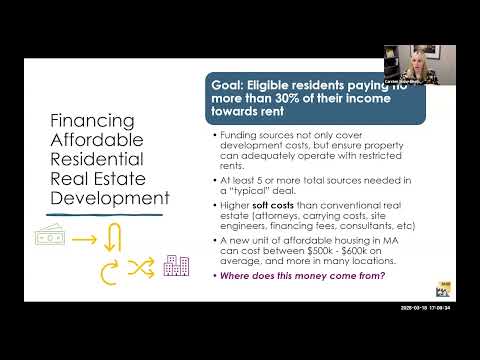
On affordability and “attainability,” the presenters proposed an alternative approach to traditional affordable‑housing rules. The draft bylaw language described a planning‑board role to require up to 10% of independent‑living or health‑service units as “attainable,” and the presenters said they would target households in the 70%–140% of area median income (AMI) range for those units. Mark Bobrowski and Brett Pelletier of Figurate Community Advisors argued that conventional state affordable programs and subsidies (for example, LIHTC, HOME, CDBG and voucher programs) are not designed for CCRCs and that alternative tools—adjustments to entrance fees, contract refund rules and income limits—were more applicable to create “attainable” units in a CCRC context.
Presenters also previewed next steps: a preliminary meeting with the planning board and a planning‑board public hearing scheduled for April 9. They said site plan review and a town‑meeting vote would be required before any overlay could take effect. The presenters invited written questions and said they would provide slides and return for further community briefings.
Ending: The trust received the presentation and agreed to circulate the slides and to forward community questions to the project team. No formal zoning vote was taken by the trust; the planning board will hold the first public hearing on April 9.