Get Full Government Meeting Transcripts, Videos, & Alerts Forever!
Get email alerts on the Housing Finance topic
No spam. Unsubscribe anytime.
MHP outlines how multiple funding sources must stack to cover rising affordable‑housing costs
Summary
MHP senior real estate development officer Carsten Snow Eichelberg told the Concord Municipal Affordable Housing Trust on March 18, 2025, that building affordable housing in Massachusetts relies on a complex mix of federal, state and local subsidies because per‑unit development costs have climbed into the mid‑hundreds of thousands of dollars.
MHP senior real estate development officer Carsten Snow Eichelberg told the Concord Municipal Affordable Housing Trust on March 18, 2025, that building affordable housing in Massachusetts relies on a complex mix of federal, state and local subsidies because per‑unit development costs have climbed into the mid‑hundreds of thousands of dollars.
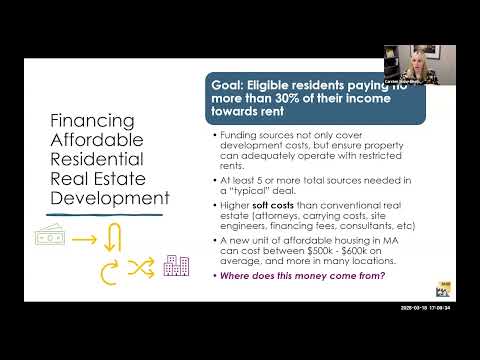
Eichelberg said the “ultimate goal is that eligible residents are paying no more than 30% of their income towards rent,” and that requirement forces developers and funders to assemble multiple financing sources so the project can both be built and operated at restricted rents.
The presentation put the trust’s role in context: local trust funds can be comparatively small but flexible pieces of a larger “stack” of financing that typically includes first mortgages, Low‑Income Housing Tax Credit (LIHTC) equity, state soft loans or bonds, and smaller local grants or loans. Eichelberg repeatedly urged municipalities to show financial and land commitments early in a project’s development because state funding rounds are competitive and programs such as LIHTC are limited.
He described a worked example of a 60‑unit tax‑credit rental project in the Boston‑Cambridge‑Quincy metropolitan area. Using sample assumptions, total development costs in the example were roughly $34 million, or about $530,000 per unit all‑in. In that scenario the developer expected about $20 million in 9% federal tax credit equity and a permanent mortgage of roughly $9 million, leaving a roughly $2 million funding gap that was filled by a mix of state tax credit funds and local trust funds in the illustrated case. After additional, unanticipated site remediation raised site costs, the local trust increased its award to close the revised gap.
Eichelberg summarized typical per‑unit ranges he has seen: long‑term mortgage debt commonly about $50,000–$100,000 per unit; tax‑credit equity roughly $200,000 per unit; additional state soft loans often around $100,000 per unit; and municipal contributions or trust funds that commonly range from $50,000 to $100,000 per unit depending on local resources and priorities. He cautioned that “there is no such thing as a typical real estate deal,” and that soft‑costs, regulatory requirements and the need for additional consultants make affordable projects more expensive than conventional development.
He walked the trust through program distinctions that affect rents and underwriting. For example, voucher programs (Housing Choice Vouchers/Section 8 and state vouchers) are typically based on a tenant’s actual income and cap tenant payments at about 30% of income; LIHTC units typically operate under a “percentage of theoretical income” calculation tied to HUD area median income and household size, which affects rent limits and operating revenue.
Eichelberg also described the competitive state application process administered by the Executive Office of Housing and Livable Communities (EOHLC), noting that the state issues a Qualified Allocation Plan (QAP) that ranks and scores projects for limited tax credits and bond funds. Because applications outnumber available funds, he said developers generally expect to apply across multiple funding cycles and that demonstrated municipal support—land, funding commitments, or other local approvals—helps a project score better.
The presentation closed with practical advice for municipal trusts: fund early feasibility or due‑diligence work for sites (or seek MHP’s municipal land technical assistance grants), use clear funding notices of funding availability (NOFAs), consider using outside development reviewers for complex proposals, and preserve flexibility so local funds can backfill gaps when state caps or contingency costs change. Eichelberg said MHP can also provide targeted technical assistance and staff or vendor support for municipal site assessments.
The trust asked for the slides to be circulated and requested an opportunity to submit written questions; Eichelberg agreed to provide slides and to return for a follow‑up Q&A.
Ending: The trust took no formal vote on the topic. The presentation was framed as information to guide future trust funding decisions and site vetting.