Get Full Government Meeting Transcripts, Videos, & Alerts Forever!
Get email alerts on the Foreign Adversary Registration topic
No spam. Unsubscribe anytime.
Nebraska senators spar over bill creating state-level foreign-adversary registration and penalties
Summary
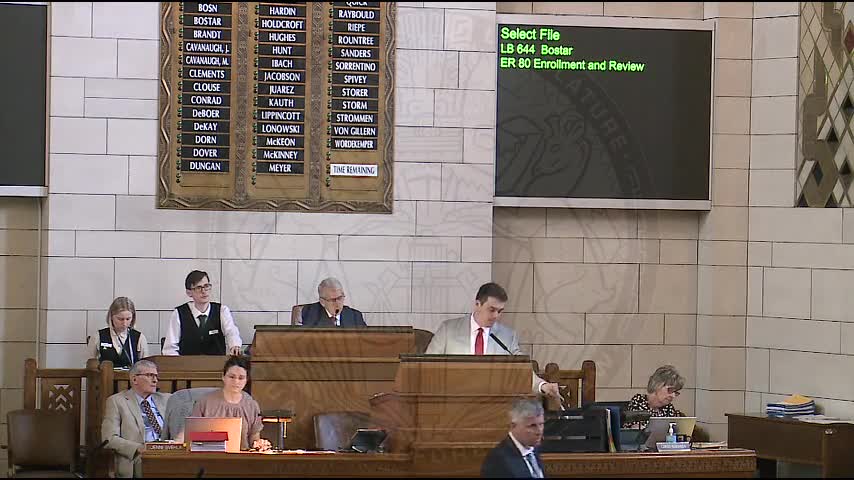
Lawmakers spent much of the floor session debating LB644, a bill that would require registration and reporting for persons or organizations acting on behalf of foreign adversaries or designated terrorist organizations and would create civil penalties and disclosure duties.
Lincoln — Lawmakers spent much of the floor session debating LB644, a bill that would create a Nebraska registration regime for persons and organizations acting on behalf of foreign adversaries or designated terrorist groups, and would add civil penalties and reporting requirements.
The bill’s sponsor, Senator Brett Bostar, said the measure is meant to create transparency about foreign influence in state affairs and to align some state reporting with federal standards. “There’s a number of differences, probably the largest difference. Is there are carve outs for lobbyists in federal Farah,” Bostar told colleagues while explaining differences with the federal Foreign Agents Registration Act (FARA).
Supporters said the measure would give state officials more visibility into influence operations; critics warned it is broad, risks chilling protected activity, and may exceed legislative authority over postsecondary institutions.
Many senators voiced constitutional and practical concerns centered on a provision that would require postsecondary institutions to dismiss and ban individuals found in violation. Senator Ben Dungan argued the provision would amount to an unconstitutional intrusion on university governance under the Nebraska Supreme Court’s Board of Regents v. Exxon line of cases. “That is problematic, colleagues. That is us literally stepping in and going into the day to day governance of the university,” Dungan said.
Senator John Cavanaugh (John Cavanaugh) and others pressed whether the attorney general’s office is the right home for registration filings. Cavanaugh said many tasks the bill contemplates — maintaining public registration records and handling disclosures — are functions already handled by the Nebraska Accountability and Disclosure Commission. He said he plans a cleanup amendment to move many filing duties to that agency and to limit the attorney general’s prosecutorial role.
Senators also debated other technical and policy points: how the bill would treat media organizations and foreign-owned outlets, whether the law would capture routine trade or educational exchanges (Senator Mike Conrad asked about trade missions to Cuba as an example), how broadly the definition of “covered activities” might sweep, and whether ordinary social-media behavior could be implicated.
Some senators urged caution because a poorly drafted state law could prompt litigation and costly defense by the state. Senator Dungan said litigation risk matters both to the state budget and to civil liberties: “If somebody brings a lawsuit against a bill or a law that we pass, the attorney general, generally speaking, is gonna be defending that… it costs a lot of money to defend these cases.”
On amendments, the Legislature adopted a cleanup amendment from Senator Megan Anderson that removed drone-related language to avoid overlap with LB6060; that amendment passed. Senator John Cavanaugh’s AM 14‑55, which clarifies that any fines levied under the bill would be paid into the common school fund, was also adopted. A DURING-FLOOR university-focused amendment (FA 2‑30) that would have stripped mandatory dismissal/ban language and left institutions required only to adopt their own plans failed on the floor; proponents said the university supported the change but the amendment did not secure enough votes.
Senators repeatedly returned to the balance between national-security goals and civil liberties, and several said they want additional drafting and agency coordination before the bill advances further. Senator Bostar told colleagues he will continue to work with other senators and agencies on technical fixes. “The short answer is I didn't. It is language consistent with FARA, federal,” he said when asked why some definitions mirrored federal law.
The floor record shows ongoing negotiations and multiple withdrawn and filed amendments; at the time the body recessed for lunch the bill remained under active amendment and debate.