Get Full Government Meeting Transcripts, Videos, & Alerts Forever!
Get email alerts on the Planning Budget And Transition topic
No spam. Unsubscribe anytime.
Council committee reviews Planning Department’s FY26 budget as city assumes BPDA functions
Summary
The Boston City Council Committee on Ways and Means heard a presentation on the Planning Department’s FY26 operating request, the department’s mission after the transfer of BPDA staff and functions to city control, and near-term budget and staffing questions from multiple councilors.
The Boston City Council Committee on Ways and Means on May 12 reviewed the Planning Department’s FY26 operating budget and heard department leaders describe the new agency’s mission after the transfer of staff and functions from the Boston Planning & Development Agency.
Chair Brian Worrell, Boston City Councilor for District 4, convened the hearing and invited the Planning Department’s leadership to present the budget and recent work. Kairo Shen, Chief of Planning, told the committee the department’s central mission is to “address our city's greatest challenges of resiliency, affordability, and equity,” and to “take real estate actions and prioritize planning, development, and urban design solutions that further these priorities.”
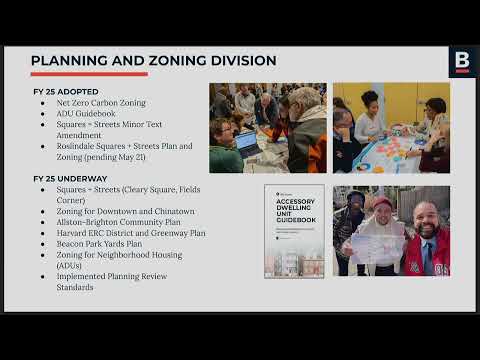
The presentation described the department’s organization, recent deliverables, and the FY26 operating request. Theresa Palhimus, acting executive director/secretary for the Planning Department, told the committee the FY26 operating budget shows a reduction from the department's first year under city budgeting; she described the change as a “rightsizing” of contractual services after last year’s budget included full, multi‑year contract amounts rather than the annual planned spend.
Councilors pressed for specifics. Councilor Murphy noted a roughly $2.6 million reduction from last year and asked whether that primarily reflected one‑time or timing differences in contracts; Palhimus and staff said the change was largely due to timing and the city budgeting practice of funding only planned annual spend. Councilor Fitzgerald asked whether pension and health‑care costs associated with the transfer from BPDA/EDIC were included in the operating totals; staff said pension and centrally budgeted health insurance are recorded outside the department’s operating line and are accounted for in the city’s overall transfer calculations.
Committee members also asked about staffing. The department reported planned staffing of roughly 235 positions for FY26 (up from a figure the committee received the prior year of about 222), which staff said reflects a mix of positions migrating from EDIC/BPDA and hires to fill previously unposted roles. Officials emphasized that some EDIC employees remain with EDIC for retirement reasons and will transition over time.
The department said its contractual services line supports projects such as the Planning Academy, design and rezoning work, Squares and Streets initiatives, and on‑call planning contracts. Palhimus said procurement timing slowed some contract encumbrances in the first year of the transfer but that many contracts remain in process.
The committee did not take formal votes during the hearing. Members asked for additional written detail on capital allocations tied to BPDA properties, pension and insurance estimates associated with the transfer, and a breakdown of contractual spending and community‑engagement costs for Squares and Streets.