Get Full Government Meeting Transcripts, Videos, & Alerts Forever!
Get email alerts on the Flood Zone Zoning Deck Amendment topic
No spam. Unsubscribe anytime.
Planning commission backs zoning changes to ease deck limits for Golden Hind Passage homes in flood zone
Summary
The Corte Madera Planning Commission voted to forward to the town council a zoning amendment that would increase lot coverage for properties in the special flood hazard area and let certain raised, uncovered rear decks be 3–5 feet high and set 5 feet from the rear property line for Golden Hind Passage waterfront parcels.
The Corte Madera Planning Commission on May 13 voted to forward to the Town Council a draft zoning ordinance amendment that would give property owners in the town’s special flood hazard area more flexibility to build uncovered decks when they elevate homes to meet FEMA and local standards.
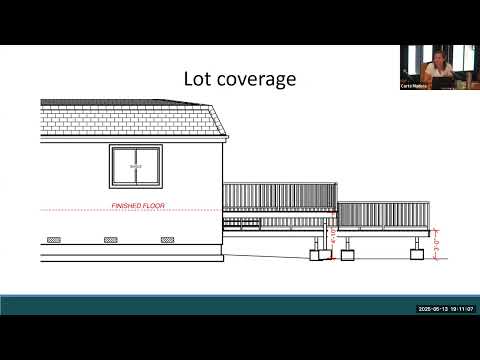
The commission recommended that the council adopt amendments to Title 18 of the Corte Madera Municipal Code to (1) increase maximum allowed residential lot coverage by 2 percentage points for parcels in the special flood hazard area in the R-1 (medium-density residential) zone, and (2) allow uncovered rear-yard decks attached to elevated houses on Golden Hind Passage that are more than 3 feet but not higher than 5 feet to follow the same setback rules as decks 3 feet or less in height (i.e., as close as 5 feet to the rear property line).
Tracy, a town planning staff member, told the commission the application was filed in January by the owner of 299 Golden Hind Passage and that the proposed changes respond to repeated tidal and storm inundation along the town’s shoreline. “The application was filed by the owner of 299 Golden Hind Passage,” Tracy said during the hearing, summarizing staff analysis and earlier public workshops with the Flood Control Board.
Why it matters: About 1,100 parcels — roughly 34% of Corte Madera’s parcels — lie in the special flood hazard area, staff said, and raising a house typically increases the height of attached decks and stairs, pushing some decks above the current 3-foot threshold that exempts them from lot coverage calculations. “Our lower deck was completely submerged,” said Eric Bizzo, the applicant and owner of 299 Golden Hind Passage, describing a recent high-tide event; Bizzo said his family’s experience and similar conditions on Golden Hind Passage motivated the application.
Key facts and decisions
- Lot coverage and setbacks now: In the R-1 zone the base maximum lot coverage is 40%; an existing special provision (added in 2009) allows an extra 2% in the flood zone for uncovered decks that do not exceed the finished-floor height of the home. Under current rules, decks more than 3 feet above grade count toward lot coverage and must meet more restrictive rear-yard setback rules (effectively a 19-foot setback from the rear property line, because raised decks may only extend 6 feet into the required 25-foot rear yard). Decks 3 feet or less are allowed as close as 5 feet to the rear property line and do not count toward coverage.
- What the draft amendment would change: The draft ordinance would (a) make the existing 2% lot-coverage allowance available more widely for elevated homes in the special flood hazard area (in practice raising the potential additional coverage to 4% for parcels that qualify), and (b) for waterfront parcels on Golden Hind Passage (93 odd-numbered parcels 1–331 along the bay), allow decks that are more than 3 feet but not more than 5 feet in height — provided the deck is attached to a primary residence elevated at least 1 foot above base flood elevation in compliance with FEMA and town standards — to be sited like 3-foot decks (i.e., as close as 5 feet to the rear property line) and treated the same for measurement of lot coverage.
- Local data staff cited: Staff said about 50 homes have been elevated above base flood elevation in the last 15 years (the map and table in the staff report cover projects since FEMA’s last base flood change in February 2016). On Golden Hind Passage staff identified eight recently elevated homes with decks between 3 and 5 feet in height and three homes with decks higher than 5 feet.
Discussion and concerns
Commissioners asked detailed questions about how deck height is measured on sloping lots, whether the allowance would be exclusive to Golden Hind Passage or apply to other waterfront streets (Harbor Drive, Seawolf Passage, Key Largo Cove/Passage, Edgemar, Yolo, Channel) and how the town would enforce flood-related building and open-under-deck standards. Tracy and other staff said the Golden Hind Passage allowance is narrowly targeted because those parcels are lower in elevation, experience more frequent sunny-day tides and storm surge, and already show a pattern of voluntarily elevated homes; staff said a broader change to other waterfront streets would be considered only after collecting more data from future elevation projects.
Flood-control review and building-code checks
Staff reported that the Bay Conservation and Development Commission (BCDC) had been consulted and expressed no concern about the proposed change in deck height for this location. The building department and public works will review building plans for flood-venting, railing design and any enclosed structures under decks; staff noted FEMA guidelines and local building-code standards (including minimum guardrail heights) will continue to apply.
Public comment
Eric Bizzo, the applicant, described repeated tidal flooding at his property and said the proposal is narrowly tailored and intended to let homeowners raise homes and retain usable backyard space: “Our lower deck was completely submerged,” Bizzo said, recounting a recent 8½-foot tide plus storm surge event.
Kirk Miller, a member of the Flood Control Board and a Golden Hind resident, spoke in support, saying homeowners along that stretch are likely to need the flexibility as sea-level and storm impacts increase.
Outcome
A motion to adopt Resolution PC 25-006 (forwarding the draft ordinance and its exhibit to the Town Council for consideration) passed on a recorded roll call. Commissioner Bridal, Commissioner McKinney, Vice Chair Rizzo and Chair Chase voted yes; Commissioner Boyd Boshoyer was recorded as absent. The commission’s recommendation will be considered by the Corte Madera Town Council.
What the action does not do
The commission’s recommendation does not itself change the municipal code; it forwards the ordinance language and the resolution to the Town Council for adoption. The recommendation also does not change FEMA requirements, does not authorize enclosed structures under decks, and does not itself set building-code approvals such as required flood vents or structural design; building permits remain subject to standard review.
Next steps
The Planning Commission’s resolution and draft ordinance will go to the Town Council for public hearing and final action. Staff said it will monitor other waterfront neighborhoods and may bring future code amendments if more data show a need beyond Golden Hind Passage.
Ending note: The proposal is framed by staff as a narrowly scoped accommodation for low-elevation, waterfront parcels that are raising homes to meet flood elevation requirements; the commission supported forwarding the measure so the council can weigh policy tradeoffs and any broader townwide implications.