Get Full Government Meeting Transcripts, Videos, & Alerts Forever!
Get email alerts on the Living Wage And Community Needs topic
No spam. Unsubscribe anytime.
Nashville report: low wages carry high costs for workers, families and city
Summary
Metro Social Services’ 16th annual Community Needs Evaluation finds many Nashville workers earn less than a local living wage, linking low pay to health, housing, childcare and education stresses. City leaders and a panel discussed policy and private‑sector steps but offered no immediate votes or mandates.
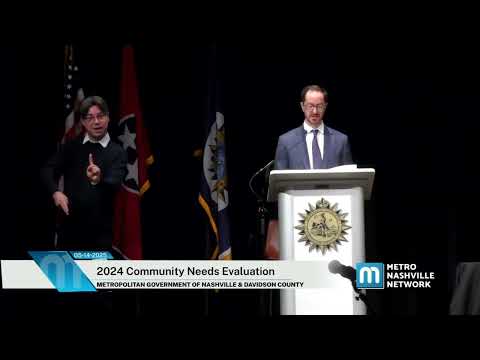
Metro Social Services released its 16th annual Community Needs Evaluation and warned that “the high cost of low wages” imposes measurable harms on workers, families and the city as a whole.
The report, summarized at a public presentation by Dr. Garrett Harper, lead researcher for the Metro Social Services strategic planning and research team, documents that many common occupations in the Nashville area pay median wages below the MIT living‑wage benchmark for Davidson County and details effects on health, housing, childcare and education. Harper said the evaluation frames the issue by contrasting the MIT living‑wage metric with the federal poverty guidelines and showed how those different measures can lead to very different policy conclusions. “The living wage calculation for Davidson County illustrates more completely what is needed for individuals and families of different composition,” Harper said.
Why it matters: Local leaders said the report translates into city budget and program choices. Mayor Freddie O’Connell, who joined the event, highlighted proposed Metro budget measures — including a recommended minimum hourly rate for Metro employees and $45 million the mayor said is proposed for the first year of a unified housing strategy — as steps intended to reduce cost pressures for residents. “These pay plans allow us as a government to continue our investment in our employees now and provide sustainable competitive pay growth in the future,” O’Connell said, while noting the limits of municipal authority over private‑sector wages.
Key findings and figures
- Living wage and earnings: The report uses the MIT living‑wage methodology. It lists a living wage for one working adult with no children in Davidson County at $52,858 per year and shows substantially higher figures for households with children (for example, roughly $82,000 for one adult with one child and $99,000 for one adult with two children as presented in the report).
- Prevalence of low wages: Dr. Harper reported that 20 of the 25 largest occupations in the Nashville region have median annual earnings below the single‑adult living wage; taken together those 20 occupations account for roughly 326,000 workers in the region.
- Costs and impacts: The evaluation ties low wages to a range of outcomes cited in the presentation: more than one in five Nashville children lack enough to eat; about 64% of Black students attend schools identified as high‑poverty; 16% of workers in the examined earnings categories lack health insurance; and more than half of renters pay 30% or more of income on housing.
- Local programs and numbers: Metro Social Services facilitates up to 16,000 home meal deliveries per month, the mayor’s office noted; the mayor also described Metro’s proposed minimum hourly rate for fiscal year 2026 moving from $20 to $21.44 per hour and said Metro pay has risen roughly 30% over the past four years.
Panel reactions and proposed directions
A panel including Stephanie Coleman, president and CEO of the Nashville Area Chamber of Commerce; Metro Councilwoman Courtney Johnston; and Tennessee State Representative Harold Love Jr. discussed policy, employer practices and programmatic responses but did not take formal votes.
- Stephanie Coleman emphasized employer involvement in understanding barriers such as the benefits cliff and urged partnerships between employers and training providers. “We interact with a lot of businesses on a day‑to‑day basis…many of them are working multiple jobs and just trying to find that one better job,” Coleman said.
- Councilwoman Courtney Johnston focused on local implementation items and pointed to a transitional benefits approach: “Instead of individuals when they increase their income being worse off financially, that we would set our benefit system up so that they would never be worse off financially.” Johnston also noted some local charter and benefit rules that limit how hours and benefits are provided to Metro employees and said chart revisions could be considered.
- Representative Harold Love urged broader state and federal policy changes and proposed a bold policy idea during the event: “Guarantee basic income,” he said, arguing that a basic income could ensure a minimum safety net while workers transition to higher earnings.
Points of debate and limits of local power
Speakers repeatedly noted the difference between what Metro can do directly and what depends on state or federal action. The panel highlighted policy levers outside local control — for example, Medicaid expansion and TANF allocations at the state level and the federal minimum wage, which the presentation noted has remained $7.25 per hour for 16 years.
Attendees and panelists also raised operational priorities within Metro government: improved coordination across departments, targeted employer engagement, expansion of workforce training and preservation of affordable housing on Metro‑owned land. The mayor described recent local initiatives, including the Choose How You Move Together transit referendum and a housing trust fund effort that, he said, helped create or preserve more than 1,300 affordable homes in 2024.
No formal action recorded
The event was a report presentation and panel discussion; there were no motions, votes or binding decisions made at the meeting. The mayor described elements of a proposed budget (including the $45 million housing commitment and a recommended Metro pay plan increase) that would require approval through normal budget and council processes.
Context and next steps
Metro Social Services said the full report will be posted on metrosocialservices.gov; a four‑page summary was made available at the event. Panelists urged incremental, measurable steps — for example targeting reductions in school concentration of poverty or expanding employer‑focused pilots — and called for cross‑sector coordination to prioritize specific goals. Metro officials said staff will continue convening partners and that some pilot efforts (for example employer outreach and training partnerships mentioned in the discussion) will continue to be developed.
The Community Needs Evaluation is in its 16th year and Metro officials said the annual report is intended to inform budgeting, program design, and cross‑sector coordination rather than to set immediate mandates. For now, the findings frame the debate over how much action to take locally versus what requires state or federal policy changes.