Get Full Government Meeting Transcripts, Videos, & Alerts Forever!
Get email alerts on the Governance Public Participation topic
No spam. Unsubscribe anytime.
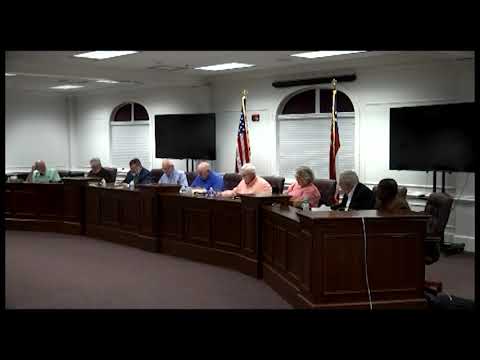
Appling County adopts formal meetings and public-comment rules
Summary
The Appling County Board of Commissioners approved a formal meetings ordinance adopting an ACCG model with local modifications, including time limits and residency requirements for public comment.
Appling County commissioners approved a formal meetings and public participation ordinance that adopts the Association County Commissioners of Georgia (ACCG) model with local modifications, including speaker time limits and residency requirements.
Legal staff told the board that the county previously followed the 2016 ACCG model without a formal resolution and that the board had asked for a formal ordinance. The presentation noted the ordinance follows OCGA (Official Code of Georgia Annotated) requirements and ACCG recommendations while incorporating board-suggested changes.
Key provisions described in the ordinance include a five-minute allotment per speaker for public comment; if more than four speakers register, the per-speaker time is reduced to three minutes. The ordinance requires speakers during the public-comment portion to be Appling County residents or owners of property in the county and states that speakers must register with the county clerk at least one week before the agenda work session. It also prohibits transfer of allotted time to another speaker and limits each person to one speaking opportunity per meeting. The ordinance allows the board, by majority vote, to suspend any rule for a particular meeting.
The ordinance also adds a campaign-disclosure requirement in rezoning opposition cases: if an individual has contributed more than $250 to a commissioner's campaign, they must file a campaign disclosure as required by OCGA 36-67A-3. The board voted to adopt the ordinance as presented; a motion to approve was seconded and passed.
Commissioners requested the county clerk and county surveyor assist when disputes over right-of-way width arise, and staff said the county surveyor would be asked to assist with contested road claims. The board also directed staff to implement the public-comment sign-up process described in the ordinance.